No Books, No Reviews

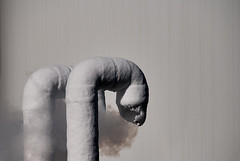
I’ve not been posting much because I haven’t actually finished any books to review since I got my new camera. In lieu of that, I thought I’d reveal what the “view from the foothills” actually looks like:

The View from the Foothills

Although, in point of fact, this isn’t the view from where I live; rather, it’s a view of where I live.

Digital Kodachrome

I’ve not posted much this past week, for the same reason that I’ve been humming an old Paul Simon tune on and off for days. You see, after much thought, and contemplation, and discussion, and research I’ve finally opted to make the move to a fancy “DSLR” camera. Here’s one of the first pictures I took with it.

20060927-160729_web.jpg

An “SLR” is a “Single Lens Reflex” camera…which is to say, a camera with a “through-the-lens” viewfinder. That’s the “single lens” part. The “reflex” part relates to the mirror which normally hangs down in front of the film and directs the light from the lens up into the view finder. When you press the shutter release, the mirror swings up out of the way. Your traditional fancy 35mm camera with the big flash unit on top and the bevy of replaceable lenses is an SLR. A DSLR, of course, is a Digital SLR, in which a digital sensor has replaced the 35mm film.

20060930-160220.jpg

What I ended up with, of course, was a Nikon; why else would I be humming “Kodachrome” to myself? (“I’ve got a Nikon camera, I love to take the pho-o-o-tographs, Oh Mama don’t ta-a-a-a-ke my Kodachrome away….”). In fact, I got a Nikon D80, a newish camera that’s rather a blend of their bottom-of-the-line D50 with their prosumer D200. Needless to say I’ve spent quite a bit of time over the last week playing with it.

20060930-160644.jpg

I’m enjoying many things about the D80. It’s got a great big bright beautiful viewfinder, which has been a revelation. I’m used to composing my shots on the LCD on the back of the camera, so it’s been a long time since I last used a camera’s viewfinder; and as I’ve never had an SLR-class camera before I’d never known what a beautiful thing a proper through-the-lens viewfinder can be. At last, I feel like I can really see what I’m doing. Instead of looking at a little picture on the back of the camera, I’m looking at the subject. Add to this that I’m nearsighted, so I wear distance glasses. When I’m wearing them, it strains my eyes a bit to look at things close up–so using that LCD, either I have to take my glasses off (in which case I can’t really see the scene) or I have to hold the camera far enough from my face that I can focus on the LCD, which just makes the picture smaller. With the D80, I can wear my glasses, and look through the viewfinder at the subject. ‘Swonderful.

Then there’s that delightful little noise it makes when I press the shutter release–that little noise that means that the mirror flipped up and then down again. I dunno why, but there’s something much more satisfying about it than that little pre-recorded click my other cameras have made. And there there’s the low-light characteristics. I took the following picture at ISO 400; there’s no noise, and it’s crystal clear:

20061001-154555.jpg
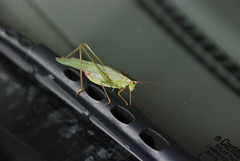
I drove into a parking garage this afternoon, and as I opened my window to push the button and grab my ticket I was bemused to see a grasshopper on my hood. It stayed there as I drove around and about and up several levels, and naturally I took some pictures of it. The day was dim and overcast, and even where I parked, at the west end of the structure, the light was none too good. I took the following picture, handheld, using a 300mm zoom lens (35mm equivalent) at ISO *1600*; the grasshopper was sitting on the windshield wiper.

20061001-150026.jpg

Couldn’t have done that with my old camera.

Bystander: A History of Street Photography, by Colin Westerbeck and Joel Meyerowitz

Some while back I reviewed Beaumont Newhall’s History of Photography. While reading that book I was particularly taken with his description of various street photographers, notably Henri Cartier-Bresson and Eugene Atget. And given that I take most of my pictures while out-and-about, walking hither-and-yon, I was curious to learn what other photographers had done in similar circumstances.

I asked around, and was pointed at this book. I had to order it on-line, and at $50 it was rather expensive to be buying sight-unseen; but it came recommended, and I was still in the early days of my passion for photography–I find that when I take up a new hobby, I almost go out looking for reasons to spend money, not a good habit but a common one, I suppose–and I went ahead and ordered it. My chief concern was that it would be too lightweight, that I’d read through it in a couple of hours and wonder what I’d spent my money on.

That was a number of months ago; and as I just finished it this evening I suppose I can’t call it lightweight. In fact, it’s quite a detailed exposition of street photography, from its earliest origins in the 19th century up through the final decades of the 20th. If I have a complaint it’s that there aren’t enough pictures–but then, there are seldom enough pictures in a book like this–and that the pictures aren’t well integrated with the text. This was done on purpose, I guess, to let the pictures stand alone, but it would have made it simpler if the pictures were closer to where they were discussed. Also, the tone of the text is rather more hifalutin’ than in Newhall’s book–so that instead of devouring it in a couple of days, as I did Newhall’s book, I spread it out in small segments over several months.

On the whole, though, I have to pronounce myself satisfied. I’ve now been exposed to the work of a great many skilled street photographers, and learned a great deal about their motivations. I’ve also taken a great deal more photographs, many of them in the street, since I acquired the book. And I’ve learned a few things.

First, it’s difficult to do real street photography walking around a quite suburban neighborhood. Street photography delights in odd juxtapositions of people, and you simply don’t get enought people on the streets. And then, if I go downtown there are more people on the streets…but I find taking pictures of folks I don’t know rather daunting, especially since I don’t really want to call attention to myself. Consequently, my forays into real street photography have been extremely limited to date. But as I intend to continue walking, and I intend to continue taking pictures (I’ve made–and kept–over a thousand exposures since January) I rather expect I’ll take a few more that qualify.

The Old Zoo

Today I returned to a place I last saw when I was no more than three years old, and probably younger than that: the old Griffith Park Zoo. The old zoo was replaced by the current Los Angeles Zoo in 1966; it has since been turned into a picnic area, and is much frequented by walkers, joggers, and photographers. I have one dim and indistinct memory of the old zoo: the zoo trams were pulled by engines in the shape of elephant heads. Picture a giant “Dumbo” head, less the circus cap and giant ears, pulling a tram and you’ve got it. At least, so I remember it. I had caught sight of these trams and wanted a closer look, and I distinctly remember running towards one that was coming down the path in our direction. I wasn’t going to get in its way, but my mom scooped me up anyway. And that’s what I remember about the old zoo.

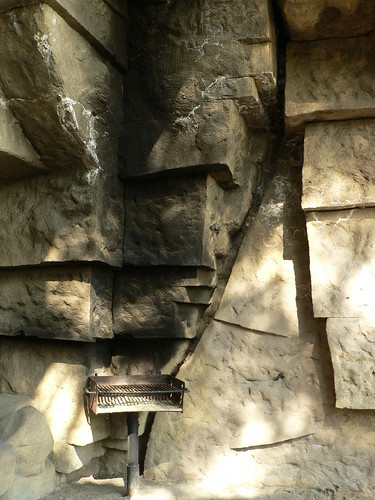
This morning, we packed up the kids and headed over there for a “family walk”. Naturally I grabbed the camera. As I say, it’s been converted into a picnic area:

20060617-075417.jpg

All of the modern amenities are close at hand (and apparently have seen considerable use).

20060617-075508.jpg

The zookeepers must have had a fun time feeding the animals; here’s a picture (slightly blurry, alas) looking up the stairs from the zookeeper’s entrance in the back of one enclosure:

20060617-075711.jpg

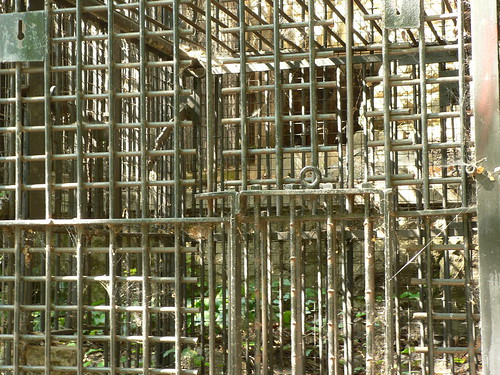
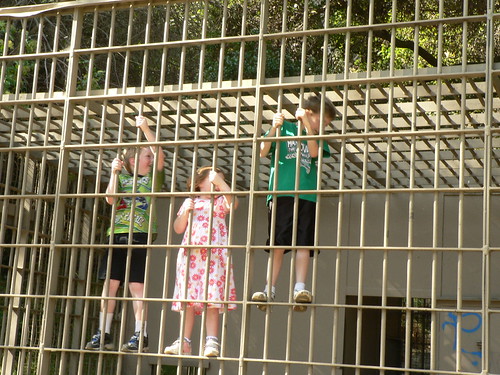
Looking at this cage, I really wonder how you were expected to see whatever kind of creature lived inside. Whatever it was, it certainly wasn’t likely to get out.

20060617-081920.jpg

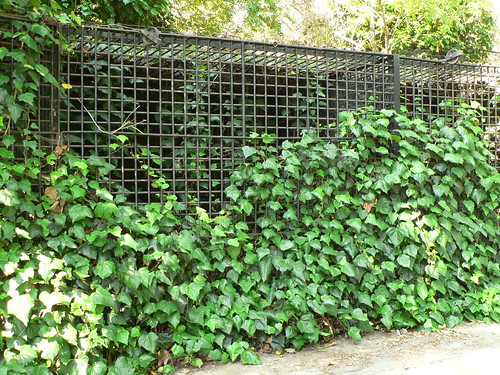
Some of the cages are still occupied, if untended. Here we see some domestic ivy escaping into the wild.

20060617-081846.jpg

And one set of monkey cages still had inhabitants.

20060617-080440.jpg

Oh, Deer!

20060606-093319.jpg

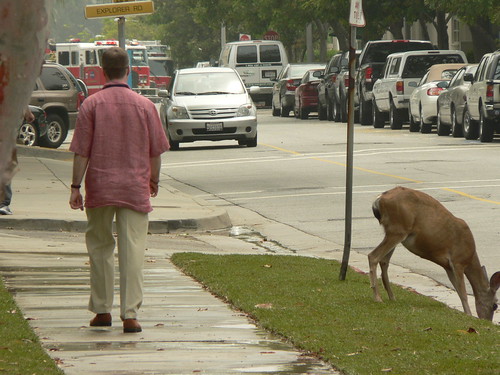
There’s always a lot going on where I work. Though I don’t believe the deer is on the payroll. (That’s Ted the Test Lead walking past the deer, by the way.)

A Long Walk

This morning I grabbed the cell phone (a recent acquisition) and headed out the door. The goal was to take a much longer walk than I usually would do, partially to impress Jane and partially to found out just how far I can walk in a morning before I run out of gas. As it happens I lasted for two hours of brisking walking (with frequent photo stops) and made it about five-and-a-half miles. And indeed, I saw a great many things on my walk.

20060610-085527.jpg

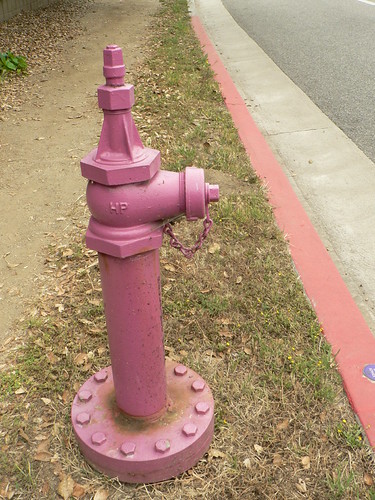
I don’t recall ever before having seen a fire hydrant painted quite this passionate a color.

20060610-084442.jpg

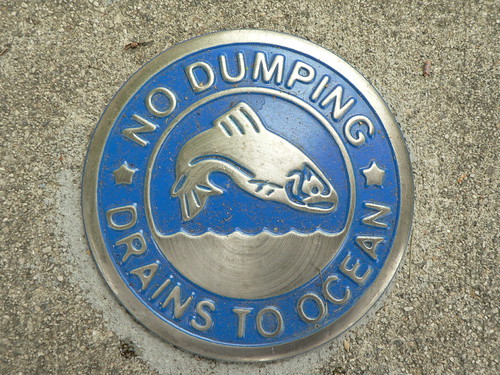
These have been popping up around town; perhaps they’ll last longer than the stencils they are replacing. Have to wonder how much just one of these cost the city to make, though.

20060610-075703.jpg

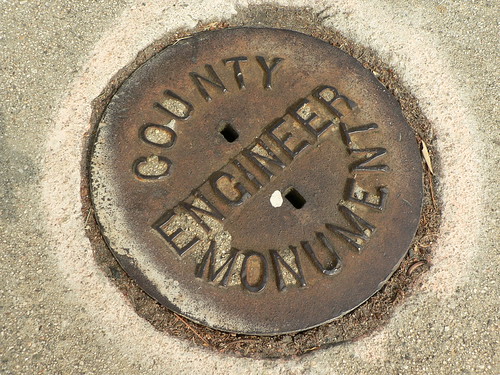
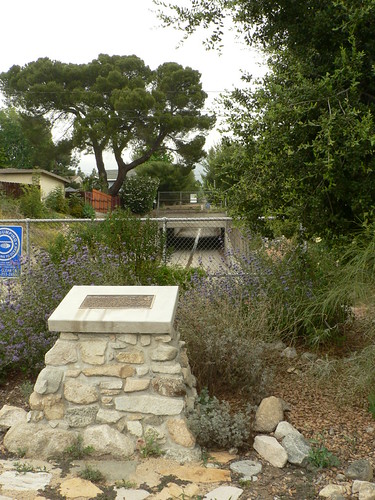
In 1934 there were heavy rains in L.A. for days on end. Folks in my town who worried about floods coming down from the mountains gathered for safety in the American Legion Hall, where volunteers supplied them with food and blankets. And then one of a number of flashfloods came roaring down the hill, and a mass of water, mud, and rocks swept the American Legion Hall completely away. Over thirty locals died, along with an unknown number of folks who’d been squatting in the canyons above town. This is a monument to the folks who died; it’s just where the American Legion Hall was. And running underneath it is one of the flood control channels built by the Corps of Engineers to prevent it from happening again. The location isn’t coincidental…..

20060610-092710.jpg

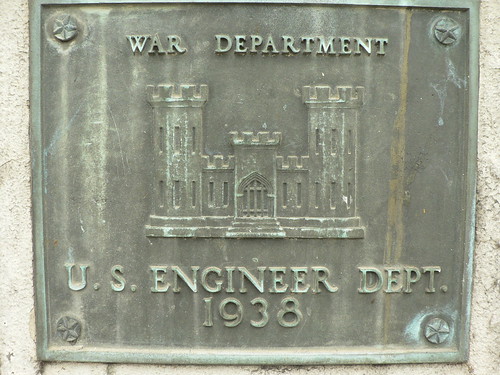
I ended my walk at point where a bridge crosses the Verdugo Wash, into which the channel shown above empties; the bridge was marked with this plaque.

Photography and the Old West, by Karen Current

This is one of the books I got on my used book binge last weekend. It’s an overview of (gasp) photography in and of the Old West, from the early days of photography up through 1915 or so. More accurately, it’s a survey of the prominent photographers of the Old West during that period. For each, the author presents a biographical sketch, describing the photographer’s life and their contributions to photography; this is followed by a handful of their photographs.

I picked this up with great anticipation, and unfortunately I was somewhat disappointed. The biographical sketches are good, certainly, and I presume the photos were well chosen from those that are available. But I was hoping for more photos from each photographer, and I would have liked a little more information about each specific photo.

On the whole, though, it’s an interesting book, and I’m glad I bought it. Some of the photographers were masters of their craft, and their photos remain classics; I especially liked C.E. Watkins’ photos of San Francisco. Others, alas, were not. The author dismisses Dr. William A. Bell, for example, as marginally competent, and the included images prove the point thoroughly–here, at least, I’m satisfied with a small selection of photos. And then there’s Camillus Fly–an unlucky gent who was foolish enough to open a photography studio in Tombstone, Arizona, one of the roughest towns in the Old West, and who somehow failed to take pictures of shoot-out at the OK Corral…even though the OK Corral was next door to his studio, the shoot-out took place at 2:30 in the afternoon, and Fly is known to have been one of the on-lookers. On the other hand, he took the only photos known to exist of Geronimo the Apache–the force that caught Geronimo happened to leave from Tombstone, and Fly was lucky enough (for once) to be asked to come along.

All in all, not a bad book if you can find it.

Examples: The Making of 40 Photographs, by Ansel Adams

A couple of months ago I joined a website for photography enthusiasts called photo.net. The site provides portfolio space (my own photo.net portfolio is here) and has many interesting articles and discussion forums. Some while back, having devoured a number of books on basic photographic technique, I asked which books should I consider reading next, and this was one of the suggestions.

As the name implies, the book is a collection of 40 of Adams’ photographs; each is accompanied by an essay in which he explains how he happened to take the shot, the things he considered before positioning the camera and pressing the shutter release, and the steps taken to make the print. These are usually accompanied by some anecdotes about the time and place, and the general circumstances surrounding them.

The pictures, of course, are excellent, and range from the subjects we’d all expect (Half Dome, El Capitan, Taos) to some that I didn’t, including a number of portraits that really caught my eye. The essays make interesting reading–if you’re in the target audience. There are no discussions here about the meaning of any of the photographs, or about how the desired emotional response is achieved by the composition; Adams felt that photographs need to speak for themselves. In short, if you’re looking for a short course in appreciating the art of photography, that is, in how to look at photographs, this isn’t it.

What is here is a great deal of technical detail on how the shots were set up, the exposures taken, and the prints made. The writing is clear and engaging, even when the details were rather over my head, as they frequently were. I’m a digital photographer; the little I know about the processes behind fine art film photography I’ve learned from my friend the Test Lead over the course of the last year. I wasn’t completely at sea, therefore, but I suspect I missed a lot of the subtleties as well.

What caught my attention most were the details of how Adams made his prints–mostly, I think, because that’s a part of photography I’ve mostly ignored to date. So far this year I’ve been focussing (no pun intended, alas; if I could think of a better word, I’d use it) on composition and exposure–on learning to get the picture right in the camera so that it requires a minimum of post-processing work. I’ve made quite a few prints, of course, but I’ve generally done little to the images beyond minor contrast adjustments and sharpening. Adams’ approach was different. His goal was to make the exposure in such a way that it was possible to produce from it the print he visualized ahead of time. In some cases that print might be very easy to produce from the exposed negative; in other cases, the visualized print might require quite a lot of work even given an optimal exposure–some “dodging” here, so that this area doesn’t get to bright, some “burning” there, so that that area isn’t too dark, and so forth.

Adams had two motives for going to this effort, or so I gather from his book. The first was to make the print resemble the subject as he saw it; and the second was (paradoxically) to make the print resemble the subject as he saw it in his mind’s eye, rather than as it was, so as to emphasize the details he found important. The human eye can see a range of light that is much wider than film can record; and if you do color photography, the color as seen by the camera is frequently somewhat different than that perceived by the eye. Even with the best camera, producing a print that appears to match the range of tones seen by the eye can be tricky. And if you wish to modify the tones so as to emphasize this or that detail, it becomes trickier still.

Consequently, the book has encouraged me to spend more time over (some of) my images; to consider whether I see in them what I saw when I pressed the shutter release, and if not, to do something about it. In addition, it has also prompted me to spend more time thinking in terms of black & white compositions, something I’ve done very little of. I like color very much; but for subjects which involve a lot of fine detail, a black and white treatment can be extremely appealing.

Anyway, if you have a serious interest in photography the book is definitely worth getting, and I’m sure I’ll go back to it from time to time; but if you’re just getting started and want to get a handle on just what photography can do, I’d start with Beaumont Newhall’s History of Photography instead. I’ve found both to be inspirational; but Adams’ book is inspirational in a much smaller, more focussed way.