How To Look At Photographs, by David Finn

I bought this at a Borders Books in Kansas City while I was on my last business trip, and read it during one long evening in my hotel room. I’m afraid it didn’t make much of an impression, especially compared to Newhall’s History of Photography, which I’d devoured just previously.

Despite the title, I don’t recall there being all that much in it about how to look at photographs. Rather, it’s more of a survey of different kinds of photography, illustrated by famous photos of yore, photos taken by the author, and a few photos taken by the author’s friends and relations. It was enjoyable enough; at least, I don’t remember being bored. But I can’t remember learning anything much from it either.

The History of Photography, by Beaumont Newhall

This is simply an outstanding book. I was prepared to find it interesting but rather dry; instead, I devoured it. Newhall covers the entire history of photography, from the early camera obscura and camera lucida devices used as an aid to drawing, through the daguerreotype and a number of other early photographic processes I’d never heard of before, all the way through the 1970’s. In addition to the technology and the people behind it, he discusses a vast number of individual photographers, different kinds of photography (portrait, nature, street, photo-journalism, and so on), and fine art photography and its different periods. And of course the book is full of outstanding photographs.

To write well, one must read widely (so as to know what good prose looks like) and then practice assiduously. Photography is similar, except that studying good photographs takes the place of reading widely. The difficulty, as with any new subject, is knowing where to start. My usual strategy is to find a book that will give me an overview, to serve as a foundation for my further reading. The best thing such an overview can do is help me identify precisely which subtopics and authors are likely to interest me.

For photography, this book fits the bill remarkably well; and I gather I’m not alone in thinking so–now that I’ve read it, I’m seeing references to both the book and its author all over the place. If you’ve any interest in photography as an art form, it’s well worth your time.

Past Photo Op


Past Photo Op

Originally uploaded by will.duquette.

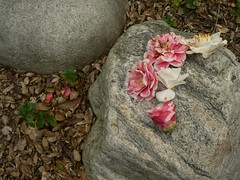
One of Descanso Garden’s two claims to fame is its Camellia Forest. Camellias aren’t native to California, but live oaks are; and camellias grow well in the shade, in acid soil. Many years ago, a man named Manchester Boddy realized that live oaks are really good at producing both, and that an oak forest is the perfect place for growing camellias.

The camellias are blooming right now, and in my in rounds I frequently see little mounds of camellia blooms in odd places. At first I was a loss to account for them; the ground under the camellia plants are frequently carpeted with fallen blooms, but not in little mounds; and anyway the mounds are never under the camellia plants.

Judging that garden gnomes are unlikely culprits, I have since concluded that these shabby little mounds are the work of other photographers. That remains conjecture, however, as I’ve never caught one at it.

Panasonic L1 DSLR

Now, I’m very happy with my Lumix FZ5. I’m taking some great pictures with it, and having buckets of fun. Still, sometimes I wonder if I’d like to take the plunge into the world of DSLRs: Digital Single Lens Reflex cameras. The “digital” in “DSLR” is obvious enough; the “SLR” part implies that the camera takes interchangeable lenses and has a “through-the-lens” viewfinder. In short, DSLRs are the digital equivalent of the serious 35mm cameras of yore.

My FZ5 has a number of advantages over any DSLR. Because it has a smaller senser, it’s got a much deeper depth-of-field at larger apertures; that makes it easier to take pictures with an extended depth of field without using a tripod. Its built-in 12x zoom Leica lens gives me the ability to shoot both telephoto and (somewhat) wide angle without changing lenses. It’s both light and compact, so it’s reasonable to carry it around me all over the place. In short, it’s a great camera for taking snapshots of the kids on family excursions, and with its manual features and outstanding lens it’s also a great camera for serious shooting.

Moving to a DSLR would buy me a number of headaches. You can swap the lenses on a DSLR; but on the other hand, you pretty much need to swap lenses to get the range of focal lengths my FZ5 has built-in. Plus, when you swap lenses, dust has a chance to sneak in and collect on the (electrostatically charged) sensor. In Understanding Digital Photography, Bryan Peterson explains that the first thing he does when he loads any new image into Photoshop is examine the whole thing at 100% and remove any dust specks. Ugh! And of course the ability to swap lenses brings with it the need to buy lenses to swap. A typical lens might cost almost as much as my FZ5 does.

When you use a DSLR, you can look through the lens, and see precisely the image the sensor will see, which is very cool. But unlike my FZ5, you have to use the viewfinder; the very design of your standard TTL viewfinder means that the current image can’t be displayed on the camera’s LCD. I’ve taken lots of neat pictures that I simply could not have taken if I’d had to look through the viewfinder to do it. During my recent jaunt to Old Town Pasadena, for example, I took a lot of pictures with the camera held down near the ground. To do the same with a DSLR, I’d have had to lie down on my stomach–and given the state of the some the alleys we were shooting in, I’m simply not that dedicated to my art.

On the other hand, DSLRs buy you a lot too. The sensor is larger, which means you need to use much smaller apertures to get equivalent depth-of-field…but that just means that you’ve got much greater control over your depth of field. I like that. Because you can swap lenses, it’s much easier to take extremely wide-angle and macro shots. It’s more work…but you can do more, including things my FZ5 will never do.

So happens, Panasonic has just announced its first DSLR: the Lumix L1. The full details aren’t available yet, but I think perhaps I’m in love. Please note: this is a DSLR with a through-the-lens viewfinder and a continuously updated LCD. You get the best of both worlds. Plus, it has a special cleaning system that gets dust off of the sensor each time the camera is turned on.

This is very new technology; frankly, I suspect I’d be wise to wait a year or so and see how it shapes up. In any event, the L1 is still in development, and the full specifications aren’t yet available. But if it proves to be a DSLR with the usability of my FZ5, I’m going to be extremely tempted.

Umbrellas


Umbrellas

Originally uploaded by will.duquette.

This is a detail of the front of a restaurant in Old Town. There are two sets of tables with umbrellas…a large area on the ground floor, and a row of them on a terrace on the second floor. I liked the way they looked together.

Balustrade


Balustrade

Originally uploaded by will.duquette.

The Test Lead and I spent a good bit of the morning traipsing about Old Town Pasadena and shooting whatever took our fancy. I was using my trusty Lumix; the Test Lead was shooting Medium Format color transparencies. Mine are cheaper; his will contain much more detail.

Here’s one I took first thing; it’s a detail of the balustrade overlooking the Gold Line Metro Station at Memorial Park.

Learning To See Creatively, by Bryan Peterson

This book contain’s Peterson’s take on the subject of photographic composition. It’s considerably more freewheeling than Grill & Scanlon’s book on the subject, and covers the ground rather differently. There was little in it that was surprising–the main points are all touched on, though in less detail, in Peterson’s other books, Understanding Digital Photography and Understanding Exposure. I enjoyed it, though, and I expect to read it again later on, when I’ve more experience under my belt.