
Human love is soft, gauzy, shrouded in emotion. It shrinks from what is necessary. God’s love is hard, crystalline, and yet exactly right. It is like a case designed to hold and protect a delicate, oddly shaped piece of machinery. Human love is never quite the right shape—indeed, is sometimes grossly the wrong shape. To protect the device it must be padded, must shroud the hard edges and sharp points with foam and bubble wrap. But God’s love is always the right shape, precisely the right shape. The device fits exactly, every joint and extrusion supported perfectly by God’s hard and unyielding and crystalline love. Human love constrains and pinches, because only by pressure can its softness be made to fit. But God’s love allows us to be exactly what we are supposed to be.
Category Archives: Faith
Mary Nodded
The song “The Little Drummer Boy” has been coming under a certain amount of fire around the Catholic Blogosphere this year, prompted by Shane MacGowan’s recent rendition (about which the less said, the better…and I’m a Pogues fan). A number of bloggers, notably Simcha, have expressed their dislike of it.* Not just of the various odd celebrity versions floating around, but of the song itself. Fair enough; no one has to like it.
But I like it. And I think I know why the various odd celebrities have recorded it over and over again. Like the Little Drummer Boy, they have no gift to bring that’s fit to give the king, and they know it. All they have is their music. All they have are the gifts God has given them. Should they play for Him? You betcha.
And the rest of us, we’re all in the same boat. St. Therese of Lisieux said that we don’t need to do great things for God; we need to do little things with great love. This is good, because next to the infinite majesty of God, little things are all we are truly capable of.
And sometimes, as we do little things for God with great love, perhaps He will do great things through us, things we could not have accomplished ourselves. Perhaps the ox and lamb really will keep time.
Mary nodded. Let’s play our best for Him.
Merry Christmas!
* Not to be banging on Simcha; she makes me laugh out loud on a regular basis.
Paul: Tarsus to Redemption, Vol. 2
Written by Matthew Salisbury and drawn by Sean Lam, this is the second volume Atiqtuq’s manga version of the life of St. Paul the Apostle. Paul is in full apostle mode at this point, making tents, preaching the word, and getting beaten up and jailed for it. He’s rescued by a young fellow named Timothy and his friend Phoebe, who eventually follow him to Jerusalem just in time to see him arrested and shipped off to Rome. Consequently, it would appear that the third volume will be the last.
I confess, I didn’t like this as well as either the first volume of Paul: Tarsus to Redemption or the first volume of Atiqtuq’s other manga, Judith. The authors are attempting to tell the entire story through pictures, with a bare minimum of dialog and virtually no exposition. There’s consequently very little sense of the passage of time, though considerable time passes, and some of the sequences made sense only because I’ve read the Acts of the Apostles. The sequence involving Simon Magus was particularly disjointed; I actually wondered whether there were pages missing.
Both of my sons liked it, though. Possibly I’m just not manga-savvy.
On Being Child-like
Jesus tells us, “Truly I say to you, unless you turn and become like children, you will never enter the kingdom of heaven.” (Matt 18:3). We tend to think that this is because there’s just something special, something innocent, about children.
In his book The Beatitudes, Simon Tugwell points out that the ancients were not sentimental about children or childhood; and any parent who is paying attention knows that small children are neither innocent nor virtuous.
Rather, the essential thing about little children is that they have no past. They have no achievements. They have no competence. They can receive nothing on their own merit; all that they receive they must receive as pure gift.
And so with adults as well. We can only receive God’s grace, God’s salvation, as pure gift. But because we can achieve things on our own in the purely human realm, we presume that we can do so in the spiritual realm as well. We cannot. All depends on the Lord.
The Big Idea
I’m currently reading The Court of the Air, a fantasy novel by Stephen Hunt, and have run into the following striking passage. Two of the characters have come across the bodies of refugees who died trying to escape from a brutal regime. The younger asks how this can happen. The elder says this:
“Why?” said Harry. “For the big idea, Oliver. Someone comes up with the big idea—could be religion, could be politics, could be the race you belong to, or your class, or philosophy, or economics, or your sex or just how many bleeding guineas you got stashed in the counting house. Doesn’t matter, because the big idea is always the same—wouldn’t it be good if everyone was the same as me—if only everyone else thought and acted and worshipped and looked like me, everything would become a paradise on earth.
“But people are too different, too diverse to fit into one way of acting or thinking or looking. And that’s where the trouble starts. That’s when they show up at the door to make the ones who don’t fit vanish, when, frustrated by the lack of progress and your stupidity and plain wrongness at not appreciating the perfection of the big idea, they start trying to shave off the imperfections. Using knives and racks and axe-men and camps and Gideon’s Collars. When you see a difference in a person and can see only wickedness in it—you and them—the them become fair game, not people anymore but obstacles to the greater good, and it’s always open season on them….
“Because the big idea suffers no rival obsessions to confuse its hosts, no dissent, no deviation or heresy from its perfection. You want to know what these poor sods really died for, Oliver? They died for a closed mind to small to hold more than a single truth.”
My emphasis.
There’s a lot of truth in what Harry says; the 20th Century was replete with examples, not to mention the French Revolution, which is more or less the pattern for the fictional country being discussed. But I’m especially struck by that last sentence. According to Harry, insistence on One Truth always leads to the same thing: repression, violence, and so forth. We must have open minds large enough to hold multiple truths.
The difficulty is that this notion is simply incoherent. Truth is. What is, is true. What is not, is not true. Two compatible truths are, in a sense, one truth; two incompatible truths cannot both be true. They can, however, both be false—and that’s what Harry’s ultimately arguing: we can’t know the truth. It sounds brave and bold enough, to say that our minds must be open wide enough to hold multiple truths, but it’s simply intellectual despair.
And then, is it necessary that an insistence on One Truth will always lead to repression, violence, and so forth? The Catholic Church claims to have the One Truth; but the Church doesn’t say, “if only everyone else thought and acted and worshipped and looked like me, everything would become a paradise on earth.” In fact, the Church says, “If everyone else thought and acted and worshipped and looked like me, the world would be in a real mess—because I’m a sinner.” The Church does say that if everyone lived in perfect accordance with the teaching of the Church…we’d have a paradise on earth? In fact, no. If everyone lived in perfect accordance with the teaching of the Church, then everyone would be saints. No doubt the trials of life would be much easier to cope with under those circumstances, but trials would remain.
And even then, even if we were all saints, we wouldn’t all look and act the same. We would all be drawn into unity with Christ…but Christ is the infinite eternal God incarnate, God of perfection inexhaustible. Each saint reflects God’s perfection in his own peculiar way. There are as many ways to be a saint as there are saints.
So what about “shaving off the imperfections”? The Church does teach that we all need to be working at shaving off our own imperfections, or rather, allowing God’s grace to do that. But that’s something each person must do for himself, with God’s help: you can’t do it for or to someone else. And given what the Church teaches about sin, it’s inevitable that at times men of the Church will commit precisely the sin that Harry describes. We did it during the Inquisition; we did it during the Wars of Religion in the 1600’s in Europe. But if what the Church teaches is true, these happenings should be the exceptions rather than the rule; and examining history we see that they are.
The real Truth doesn’t need “knives and racks and axe-men and camps”.
Five Favorite Devotions
So Julie tagged me with this “Five Favorite Devotions” meme that’s been going around the Catholic blogosphere. After some thought and pondering, here are mine:
- The Liturgy of the Hours (aka the Divine Office).
- The Rosary.
- Spiritual reading, and study in general.
- The Oramus prayer
- The Novena to the Sacred Heart (in times of need).
- Adoration.
As a Lay Dominican, #1, #2, and #3 pretty much come with the territory—not that I only do them because I’m a Lay Dominican, but that I probably wouldn’t have become a Lay Dominican if they didn’t work for me. #5 is for particularly serious needs, generally for other people, so it’s an on-again, off-again kind of thing. #6 depends on time and opportunity, both of which are scarce.
Lord of the World
I’ve just read a remarkably odd novel, Lord of the World by Robert Hugh Benson. Published in 1907 and set in the distant future—our own day, more or less—it’s a classic science fiction tale of the “If this goes on…” variety. It’s also a tale of the coming of the Anti-Christ and the End of Time. Perhaps most remarkably, it’s written by a English Catholic priest from a very Catholic point of view. (I’d love to give a copy to the fans of the Left Behind series, just to watch their heads explode.)
In Benson’s book, Europe is technologically advanced and entirely at peace with itself. All materials wants have been abolished, thanks to the efforts of the communists/socialists, who came to power across Europe in the 1920’s. Religion, though not extinct, is withering away; only Catholicism remains, a tiny remnant. The one threat is the Empire of the East, a sort of amalgam of the Japanese and Chinese empires that encompasses all of Asia and Australia; the signs are that the East may wish to add Europe and Africa to its holdings. Then arises a mysterious figure named Julian Felsenburgh, an American of great charism, oratorical skill, and political acumen. The world watches as Felsenburgh leads a party of diplomats to the East and negotiates world peace. Those who meet him are awestruck: he seems to be the perfect embodiment of Mankind, of the Spirit of the Age.
We follow the action through three figures, all from England: Oliver Brand, a Communist and Member of Parliament, one of the rising men in Government, his wife Mabel, and a Catholic priest, Fr. Percy Franklin. Brand represents the thinking of the Brave New World and its faith in Humanity; Fr. Percy, the old Faith in Christ; and Mabel the tension between the two.
In writing Lord of the World, Benson asks what would happen if the Communists really were able to create a materialist “Kingdom of Heaven” here on Earth. What if it were truly possible for mankind to feed the hungry, clothe the poor and take care of the sick, not out of Christian charity but out of faith in Mankind itself? What if it were possible to abolish all war that all men might live in peace, without reference to Christian revelation? What would happen then? What would be the effect on mankind? What would happen to the Church?
In our day, the question might seem remote. Benson wrote before the horrors of the World Wars, and especially before the Russian Revolution; in his day the Communists had nowhere come to power, and many admired their goals and idealism. The mass killings of Stalin, Hitler, Pol Pot, and the like were unforeseen. And yet, the Western Europe of our day does have its reflections in Benson’s book. Soft socialism, not hard Communism, is the order of the day; euthanasia, driven by a misplaced sense of mercy, is becoming ever more common; religion is becoming the province of the few rather than the many.
And yet, even in Benson’s far future the materialist Perfectibility of Man is but a thin veneer. In our day it is not even that.
Benson was extremely popular in his day; the son of the Archbishop of Canterbury and a high-profile convert to Catholicism, he was regarded as one of the leading lights of English Catholic letters. Nowadays, few have heard of him. You can find some of his books at Project Gutenberg.
Judith: Captive to Conqueror, Vol. 1
The good folks at Atiqtuq have sent me a follow-on to their first graphic novel, Paul: Tarsus to Redemption, Vol 1. The new one is called Judith: Captive to Conqueror; it features the same artist as Paul, Sean Lam, and is written by Gabrielle Gniewek. Like Paul, it’s aimed at the middle-schoolers, 12 and up.

The story is drawn from the Old Testament book of Judith, and focuses primarily on two characters: Judith, a devout young widow of the Judean city of Bethulia, and Holofernes, the commander of the armies of Nebuchadnezzar. It seems that Nebby has a problem with disrepect: all surrounding kingdoms must submit to him peacefully and worship him as a god, or he’ll grind them into the dirt…and then make the survivors worship him as a god. Holofernes is his chosen tool for the job—at least, once Holofernes knifes his predecessor to get it.
Bethulia is the only city standing between Holofernes and Jerusalem; he must be held there at all costs. But the people of Bethulia are inclined to trust more in Holofernes’ mercy rather than the Lord’s saving arm, so Judith has a bit of a job to do.
This is the first book in a series, and it is devoted to painting pictures of Holofernes and Judith and setting up the conflict between them. And I have to say, Holofernes is a real piece of work. He’s got long ropes of hair, and anime good looks; he likes to do his dirty work with a smile, preferably after persuading his victim of his benevolence. Outwardly warm, inwardly cold, he’s both ruthless and ambitious, and if I were Nebuchadnezzar I wouldn’t trust him any farther than I could sling a piano.
Judith, on the other hand, is generous, devout, God-fearing, kind, and disgusted with the leaders of her city; she’s surprisingly compelling for such a goodie-two-shoes.
On the whole, I enjoyed the book, as did my two sons, who are 13 and going on 11. I had a few problems with the continuity; there are some significant flashbacks that took me by surprise, and some of the scene changes were a little abrupt. I’ve not previously read the book of Judith, so I was a little unclear about the setting at first; in particular, I had no idea that Judith was somewhere different than Holofernes. Now, there’s this serving girl in Nebuchadnezzar’s palace that Holofernes winks at from time to time…or maybe it’s a succession of them, which is also possible…and for a while I thought that Judith might be the serving girl. In time, though, all became clear.
So, a quick, fun read, and I’d be glad to see the next volume.
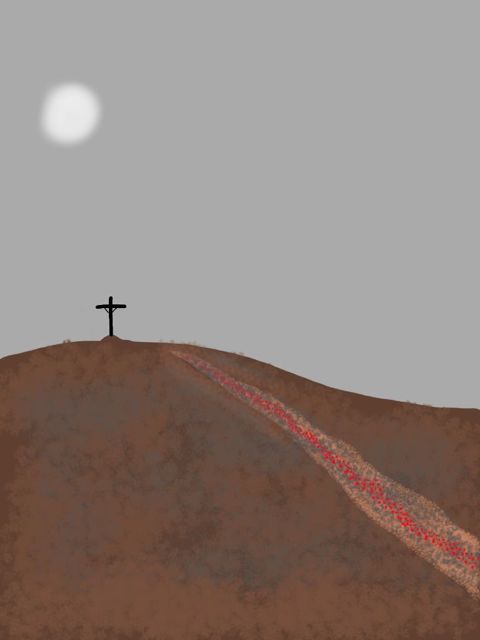
Calvary
Image
The Founding of Christendom
The Founding of Christendom, by Warren H. Carroll, is the first volume in a projected six-volume series of the history of Christendom from the earliest days until the present. Five of the six volumes are now in print. By the term Christendom, Carroll harks back to the age when the Christian world was more or less united, first in both religion and politics, then in religion only—back to the birth, in fact, of Western Civilization. This volume covers the span from the beginning of time, more or less, up until the Emperor Constantine.
As such, he’s writing sacred history rather than secular history, and sacred history from an explicitly (and unabashedly) Catholic point of view. The difference is one of method. The secular historian, though he may be a believer, does not take the truth of his religion as part of the data he uses to explain and describe the course of history. The sacred historian does. Both methods are fraught with peril.
If Christianity is true, then the Incarnation is simply the central fact of all human existence. History which ignores this fact, then, runs the risk of missing the main point, and can also get into all sorts of knots. During the 19th and 20th century, for example, followers of the historical-critical method of scripture scholarship rejected the traditional dates for the writing of many of the books of the Bible, on the basis of “internal evidence”. The logic was often of this kind: this book contains statements that appear to prophesy this historical happening. Such “prophecy” must therefore have been written after the historical happening it describes. Therefore, the book wasn’t written when tradition says it was written, but fifty, one-hundred, two-hundred years later.
There is a hidden premise in this chain of reasoning: that historical events can never be prophesied in advance. And this use of the historical-critical method was driven by a secularizing desire to “de-fang” Christianity of its supernatural elements. But if Christianity is true, it is precisely those supernatural elements on which it insists. But whatever the cause, bad scholarship leads one to be build amazing houses-of-cards; and it’s my understanding that those houses are collapsing and scripture scholarship is returning more or less to the traditional dating for the books of the Bible.
So Carroll’s project is a worthy one; written from an explicitly Catholic point of view, he rejects the ideological incredulity that prevents us from seeing the Hand of God at work among us.
But there’s a great possibility of error on Carroll’s side, as well, the possibility of excess of credulity. His book is full of events and written sources that historians generally reject, for reasons, according to Carroll, like those I’ve described above, but that Carroll, doing his research with the eyes of faith has decided are likely true. And that’s the great difficulty with this book. I’m a bit of a history buff, but I’m not a historian; and if Carroll goes too far, I’m not sure how I’d know. Given that he rejects conventional wisdom so frequently, it seems likely that he does.
All that said, each chapter of the book is accompanied by many pages of end notes, citing sources, especially those of the authors who disagree with him. I cannot question Carroll’s integrity as a scholar; rather, he seems to be playing fair. It’s his judgement I’m unsure of.
So much for sacred vs. secular history; how is The Founding of Christendom as a book? How is it as a way to become familiar with the sweep of human history?
First, Carroll’s book is quite readable and informative. I learned a few things, and was told a number of others that I’m curious to look into further. It casts an interesting light on ages and events that I’ve already read a fair amount about. Sacred history usually focusses on the history of the Church; Carroll is focussing on the things that secular historians usually write about, but from a Christian slant. I like that.
The big question, though, is whether this would be a good first book on this period of time, for a reader who is unfamiliar with it, and I’m not at sure that it would. As I indicated above, some of Carroll’s conclusions strike me as being possibly rather idiosyncratic; and then, he seems to assume that the reader has at least a cursory familiarity with the broad sweep of things. Thus, it might be best to acquire that familiarity elsewhere.
I’ve not yet decided whether or not I’ll look up the second book in the series.
 The View from the Foothills