Womb to Tomb

Today is Holy Saturday, when we remember Jesus in the tomb; and when one prays the Rosary, Saturday is also one of the days when you pray the Joyful Mysteries, which recount (among other things) Jesus’ conception and birth. (I gather that there are different rules for praying the Rosary during Lent; but I haven’t learned them. I simply go on praying the same pattern of mysteries that I pray the rest of the year.) So today I’ve been pondering Jesus’ life from womb to tomb. And it occurred to me that Jesus’ death was necessary, if he was to a human like us in all things but sin, because the quality of a human life can only be seen in retrospect.

St. Paul compares our human lives to a race, a race that ends only with our deaths:

Do you not know that in a race all the runners compete, but only one receives the prize? So run that you may obtain it. (1 Cor 9:24)

For I am already on the point of being sacrificed; the time of my departure has come. I have fought the good fight, I have finished the race, I have kept the faith. (2 Tim 4-7)

The letter to the Hebrews uses the same metaphor.

…let us also lay aside every weight, and sin which clings so closely, and let us run with perseverance the race that is set before us… (Heb 12:1)

Until you’ve finished the race, you don’t know where you stand in the rankings. How you run the race matters—”run that you may obtain it”—but clearly, finishing the race is essential. Jesus ran the whole race. Yesterday, on Good Friday, we remembered the moment He crossed the finish line. Tomorrow, we remember His entry into the Winner’s Circle.

We the living still have the race to finish. Thanks be to God! For in Christ’s victory we have the hope that we can not only finish it—any fool can do that, and will—but by His grace, can run so that we may obtain the prize.
A Heart on Fire

Archbishop Charles Chaput of Philadelphia has a new little book out; it’s what you might call an “e-pamphlet” ($0.99 at Amazon) called A Heart on Fire. It’s about the fault line running through American society these days on the subject of religion and its role in the public square, and about what we can do about it.

Actually, it’s mostly about diagnosing the fault line, because the prescription is really pretty simple. If you want to catch others on fire, you have to be on fire yourself. It’s not enough to complain about others, or about how we Christians are being attacked; in fact, complaints are mostly useless. Rather, we need to live active, dynamic, vibrant Christian lives.

And the key to living an active, dynamic, vibrant Christian life is spending time with Christ himself…which is to say, we have to make time for prayer and the sacraments.

It’s Holy Thursday–a great time to get started.

(Thanks to Richard, who brought the book to my attention.)

Penance vs. Suffering

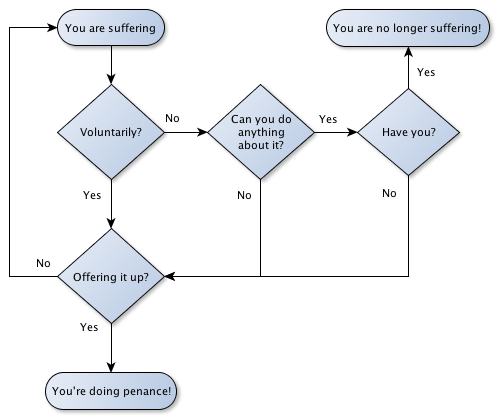
For Palm Sunday, here are some thoughts on suffering and penance, in the form of a flow chart.

penance.png

We all suffer every day, some of us a little, some of us a lot. Some of that suffering is unavoidable. Some of it we can prevent if we take a little effort, if not now, then later (in the meantime, it’s still unavoidable). Some of it is voluntary: we choose the suffering because it goes along with something else we want.

The point is, we can choose how we respond to it. If we offer it up to God, then we are still suffering…but we are also doing penance. If we don’t offer it up, then we’re just suffering pointlessly, and that’s a bummer.

Even if you’re not going out of your way to do penance, you’ll find you have ample opportunity if you just offer up the little sufferings and annoyances that pop up every day. And why waste them?

Humily != Low Self-esteem

John C. Wright comments on an article by somebody else about leading a spiritual formation class. The original poster has three times taught this class. Each time he has discussed besetting sins, and asked the class to list the sins they think most Christians face today. And the men in the class have listed internet porn, pride, lust, and anger; and all the women can come up for themselves is lack of self-esteem. Much discussion ensues.

It’s an interesting thing, but it’s not what I want to write about. (You can go look at it yourself.) What I want to write about is Wright’s response. He says this:

My comment: lack of self-esteem, sometimes called humility, is a feature and not a bug. Let a woman esteem herself for her virtue and chastity in her youth, for her maternal love and self-sacrifice after marriage, for her wisdom in her old age, but let her not esteem herself for the sake of self esteem, lest it swell into pride, which is a sin.

I think Wright is simply wrong here when he equates humility with lack of self-esteem. Humility isn’t thinking poorly of yourself. Rather, humility is a compound of two things: radical honesty, and self-forgetfulness. The truly humble person has come to terms with who he is relative to God. He sees himself clearly, both the good and the bad, and knows how much he must rely on God in all he does. But more than that, he thinks about God and about others more than he thinks about himself.*

But if the humble person knows he’s nothing in comparison with God’s majesty, love, and grace, he doesn’t sell himself short, either. He sees himself accurately. And while he knows that all his talents and skills are God-given, nevertheless he rejoices in the use of them.

Insofar as “lack of self-esteem” is a nagging, underlying feeling, a recurring worry that “I’m no good”, that “I have no value,” it may well be called a sin. Or, rather, giving into it may well be called a sin (feelings are not sins). God loves us, and He values us, even in our brokenness and poverty, and we are men and women made in His image and for whom he died. It’s a sin against truth, for if we are infinitely less than God, still we are his handiwork.

Humility is essential, say the saints; it’s a hallmark of true holiness. And it’s poorly understood, these days. But it’s something that you can rest in, not something that makes you feel bad.

I do agree with this part of Wright’s comment: “let her not esteem herself for the sake of self esteem”. There’s been a lot of hogwash talked about self-esteem, especially in the schools, over the last couple of decades; much has been done to build up the self-esteem of our children. But you don’t build up self-esteem by trying build-up self-esteem. It doesn’t work. At best you can build up a general feeling of self-love and entitlement with no basis in truth or accomplishment; which is to say, pride and greed. Real self-esteem needs to be based on real accomplishment, which requires work, and on a real sense of one’s own capacity. Telling everyone that they are equally capable is a pernicious lie.

* I am not describing myself here, more’s the pity.

Pictures of the Rally

Here are some pictures of the rally. I have pictures of each of the speakers, but I generally didn’t catch their names (or recognize them, for that matter), so I’ll skip those. Instead, my goal was to try to capture the size of the crowd.

Here’s the crowd from the back, early in the rally. That’s L.A.’s City Hall in the background.

Crowd0.jpeg

Here’s another view from a point behind the speaker.

Crowd1.jpeg

A little later on I was listening to the speakers, and happened to turn around and see that some more people had gathered. This was taken from toward the front of the crowd.

Crowd2.jpeg

Finally, here’s one I took whilst trying to be artsy; but at the time I didn’t notice all of the other people with cameras in hand.

CityHall.jpeg

If you ask your browser to show the images in their own window, they will be bigger.

Rally for Religious Freedom Redux

So I went to the Rally for Religious Freedom at the Federal Building in Downtown L.A. this noon; I’ll have pictures later. I’m not particularly good at estimating the size of crowds, but I’d say that there were between two to three-hundred people there.

I’d never heard of any of the speakers, but they were all good; they didn’t rabble-rouse, and they didn’t demonize the opposition. The strongest note was a call to prayer. The speakers included a Catholic priest from Downey, a bishop from the “Charismatic Episcopal Church”, which despite my twenty years as an Anglican I don’t believe I’d ever heard of before, a priest from the Antiochean Orthodox Church, a Lutheran minister, a couple of Evangelical ministers, and a number of lay-people. The event was sponsored by the group “Survivors of Abortion”.

There was only one heckler, an angry man who walked past and told the clergy present in rather foul language that they should stay out of politics. He was just passing through, though, and the crowd did not respond in kind.

There was no media presence at all, so far as I could tell.

Subsidiarity

One of the basic notions in Catholic social teaching is “subsidiarity”. I’ve usually heard this principle explained in this way: social problems should be solved at the lowest possible levels that are up to the task. What a person can reasonably do for himself, he should do. What a family can do for itself, the city shouldn’t do. What the city can do for itself, the state shouldn’t do. This popular in some circles currently, because it militates against big government, something it’s clear we have too much of.

However, Brandon has written a post on subsidiarity that shows that this is not quite what the Church is saying. It would be more accurate to say that certain institutions arise naturally in human society (e.g., the family) and that these institutions are naturally good at doing particular things—and that it is the responsibility of these institutions both to do what they do well, and to support the other institutions in doing what they do well!

Thus, if the family is naturally good at ensuring the well-being of children, then the state should do what it can to support the family in this role, rather than taking on this role itself. In American society today, I think that responsibilities do need to move downwards toward the family and the individual and away from the state, and that the state should be trying to encourage the family rather than replace it. But that’s happenstance.

We can see this in the current HHS attack on the Catholic Church. The Church is not really in any kind of simply hierarchy with the federal government. The federal government is not above the Church nor below the Church; they are independent. The Church does some things well; healthcare, education, and feeding the poor happen to be three of them. These things serve the public good, and the federal government should encourage them rather than hindering them.

Anyway, take a look at Brandon’s post; he’s more interesting than I am.

Natural Law

Having gotten myself started with philosophy blogging, I’ve been kind of at a loss to know what to talk about next. There are so many topics of interest, and they are all related, and it’s hard to know where to start.

Thanks to the peculiarly timed bit of tyrannical overreach on the part of the Department of Health and Human Services that’s been much discussed on-line in recent weeks, however, lots of people have been talking about the Church’s position on contraception. This, in turn, is based on natural law theory, and natural law theory is based on an Aristotelian view of causality and of human nature; and if I can’t get at least half-a-dozen good-sized posts out of the first half of this sentence I’m not trying hard enough.

The essence of natural law theory (about which, as always, I am not an expert) is that there are certain natural laws of human behavior—laws about how humans ought to behave—that derive from human nature, from what it means to be human, and that can be be known with certainty by human reason, without any need for divine revelation. If this were true, one would expect that most cultures in most times and places would generally agree on questions of morality. It’s customary these days to emphasize the disagreements, and even to say that they outweigh the agreements; but this turns out not to be the case.

C.S. Lewis talks about the natural law in his book The Abolition of Man, which I highly recommend. In an appendix, he goes through the moral teachings of the great cultures of the world point by point, appealing to their holy books and great teachers, and shows that to a first approximation moral teachings really are the same everywhere. The same principles apply. Often they are held to apply only to “real people”, “people like us”: my family, my race, my country. But even if I believe that I may morally steal from you, or kill you, you’ll note that you aren’t allowed to steal from me or kill me. The shocking thing about Christianity is that in principle (thought not always in practice) it increases the range of “people like us” to all of humanity.

Next up: causality.