
Judith: Captive to Conqueror, Vol. 1

The good folks at Atiqtuq have sent me a follow-on to their first graphic novel, Paul: Tarsus to Redemption, Vol 1. The new one is called Judith: Captive to Conqueror; it features the same artist as Paul, Sean Lam, and is written by Gabrielle Gniewek. Like Paul, it’s aimed at the middle-schoolers, 12 and up.

cover-judith-volume-1.jpg

The story is drawn from the Old Testament book of Judith, and focuses primarily on two characters: Judith, a devout young widow of the Judean city of Bethulia, and Holofernes, the commander of the armies of Nebuchadnezzar. It seems that Nebby has a problem with disrepect: all surrounding kingdoms must submit to him peacefully and worship him as a god, or he’ll grind them into the dirt…and then make the survivors worship him as a god. Holofernes is his chosen tool for the job—at least, once Holofernes knifes his predecessor to get it.

Bethulia is the only city standing between Holofernes and Jerusalem; he must be held there at all costs. But the people of Bethulia are inclined to trust more in Holofernes’ mercy rather than the Lord’s saving arm, so Judith has a bit of a job to do.

This is the first book in a series, and it is devoted to painting pictures of Holofernes and Judith and setting up the conflict between them. And I have to say, Holofernes is a real piece of work. He’s got long ropes of hair, and anime good looks; he likes to do his dirty work with a smile, preferably after persuading his victim of his benevolence. Outwardly warm, inwardly cold, he’s both ruthless and ambitious, and if I were Nebuchadnezzar I wouldn’t trust him any farther than I could sling a piano.

Judith, on the other hand, is generous, devout, God-fearing, kind, and disgusted with the leaders of her city; she’s surprisingly compelling for such a goodie-two-shoes.

On the whole, I enjoyed the book, as did my two sons, who are 13 and going on 11. I had a few problems with the continuity; there are some significant flashbacks that took me by surprise, and some of the scene changes were a little abrupt. I’ve not previously read the book of Judith, so I was a little unclear about the setting at first; in particular, I had no idea that Judith was somewhere different than Holofernes. Now, there’s this serving girl in Nebuchadnezzar’s palace that Holofernes winks at from time to time…or maybe it’s a succession of them, which is also possible…and for a while I thought that Judith might be the serving girl. In time, though, all became clear.

So, a quick, fun read, and I’d be glad to see the next volume.
The Founding of Christendom

The Founding of Christendom, by Warren H. Carroll, is the first volume in a projected six-volume series of the history of Christendom from the earliest days until the present. Five of the six volumes are now in print. By the term Christendom, Carroll harks back to the age when the Christian world was more or less united, first in both religion and politics, then in religion only—back to the birth, in fact, of Western Civilization. This volume covers the span from the beginning of time, more or less, up until the Emperor Constantine.

As such, he’s writing sacred history rather than secular history, and sacred history from an explicitly (and unabashedly) Catholic point of view. The difference is one of method. The secular historian, though he may be a believer, does not take the truth of his religion as part of the data he uses to explain and describe the course of history. The sacred historian does. Both methods are fraught with peril.

If Christianity is true, then the Incarnation is simply the central fact of all human existence. History which ignores this fact, then, runs the risk of missing the main point, and can also get into all sorts of knots. During the 19th and 20th century, for example, followers of the historical-critical method of scripture scholarship rejected the traditional dates for the writing of many of the books of the Bible, on the basis of “internal evidence”. The logic was often of this kind: this book contains statements that appear to prophesy this historical happening. Such “prophecy” must therefore have been written after the historical happening it describes. Therefore, the book wasn’t written when tradition says it was written, but fifty, one-hundred, two-hundred years later.

There is a hidden premise in this chain of reasoning: that historical events can never be prophesied in advance. And this use of the historical-critical method was driven by a secularizing desire to “de-fang” Christianity of its supernatural elements. But if Christianity is true, it is precisely those supernatural elements on which it insists. But whatever the cause, bad scholarship leads one to be build amazing houses-of-cards; and it’s my understanding that those houses are collapsing and scripture scholarship is returning more or less to the traditional dating for the books of the Bible.

So Carroll’s project is a worthy one; written from an explicitly Catholic point of view, he rejects the ideological incredulity that prevents us from seeing the Hand of God at work among us.

But there’s a great possibility of error on Carroll’s side, as well, the possibility of excess of credulity. His book is full of events and written sources that historians generally reject, for reasons, according to Carroll, like those I’ve described above, but that Carroll, doing his research with the eyes of faith has decided are likely true. And that’s the great difficulty with this book. I’m a bit of a history buff, but I’m not a historian; and if Carroll goes too far, I’m not sure how I’d know. Given that he rejects conventional wisdom so frequently, it seems likely that he does.

All that said, each chapter of the book is accompanied by many pages of end notes, citing sources, especially those of the authors who disagree with him. I cannot question Carroll’s integrity as a scholar; rather, he seems to be playing fair. It’s his judgement I’m unsure of.

So much for sacred vs. secular history; how is The Founding of Christendom as a book? How is it as a way to become familiar with the sweep of human history?

First, Carroll’s book is quite readable and informative. I learned a few things, and was told a number of others that I’m curious to look into further. It casts an interesting light on ages and events that I’ve already read a fair amount about. Sacred history usually focusses on the history of the Church; Carroll is focussing on the things that secular historians usually write about, but from a Christian slant. I like that.

The big question, though, is whether this would be a good first book on this period of time, for a reader who is unfamiliar with it, and I’m not at sure that it would. As I indicated above, some of Carroll’s conclusions strike me as being possibly rather idiosyncratic; and then, he seems to assume that the reader has at least a cursory familiarity with the broad sweep of things. Thus, it might be best to acquire that familiarity elsewhere.

I’ve not yet decided whether or not I’ll look up the second book in the series.

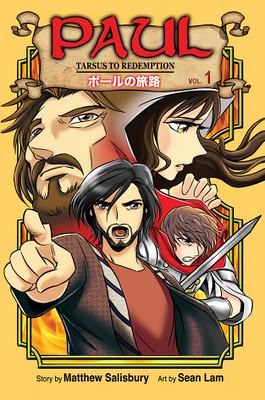
Paul: Tarsus to Redemption

I’ve read a fair number of books that Julie has recommended, but she’s just put a new spin on it.

Paul: Tarsus to Redemption, Vol. 1 (story by Matthew Salisbury, Art by Sean Lam) is a fictional take on the life of St. Paul…presented as a manga-style comic. Julie mentioned on her blog that she’d gotten a review copy from the publisher, and that it looked interesting. A few days later, I got an e-mail from the publisher saying that Julie had mentioned to them that I might like it, and would I like a copy? I said, “Sure”, and it arrived yesterday. So now, not only has Julie recommended it to me, she’s arranged to have the publisher supply me with it. How cool is that?

paul.jpg

As I say, the book is a manga re-telling of the life of Saul of Tarsus. The very notion kind of filled me with dread. It gave me visions of something painfully earnest, with characters who smile too much and are filled with warmth and growfulness—sort of like a Japanese version of the old “Davy and Goliath” TV show. I feared it would be both tedious and didactic.

In fact, it’s nothing of the kind. As the book begins, Saul, with help from his buddy Septus and some others, kills a pair of Christians and burns their home to the ground. He has dedicated his life to rooting out this pernicious “sect”. Septus, his helper, is a Roman centurion, a convert to Judaism; he’s even more zealous than Saul. He’s exactly the sort of person Jesus talks about when he says,

Woe to you, scribes and Pharisees, hypocrites! for you traverse sea and land to make a single proselyte, and when he becomes a proselyte, you make him twice as much a child of hell as yourselves.

Then, of course, Saul has his encounter on the road to Damascus. He changes in ways that Septus cannot accept. And he learns the heroism to stand up for the Lord when it isn’t safe to do so: to stand up when it might mean your life, rather than seeking to take the lives of others. The authors have done something interesting here. They make Saul’s conversion realistic; they make his repentance real, and gripping; and they show how much he has given up.

So the story works for me. On the other hand, I thought the book was a little too long on purely visual story-telling; I’d have like a few more words. And there were a few places where I was honestly puzzled by the words that were there; places where the dialog didn’t seem to flow quite right. Of course, I’m not usually a manga reader; there are probably some conventions that I’m unaware of that would make it clearer.

Also, it’s rather short. I got through it in about half-an-hour, and my son David raced through it over breakfast this morning. But all that said, I liked it well enough, and David’s eager to read Volume 2, which is supposed to be out this summer. As Paul is intended for readers of age 12 and up, I’d say the authors have accomplished what they set out to accomplish. ‘Nuff said.

The Fourth Pillar: Preaching

Tomorrow’s the big day, so I thought I’d finish up my series on the Four Pillars of the Dominican life tonight.

Preaching is the point of the Dominican Order, the Order of Preachers: preaching for the salvation of souls. It’s that last bit that makes it difficult. Anyone can preach so as to annoy, offend, or bore their listeners, and this is so usual a thing that the word “preachy” has distinctly negative connotations. Outside of church, people don’t like to be preached at, and they especially don’t like to be preached at when they aren’t expecting it. One is unlikely to bring souls to Christ by being annoying, offensive, or boring.

So what does it mean for me to preach? How do I propose to do it without being annoying? These are good questions, questions that I expect I’ll be pondering for a good long while. Here’s what I think I know now.

First, St. Francis is famously said to have said (though I’m told he probably didn’t) that one should preach always; when necessary, use words. In other words, one should draw others to Christ simply by how one lives. This is a tall order; but it is, in fact, what all Christians are called to. But leading a life of Christian holiness is a big topic, and one that I don’t intend to get into now.

Second, I intend to preach through this blog. That doesn’t mean that I’m going to write posts filled with hellfire-and-brimstone; it simply means that I’m going to continue to post on the topics that interest me, and one of those topics is the Lord.

In one sense, I regard preaching as simply communicating truth, goodness, and beauty so far as I see them; and as God is the summit of all that is Good, True, and Beautiful, that will mean talking about God. Further, I think we live in a culture that often has only a shadowy notion of what the truth is—indeed, many doubt that truth can really be known.

It might be difficult to do this in a fitting way; but I’ve been shooting my mouth off here long enough that I rather expect I’ll be able to continue. And if I’m boring, well, folks will just go read something else.

Finally, I intend to preach to my family, friends, and co-workers, though I’m not quite sure how. This is the most challenging way, as it’s so easy to do it badly, and so hard to do it well (and I don’t believe that I’ve ever shown much aptitude for it). And then, there are a variety of constraints. For example, however much I might want to reach my co-workers, I am clearly not paid to evangelize them on company time. On the job, my number one tool must be the way I do my work, and the way I work with others.

If I seem unsure, it’s because I am. But then, I’m not becoming a Dominican because I already know how to do these things; I’m becoming a Dominican to learn.

Study: The Third Pillar

The Dominican Order is officially titled the “Order of Preachers”. Everything the order does is supposed to be aimed toward preaching for the salvation of souls. But Dominicans have the wonderfully old-fashioned notion that if you’re going to speak about something you should know what you’re talking about. Hence, study has been an essential part of Dominican life from the beginning. A Dominican might not have anything to eat—the early Dominican friars were mendicants, and begged for their food—but a Dominican always has books.

The first book to study, is, of course, the Bible. Studying the Bible in a Catholic context is a challenging endeavor—not because the Church frowns on it, as some have said, but because there is so very much to know. One of the major principles of exegesis is that a passage of scripture cannot be interpreted in a vacuum, but must be interpreted in the light of all of the remainder of scripture and the entire deposit of faith. Acquiring such a universal knowledge of scripture is difficult, to say the least, and practically speaking we must look for help. Even there, the task is daunting, as Catholics have been reading and commenting on scripture from the earliest days of the Church.

But although study must begin with scripture it doesn’t end there. Dominican study often includes philosophy and theology, as well as various kinds of spiritual reading; and in the lay context, it also includes any kind of study required to live one’s life in the world. In my case, for example, it’s appropriate for me to study software engineering and computer science.

Finally, Dominicans need to be up on current events so as to bring the Faith to bear on the issues of the day. This is the bit, I confess, that I have the least interest in.

I said above that study must begin with scripture, but in fact that’s not quite true. In fact, study must begin with prayer, for prayer is the foundation for everything we do.

Community: The Second Pillar

It’s been said that there’s no such thing as one Christian. As St. Paul tells, we are all members of the body of Christ; and fingers, noses, and spleens can’t live on their own. (We have a lot of spleens in the blogosphere, I notice.) Even the desert hermits lived to some extent in community. And this is also true for Lay Dominicans.

To be a Lay Dominican is to be part of a Lay Dominican Fraternity, also known as a Chapter. And there are two aspects to this. The first is that in a chapter you associate with and can learn from those who are more mature in the faith and in the ways of St. Dominic than you are. You have brothers and sisters who can pull you up and hold you accountable and give you guidance and encouragement. They are companions on your journey.

But there’s a second aspect, too. One’s chapter is very like a family, in the sense that you can choose your friends, but you can’t choose your family; and in every family there is occasionally some friction. And interpersonal friction is an occasion for growing in holiness: for being forbearing and serene in trial, for forgiving others, for loving even when it’s difficult.

Prayer: The First Pillar

The First Pillar of the Dominican life is Prayer, with a capital P, just as it is the First Pillar of any Christian life. As a Lay Dominican I will be expected to pray the principle hours of the Divine Office each day, and also the Rosary, and to attend Mass as often as I can, and this in addition to other forms of prayer on a more ad hoc basis. That’s a lot, and it helps that I haven’t really watched TV in years.

Prayer is not, despite the common misconception, primarily about asking God for things. This is one kind of prayer, and an important one; Jesus himself gave us the Our Father, in which we ask God for a number of things, including our daily bread, that which we need to live. But it isn’t the main event. The primary purpose of prayer is intimacy with God. It is, ultimately an act of will, the act of focussing our attention and concentration upon the Lord, of placing ourselves in God’s presence and simply being there with Him.

This is easier said than done—indeed, without God’s grace and the aid of the Holy Spirit we couldn’t manage it at all. It takes practice, and patience, and lots and lots of grace. But the essence of love is not that we have loved God, but that He has loved us. The history of the world is not one of Man reaching up to God but of God reaching down to us. And that makes true intimacy with God possible.* And as God, infinite God, is the source of all that is good, all that is true, all that is beautiful, He is the answer to our deepest yearnings.

* Please do not think that I’m writing as some kind of spiritual master. At most I’ve taken a few steps on what promises to be a very long journey. But I’ve read a lot of travel brochures!

The Four Pillars

To be a Lay Dominican is to follow Christ in the manner of St. Dominic, as appropriate to the lay state. (That qualification is important; I’m not becoming some kind of pseudo-priest or religious brother.) So what does it mean to follow Christ in the manner of St. Dominic? I’ll say a little bit about it here, and expand on it in subsequent posts.

First, of course, to be a Dominican is to follow Christ, and in particular to be a good Catholic: daily prayer, frequent reception of the sacraments, and so forth. All Christians are called to a holy life in Jesus Christ. This is key. Without Christ, and him crucified, there’s no point to any of this.

But given that, there are four pillars to the Dominican life: Prayer, Community, Study, and Preaching. There is daily prayer: the Liturgy of the Hours, the Rosary, and (if possible) the Mass. There is community: a monthly meeting with one’s chapter, plus occasional retreats. These two things are common to all of the “third orders”: Lay Dominicans, Secular Franciscans, Benedictine Oblates. But Dominican life is especially a life of study: of scripture, of theology, of philosophy, of Jesus. And this study has a particular end in view: the salvation of souls, starting first with one’s own soul, and then the souls of others…which leads naturally to the fourth pillar, which is preaching.

I’ll have more to say, later, but for now I’ll simply point out that preaching doesn’t happen in a vacuum—it must be solidly rooted in prayer, community, and study.