Pictures of the Rally

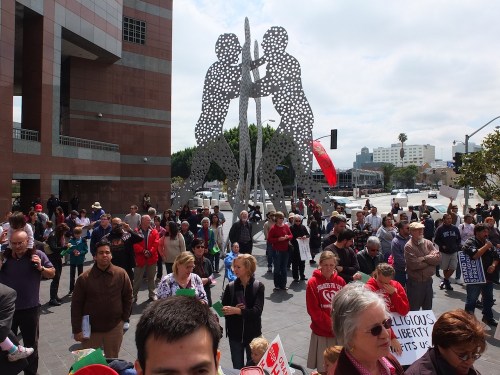
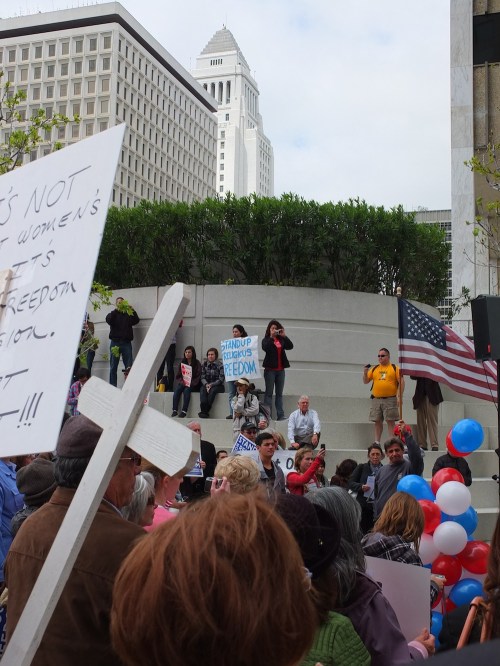
Here are some pictures of the rally. I have pictures of each of the speakers, but I generally didn’t catch their names (or recognize them, for that matter), so I’ll skip those. Instead, my goal was to try to capture the size of the crowd.

Here’s the crowd from the back, early in the rally. That’s L.A.’s City Hall in the background.

Crowd0.jpeg

Here’s another view from a point behind the speaker.

Crowd1.jpeg

A little later on I was listening to the speakers, and happened to turn around and see that some more people had gathered. This was taken from toward the front of the crowd.

Crowd2.jpeg

Finally, here’s one I took whilst trying to be artsy; but at the time I didn’t notice all of the other people with cameras in hand.

CityHall.jpeg

If you ask your browser to show the images in their own window, they will be bigger.

Rally for Religious Freedom Redux

So I went to the Rally for Religious Freedom at the Federal Building in Downtown L.A. this noon; I’ll have pictures later. I’m not particularly good at estimating the size of crowds, but I’d say that there were between two to three-hundred people there.

I’d never heard of any of the speakers, but they were all good; they didn’t rabble-rouse, and they didn’t demonize the opposition. The strongest note was a call to prayer. The speakers included a Catholic priest from Downey, a bishop from the “Charismatic Episcopal Church”, which despite my twenty years as an Anglican I don’t believe I’d ever heard of before, a priest from the Antiochean Orthodox Church, a Lutheran minister, a couple of Evangelical ministers, and a number of lay-people. The event was sponsored by the group “Survivors of Abortion”.

There was only one heckler, an angry man who walked past and told the clergy present in rather foul language that they should stay out of politics. He was just passing through, though, and the crowd did not respond in kind.

There was no media presence at all, so far as I could tell.

Subsidiarity

One of the basic notions in Catholic social teaching is “subsidiarity”. I’ve usually heard this principle explained in this way: social problems should be solved at the lowest possible levels that are up to the task. What a person can reasonably do for himself, he should do. What a family can do for itself, the city shouldn’t do. What the city can do for itself, the state shouldn’t do. This popular in some circles currently, because it militates against big government, something it’s clear we have too much of.

However, Brandon has written a post on subsidiarity that shows that this is not quite what the Church is saying. It would be more accurate to say that certain institutions arise naturally in human society (e.g., the family) and that these institutions are naturally good at doing particular things—and that it is the responsibility of these institutions both to do what they do well, and to support the other institutions in doing what they do well!

Thus, if the family is naturally good at ensuring the well-being of children, then the state should do what it can to support the family in this role, rather than taking on this role itself. In American society today, I think that responsibilities do need to move downwards toward the family and the individual and away from the state, and that the state should be trying to encourage the family rather than replace it. But that’s happenstance.

We can see this in the current HHS attack on the Catholic Church. The Church is not really in any kind of simply hierarchy with the federal government. The federal government is not above the Church nor below the Church; they are independent. The Church does some things well; healthcare, education, and feeding the poor happen to be three of them. These things serve the public good, and the federal government should encourage them rather than hindering them.

Anyway, take a look at Brandon’s post; he’s more interesting than I am.

Natural Law

Having gotten myself started with philosophy blogging, I’ve been kind of at a loss to know what to talk about next. There are so many topics of interest, and they are all related, and it’s hard to know where to start.

Thanks to the peculiarly timed bit of tyrannical overreach on the part of the Department of Health and Human Services that’s been much discussed on-line in recent weeks, however, lots of people have been talking about the Church’s position on contraception. This, in turn, is based on natural law theory, and natural law theory is based on an Aristotelian view of causality and of human nature; and if I can’t get at least half-a-dozen good-sized posts out of the first half of this sentence I’m not trying hard enough.

The essence of natural law theory (about which, as always, I am not an expert) is that there are certain natural laws of human behavior—laws about how humans ought to behave—that derive from human nature, from what it means to be human, and that can be be known with certainty by human reason, without any need for divine revelation. If this were true, one would expect that most cultures in most times and places would generally agree on questions of morality. It’s customary these days to emphasize the disagreements, and even to say that they outweigh the agreements; but this turns out not to be the case.

C.S. Lewis talks about the natural law in his book The Abolition of Man, which I highly recommend. In an appendix, he goes through the moral teachings of the great cultures of the world point by point, appealing to their holy books and great teachers, and shows that to a first approximation moral teachings really are the same everywhere. The same principles apply. Often they are held to apply only to “real people”, “people like us”: my family, my race, my country. But even if I believe that I may morally steal from you, or kill you, you’ll note that you aren’t allowed to steal from me or kill me. The shocking thing about Christianity is that in principle (thought not always in practice) it increases the range of “people like us” to all of humanity.

Next up: causality.

Lord, Open My Heart

Julie Davis has a new e-book out: Lord, Open My Heart — Daily Scriptural Reflections for Lent. It’s $0.99 at the Kindle Store; I’m not sure whether it’s available for other e-book platforms or not. (Julie will no doubt chime in and let us know.)

I’ve gotten a copy of the book…but I confess, I’ve not yet read it. I mean, really: it’s a day-by-day book of scriptural reflections for use during Lent, and Lent is nearly upon us. So I’m saving it. On the other hand, I didn’t want to wait to say anything about it until I had read it, because that would be when Lent is over, and that’s too late for this year.

So c’mon. $0.99. You know you want to.

The Human Wisdom of St. Thomas

It’s nicely coincident to my current series of posts that today is the feast of St. Thomas Aquinas. In addition to being one of the greatest thinkers in the history of the world, he is also my elder brother in the Dominican order, and my patron saint.

Recently I got a little book by Josef Pieper called The Human Wisdom of St. Thomas: A Breviary of Philosophy. I say that it’s by Josef Pieper, by that’s misleading—except for a brief forward, all of the text comes from St. Thomas’ own writings. Pieper has simply selected them and arranged them in an interesting and useful way.

Although St. Thomas is one of the great philosophers, he was primarily a theologian, and philosophy, the “handmaiden of theology”, was simply one of the tools he used to illuminate the glory of God. Thus, his philosophy is apparent throughout his writings…but he never attempted to write down his philosophy all in one place. It makes it hard to study.

What Pieper has done is pull brief quotations from across the vast expanse of Thomas’ work, and arrange them by topic…and then arrange them within each topic so that they almost form a continuous thread. His desire for this book was that the would-be Thomist would read a bit of it every day, so that Thomas’ principles and conclusions would sink in.

As an example of the style, the third section is titled (in Thomas’ own words),

There can be good without evil, but there cannot be evil without good.

The quotes in this section all build on this theme. Partway down the first page, for example, we see these three related thoughts:

No essence is in itself evil. Evil has no essence.

Evil consists entirely of not-being.

Nothing can be called evil insofar as it has being, but only insofar as it is deprived of part of its being.

Thus, a man who does evil is one who turns from that which would perfect him to that which diminishes him, makes him less a man. And yet, what remains of him is still good.

Pieper does provide a detailed set of citations at the end of the book; thus, I know that the four quotes I listed here are from the Summa Theologiae, the Summa Contra Gentiles, and from one of the “disputed questions”. Pieper also pulls quotes from the Compendium Theologiae, the commentaries on scripture, the commentaries on Aristotle, and a number of other short works.

In short, the whole book is remarkably pithy, and I would recommend it to anyone interested in St. Thomas and his thought. The joy of philosophy is the wonder at and contemplation of the richness of the world than it engenders, and the briefly stated ideas in this book are an outstanding place to get started with the wondering and the contemplating.

Requiem for the Unborn

So last night the whole family went down to the Cathedral of the Angels for the annual Requiem for the Unborn. This mass is held every year on the Saturday nearest to the anniversary of Roe vs. Wade, which is 22 January, or today. It is a funeral mass for the the victims of abortion over the past year, and particularly for those aborted in the city of Los Angeles on the day of the requiem. At the end of the mass, one candle is lit for each of them, and placed around the altar; and then silence is maintained. This year there were 150 candles; on average, 150 unborn people are being killed each day in the City of Los Angeles, and we were silent for 150 seconds.

Progress is clearly being made. There were 180 candles last year, if we recall correctly; and at the first Requiem for the Unborn (this year’s was the ninth) there were over 450.

The celebrant was our new bishop, Archbishop José Gomez; also in attendance were the remaining bishops of the archdiocese (including Cardinal Mahoney) many priests and deacons, the seminarians from our seminary, many sisters, a sizable cohort of the Knights of Columbus, and many, many just plain folks like us. The Cathedral was packed.

We had a surprise guest, Cardinal Pell, Archbishop of Sydney, Australia, who concelebrated the mass with Archbishop Gomez and Cardinal Mahoney. I have no idea what Cardinal Pell is doing in Los Angeles, and he didn’t speak at the mass.

Archbishop Gomez gave the homily, naturally. I was eager to hear it, as this is the first chance I’d had to hear him since he became our bishop. The gospel text concerned the Magi and King Herod, the flight of the Holy Family to Egypt, and Herod’s slaughter of the Holy Innocents. The archbishop compared Herod to those in the present day who will do anything to keep God from interfering with their control of the world. It was interesting to compare Gomez’ homily with those Cardinal Mahoney gave at this mass over the last several years; Mahoney usually gave a talk about the state of the pro-life movement and the progress being made, complete with statistics. Gomez gave a genuine homily, making his points but drawing them from the scriptures read at the mass. In one way I was sorry for this; I wanted to get a sense of what Gomez is like as a person, and was hoping for something less formal. But on the other hand, a homily is supposed to be a homily, not an informal, off-the-cuff speech, and I’m glad that’s what we got.

In general, the mass went much as it had in past years; the music was the same, the Shantigarh Requiem for the Unborn, a piece written for this mass, and there were still liturgical “dancers”, sort of. I put “dancers” in quotes, because it’s almost certain to give the wrong impression. The dancers are young women in white dresses. They came in at the beginning of the procession with incense in these metal cones or funnels, as they have in past years; but they did so more quickly, and almost perfunctorily, than in the past, and there was also a server with a traditional censer that I don’t remember having seen in the past. (I might well be mistaken about that.) They brought in the altar cloths at the time of the offertory, and dressed the altar as they had done in the past. They led the procession of 150 candles at the end of the mass, and were responsible for placing the candles around the altar; but I’m not sure they processed out afterwards, and they certainly didn’t dance down the aisle as they had in the past.

What I’m trying to convey with all this is that even in past years, there was very little actual dancing being done; the “dancers” were mostly a fancy kind of altar server. More than that, any real dancing took place outside of the mass proper, which is to say that it wasn’t really liturgical dancing because it wasn’t part of the liturgy. And this year, even that was muted; apparently our new archbishop is already making his mark.

Mary and Eve

Mary is often said to be the new Eve. The mother of all humanity, Eve chose the lesser over the greater, and sin and death came into the world. The Mother of God and of all Christians, Mary chose the greater over the lesser and life came into the world in the person of her son. Through one came damnation; through one came salvation. Why was there such a great difference? Both were filled with the grace of God; neither were subject to Original Sin. How is that one chose ill and the other chose well?

It occurred to me today that Eve’s sin was not sin as we experience it today. Thanks to Original Sin, our desires and appetites are disordered: we see the greater thing, but we desire, we hunger for, the lesser thing, and all too often we choose it, despite knowing full well that we shouldn’t. My wife’s Chocolate-Peanut butter-Butterscotch Rice Krispie treats are to die for–and that’s just what I’ll do if I keep eating them. I know better, but I want just another one, and all too often I eat it. And then another, and another….

But Eve was not subject to this kind of disordered appetite. Free from concupiscence, she was much better able than we are to choose what her reason told her was good. Unlike us, she had no desire to choose the lesser over the greater. So why did she fall?

And the answer is simple: she was misled. The serpent, father of lies, persuaded her that the lesser was the greater: that the fruit was both good for food, and would bring knowledge (both good things in and of themselves). It was with the full assent of her intellect, I imagine, that she chose to eat the fruit she had been commanded not to eat. The serpent had taught her, and now she knew “better”.

It was a lie; and in her innocence Eve had no experience of lies or of liars. It has been said that the knowledge of good and evil that the serpent promised was truly only the knowledge of evil, which is to say the knowledge of the serpent’s guile and its lies–and knowledge of her own failure. (Tradition records that Eve repented, and was not taken in again; the Eastern Orthodox churches revere her as a saint to this day.)

Eve was not stupid; she was not evil; but she was naive, and she believed a lie. Often, no doubt, we do the same. But not always–and hey, is that another Krispie Treat over there?

The Church tells us that Mary was born without Original Sin, that by the grace of Christ she was preserved from all stain of sin from the moment of her conception in her mother’s womb. Like Eve, then, her appetites were not at war with her intellect. Given that she knew the greater, she was not drawn by her desires to choose the lesser. And here we come to the big difference between Eve and Mary. Mary was young, and unstained; but she was not naive. Two-thousand years of Hebrew history came to a point in her. She knew the history of her forebears, and the consequences that came to Adam and Eve and to the tribes of Israel from choosing the lesser over the greater. She knew what sin was, not from inside, granted, but from outside. She knew what was due to God as her creator, and the natural consequences that came from spurning Him.

God put thousands of years of care into leading one branch of Adam and Eve’s descendants to the point where one human being, one young daughter of Eve, could be given the gift of holiness and would know enough to trust in Him and not squander it. All of human history comes down to that moment: when through Gabriel, God told Mary that she would bear a son; and choosing the greater part over the lesser part, she replied “Fiat voluntas tua: let it be done to me according to thy will.”

Our Lady, Mother of Virtue, pray for us.