
Forming Intentional Disciples

Forming Intentional Disciples by Sherry Weddell is a book the Church desperately needs today. It is a description of the Church (and of Christianity in general) as it is. Sherry has all of the statistics in hand. It is a vision of what the Church can be, is meant to be, with glimpses of the parishes where the vision has already taken root. And it is a deeply pragmatic book with practical steps for achieving that vision given the situation we currently find ourselves in.

The core of the vision centers on Christ our Lord, and on what Sherry calls “intentional disciples,” people who make it their business to be disciples of Christ, who devote themselves to the love of Jesus before everything else, and to their fellow men and women because he loves them. She makes the point over and over again that a strong, living relationship with Jesus is crucial—and that if we want our parishes to be bursting with life and service to God and our neighbor, we must first foster that strong, living relationship.

My evangelical readers are nodding and saying, “Well, duh—of course that’s where you have to start.” I need to say a few words to them; the rest of you, feel free to follow along if you like.

I was a member of Inter-Varsity Christian Fellowship when I was in college. I was a member of a rather evangelical Episcopalian (later, Anglican) parish for many, many years before I returned to the Catholic Church. I’ve known about the importance of a strong friendship with Jesus since I was in my teens. It’s only since I rejoined the Catholic Church that I’ve begun to get the hang of it.

What’s this! you ask? That’s not the usual way. And it isn’t; and yet, at the same time, it is. For almost two thousand years, the Catholic Church has had members who have stepped apart from the world and devoted their lives to building their relationships with Jesus. We call them monks, and friars, and sisters, and nuns, and canons, and hermits. We call them Dominicans and Franciscans and Benedictines and Carmelites and a whole host of other names. There have always been those in the Church who not only know the way but have mapped it out in detail; and not only mapped it out in detail, but have mapped out a number of routes, suited to every variety of temperament. Dominican spirituality is not the same as Benedictine spirituality. But all of them are about coming to Jesus, knowing him, loving him, and accepting his discipline.

As a Protestant, I felt like I had a do-it-yourself kit and no hardware store in sight. The books I read were some help, but they only went so far. As a Catholic I’ve got the experience of the ages available to me, and I’ve done my best, with God’s help, to take advantage of it. I look back on my days as an Anglican, and I feel like I was trying to get the job done with one hand tied behind my back and a blindfold.*

The Catholic Church as a body understands how to know and love and follow Jesus. But many of us in the pews do not; and that’s what this book is about: encouraging Catholics like me to spread the word, as well as sage advice on how to go about it. Here’s a hint: it doesn’t look like a sales call. And mostly it involves listening, not speaking.

This is not properly a review; I don’t feel qualified to review the material in this book, especially after only one reading. But I’ll be reading it again; and I’ll be passing it around.

_____________
* I’m not criticizing my non-Catholic brothers and sisters here; I’m talking about my own personal experience trying to put my faith into practice.
Aquinas 101

Aquinas 101, by Francis Selman, is subtitled “A Basic Introduction to the Thought of St. Thomas Aquinas”; and that’s a pretty good description.

Most of the books I’ve read about Thomas have focussed on his philosophy and natural theology, e.g., his proofs for the existence of God and of God’s attributes, as accessible to reason. This one covers that, but then goes on to cover the remainder of his theology as well. It isn’t a long book, only about 200 pages, so the coverage isn’t deep; at least, I found the opening chapters on the existence of God to be rather shallower than other books I’d read. But on the other hand it covers the waterfront, which is a really good start. It helps to study the map before putting on your boots and going for a hike.

So, recommended, with caveats.

First Communion Retreat

Today I shall be attending a “First Communion Retreat” with my youngest, who will be making her first communion in about a month. This is a new thing for me. They’ve been doing these retreats for the kids for some years, but I think this is the first time they have asked a parent to attend as well. At least, it’s the first time we’ve been asked.

I’m quite curious about it. I don’t know whether I’ll be with my daughter all morning, or whether the adults and kids are going to spend some time getting catechized separately. (I’m hoping the later; more adult faith formation is a Good Thing.)

Profession

So today I renewed my profession as a Lay Dominican. Last year, I promised to live as a Lay Dominican for one year; today I promised to live as a Lay Dominican for the next two years. If all goes as planned, then in two years, I’ll make my Life Profession, and that will be that.

So this is a milestone of sorts; but it’s kind of like turning 45. 40 is a significant milestone; 50 is a significant milestone; 45 is 45.

Still, it’s good. It’s very, very good.

Heretics

Continuing my jaunt through G.K. Chesterton’s books, I’ve just finished re-reading Heretics, an odd and not entirely satisfactory little book in which Chesterton examines the beliefs of many of the prominent people of his day. Toward the end of the book, he has a few words about progress, about the notion that we are, mentally, ethically, socially, every day in every way getting better and better:

The vice of the modern notion of mental progress is that it is always something concerned with the breaking of bonds, the effacing of boundaries, the casting away of dogmas. But if there be such a thing as mental growth, it must mean the growth into more and more definite convictions, into more and more dogmas. The human brain is a machine for coming to conclusions; if it cannot come to conclusions it is rusty. When we hear of a man too clever to believe, we are hearing of something having almost the character of a contradiction in terms. It is like hearing of a nail that was too good to hold down a carpet; or a bolt that was too strong to keep a door shut.

What would we say to a physicist who told us that the goal of physics is to know gradually less and less about the physical world? The goal of physics is to know more and more, with more and more certainty, about the physical world. And the same is true in all fields of knowledge, philosophy and religion not least. But if you’d rather not know, well…Chesterton has a word just for you.

Trees have no dogmas. Turnips are singularly broad-minded.

Womb to Tomb

Today is Holy Saturday, when we remember Jesus in the tomb; and when one prays the Rosary, Saturday is also one of the days when you pray the Joyful Mysteries, which recount (among other things) Jesus’ conception and birth. (I gather that there are different rules for praying the Rosary during Lent; but I haven’t learned them. I simply go on praying the same pattern of mysteries that I pray the rest of the year.) So today I’ve been pondering Jesus’ life from womb to tomb. And it occurred to me that Jesus’ death was necessary, if he was to a human like us in all things but sin, because the quality of a human life can only be seen in retrospect.

St. Paul compares our human lives to a race, a race that ends only with our deaths:

Do you not know that in a race all the runners compete, but only one receives the prize? So run that you may obtain it. (1 Cor 9:24)

For I am already on the point of being sacrificed; the time of my departure has come. I have fought the good fight, I have finished the race, I have kept the faith. (2 Tim 4-7)

The letter to the Hebrews uses the same metaphor.

…let us also lay aside every weight, and sin which clings so closely, and let us run with perseverance the race that is set before us… (Heb 12:1)

Until you’ve finished the race, you don’t know where you stand in the rankings. How you run the race matters—”run that you may obtain it”—but clearly, finishing the race is essential. Jesus ran the whole race. Yesterday, on Good Friday, we remembered the moment He crossed the finish line. Tomorrow, we remember His entry into the Winner’s Circle.

We the living still have the race to finish. Thanks be to God! For in Christ’s victory we have the hope that we can not only finish it—any fool can do that, and will—but by His grace, can run so that we may obtain the prize.

A Heart on Fire

Archbishop Charles Chaput of Philadelphia has a new little book out; it’s what you might call an “e-pamphlet” ($0.99 at Amazon) called A Heart on Fire. It’s about the fault line running through American society these days on the subject of religion and its role in the public square, and about what we can do about it.

Actually, it’s mostly about diagnosing the fault line, because the prescription is really pretty simple. If you want to catch others on fire, you have to be on fire yourself. It’s not enough to complain about others, or about how we Christians are being attacked; in fact, complaints are mostly useless. Rather, we need to live active, dynamic, vibrant Christian lives.

And the key to living an active, dynamic, vibrant Christian life is spending time with Christ himself…which is to say, we have to make time for prayer and the sacraments.

It’s Holy Thursday–a great time to get started.

(Thanks to Richard, who brought the book to my attention.)

Penance vs. Suffering

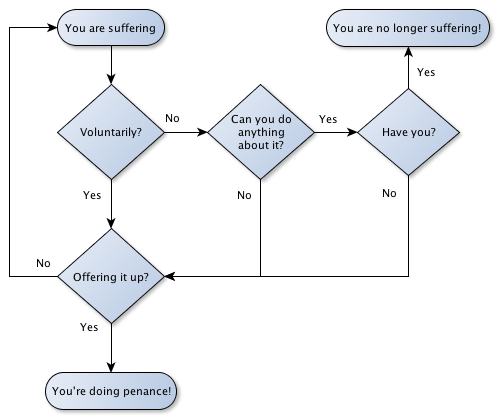
For Palm Sunday, here are some thoughts on suffering and penance, in the form of a flow chart.

penance.png

We all suffer every day, some of us a little, some of us a lot. Some of that suffering is unavoidable. Some of it we can prevent if we take a little effort, if not now, then later (in the meantime, it’s still unavoidable). Some of it is voluntary: we choose the suffering because it goes along with something else we want.

The point is, we can choose how we respond to it. If we offer it up to God, then we are still suffering…but we are also doing penance. If we don’t offer it up, then we’re just suffering pointlessly, and that’s a bummer.

Even if you’re not going out of your way to do penance, you’ll find you have ample opportunity if you just offer up the little sufferings and annoyances that pop up every day. And why waste them?

Humily != Low Self-esteem

John C. Wright comments on an article by somebody else about leading a spiritual formation class. The original poster has three times taught this class. Each time he has discussed besetting sins, and asked the class to list the sins they think most Christians face today. And the men in the class have listed internet porn, pride, lust, and anger; and all the women can come up for themselves is lack of self-esteem. Much discussion ensues.

It’s an interesting thing, but it’s not what I want to write about. (You can go look at it yourself.) What I want to write about is Wright’s response. He says this:

My comment: lack of self-esteem, sometimes called humility, is a feature and not a bug. Let a woman esteem herself for her virtue and chastity in her youth, for her maternal love and self-sacrifice after marriage, for her wisdom in her old age, but let her not esteem herself for the sake of self esteem, lest it swell into pride, which is a sin.

I think Wright is simply wrong here when he equates humility with lack of self-esteem. Humility isn’t thinking poorly of yourself. Rather, humility is a compound of two things: radical honesty, and self-forgetfulness. The truly humble person has come to terms with who he is relative to God. He sees himself clearly, both the good and the bad, and knows how much he must rely on God in all he does. But more than that, he thinks about God and about others more than he thinks about himself.*

But if the humble person knows he’s nothing in comparison with God’s majesty, love, and grace, he doesn’t sell himself short, either. He sees himself accurately. And while he knows that all his talents and skills are God-given, nevertheless he rejoices in the use of them.

Insofar as “lack of self-esteem” is a nagging, underlying feeling, a recurring worry that “I’m no good”, that “I have no value,” it may well be called a sin. Or, rather, giving into it may well be called a sin (feelings are not sins). God loves us, and He values us, even in our brokenness and poverty, and we are men and women made in His image and for whom he died. It’s a sin against truth, for if we are infinitely less than God, still we are his handiwork.

Humility is essential, say the saints; it’s a hallmark of true holiness. And it’s poorly understood, these days. But it’s something that you can rest in, not something that makes you feel bad.

I do agree with this part of Wright’s comment: “let her not esteem herself for the sake of self esteem”. There’s been a lot of hogwash talked about self-esteem, especially in the schools, over the last couple of decades; much has been done to build up the self-esteem of our children. But you don’t build up self-esteem by trying build-up self-esteem. It doesn’t work. At best you can build up a general feeling of self-love and entitlement with no basis in truth or accomplishment; which is to say, pride and greed. Real self-esteem needs to be based on real accomplishment, which requires work, and on a real sense of one’s own capacity. Telling everyone that they are equally capable is a pernicious lie.

* I am not describing myself here, more’s the pity.