The Four Elements

Everyone these days knows about the Four Elements of Air, Earth, Fire, and Water; heck, you can’t play your average fantasy-themed video game without running into them, from Pokémon right on up. Those foolish medievals, thinking things were made up of only four elements.

It turns out that what we think of when we hear Air, Earth, Fire, and Water, is not at all what the medieval philosophers meant by those terms. They were technical terms, as were their primary qualities; Fire, for example, is Hot and Dry, and those terms don’t mean what you’d think, either.

If you’re at all curious what they really did mean by them, Brandon has got you covered.

Sound vs. Sense

I’ve been a subscriber to Pandora for a couple of years now, and I really enjoy it. For those aren’t familiar with it, Pandora is a streaming music service that plays music based on seeds that you give it. The goal is to analyze the music you like, determine the characteristics that music has, and identify other music that matches the pattern and play it for you. I hasten to add, there’s no AI magic going on here; Pandora is based on something called the Music Genome Project, in which humans listen to songs and assess them relative to various qualities. For example, I asked Pandora why it was playing its current song. It answered:

We’re playing this track because it features electric rock instrumentation, ska influences, mild rhythmic syncopation, heavy use of vocal harmonies and many other similarities identified in the Music Genome Project.

And apparently I like all those things.

The interesting thing is that Pandora adjusts its notion of what you’ll like as it plays. You can give each song that appears a thumb’s up or a thumb’s down, and Pandora will use those assignments to better understand your preferences. And that’s a problem.

It’s a problem because Pandora can only assess the sound of a song, and not its sense. Once in a while a song will come along that I like the sound of, but dislike because of the lyrics—because the sense of the lyrics is egregiously immoral, or unpleasant, or simply repulsive. I can give it a thumb’s down, and Pandora will never play the song again, but I worry that Pandora will get the wrong idea. I’m objecting to the sense, and Pandora is going to assume that I’m objecting to the sound.

I don’t blame Pandora for this; it’s amazing that it does as good a job with the aesthetics as it does, and I expect that attempts to assess the sense in the same way would be unsatisfactory to everyone involved.

The reason I bring this up, though, is it seems to me that we listeners often judge music in the same way. We listen to the sound, and we ignore the sense. If it sounds good to us, we like it and we listen to it. What’s up with that? Where did the expectation that the sense doesn’t matter come from?

I’m no Tipper Gore; I’m not looking for parental advisory notifications or advocating a ban on music I personally find offensive. But why is it that we assume that popular music should be considered morally and philosophically neutral, when it manifestly is not?

Womb to Tomb

Today is Holy Saturday, when we remember Jesus in the tomb; and when one prays the Rosary, Saturday is also one of the days when you pray the Joyful Mysteries, which recount (among other things) Jesus’ conception and birth. (I gather that there are different rules for praying the Rosary during Lent; but I haven’t learned them. I simply go on praying the same pattern of mysteries that I pray the rest of the year.) So today I’ve been pondering Jesus’ life from womb to tomb. And it occurred to me that Jesus’ death was necessary, if he was to a human like us in all things but sin, because the quality of a human life can only be seen in retrospect.

St. Paul compares our human lives to a race, a race that ends only with our deaths:

Do you not know that in a race all the runners compete, but only one receives the prize? So run that you may obtain it. (1 Cor 9:24)

For I am already on the point of being sacrificed; the time of my departure has come. I have fought the good fight, I have finished the race, I have kept the faith. (2 Tim 4-7)

The letter to the Hebrews uses the same metaphor.

…let us also lay aside every weight, and sin which clings so closely, and let us run with perseverance the race that is set before us… (Heb 12:1)

Until you’ve finished the race, you don’t know where you stand in the rankings. How you run the race matters—”run that you may obtain it”—but clearly, finishing the race is essential. Jesus ran the whole race. Yesterday, on Good Friday, we remembered the moment He crossed the finish line. Tomorrow, we remember His entry into the Winner’s Circle.

We the living still have the race to finish. Thanks be to God! For in Christ’s victory we have the hope that we can not only finish it—any fool can do that, and will—but by His grace, can run so that we may obtain the prize.

Penance vs. Suffering

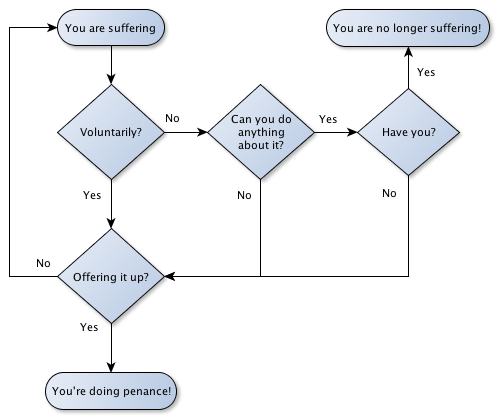
For Palm Sunday, here are some thoughts on suffering and penance, in the form of a flow chart.

penance.png

We all suffer every day, some of us a little, some of us a lot. Some of that suffering is unavoidable. Some of it we can prevent if we take a little effort, if not now, then later (in the meantime, it’s still unavoidable). Some of it is voluntary: we choose the suffering because it goes along with something else we want.

The point is, we can choose how we respond to it. If we offer it up to God, then we are still suffering…but we are also doing penance. If we don’t offer it up, then we’re just suffering pointlessly, and that’s a bummer.

Even if you’re not going out of your way to do penance, you’ll find you have ample opportunity if you just offer up the little sufferings and annoyances that pop up every day. And why waste them?

Just What Is A Soul, Anyway?

Ed Feser has a great post up about what it means to be human, and what it means to have a soul or be a soul. It’s precisely what I’ve been driving at with my discussions of natures and so forth, only Feser does it much better than I do.

I was especially interested by the last paragraph, which is to some extent tangential to the rest of the post:

I noted in a recent post that those beholden to scientism tend to reify abstractions — to abstract the mathematical structure of a concrete physical system and treat it as if it were the entirety of the system, or to abstract the neurobiological processes underlying human action and treat them as if they were the whole source of human action.

And this is true. Physics is the study of the physical world as measured. But when you’ve measured every aspect of, say, a steel girder, you don’t have a steel girder. You have enough information for a detailed CAD model of the girder (along with other physical variables), but not the girder itself. The subject of physics is the real world, but physics itself is an abstraction of reality, not reality itself.

7 Diversionary Tactics

Taylor Marshall outlines seven “arguments” you might run into that aren’t arguments at all, but are really just attempts to change the subject and derail the discussion. You’ve probably run into all of these at one or another, and you certainly know the name of at least one, the famous ad hominem. See if you know the others.

Sense Nonsense

I saw a pointer from Julie the other day about a book called Sense Nonsense: Fundamental Propositions Not Too Good to Be True, Just Too Hard to Accept, by Francisco J. Garcia-Julve. It sounded interesting, so I picked up a copy. It’s mostly a collection of statements intended to make you think about things. Many of them are intended to be (or at least to appear) somewhat paradoxical. And some of them are more interesting than others.

For example, I think this one is kind of light-weight.

As a rule, people care most about what matters least and care least about what matters most.

An interesting statement, and quite possibly true for the general run of people. Read one way, it’s an invitation to look for things in my life that I care about a lot that don’t really matter; read another way, it’s an invitation to look down on all those folks who don’t care about the things I think are important. But is it profound?

On the other hand, I quite like this one:

Going into prayer should not mean starting to talk with God but starting to only talk with God; neither should starting work mean stopping prayer, but just changing the subject of prayer.

Now, if only I could live like that I’d be all set.

I’ve not read the whole book yet—it’s not the sort of book you just read through from cover to cover—so I don’t know whether I like it or not.

A Fact of Life

The most basic rule of conduct is that practice makes perfect. If you want to be a concert pianist, you have to practice. If you want to grill the perfect steak, you have to practice. If you want to tie your shoes so that they don’t come untied and you don’t trip, you have to practice (for a while, then you get it).

But there’s more to it than simply practice. You have to be doing it right. Noodling on the piano for eight hours a day for ten years won’t make you a concert pianist.

If you want to be happy, you have to practice. And you have to do it right. It’s a skill. And the rules for how to do it right are what we call “morality”.

People who live for pleasure and object to moral rules on the grounds that they don’t let you have any fun are like the guy who spends all his time noodling on the piano but refuses to learn to read music or understand harmony and rhythm. He may think he’s having a great time, but all he’s producing is a noisy mess. How much more he could do if he buckled down to it!