
“If the human heart were satisfied with the world, then every day would be Monday, and all trains would be freight trains, and never the circus train.” — John C. Wright
Category Archives: Deep Thoughts
On Not Writing Much
Rick Saenz has an interesting post on the subject of writing less material for public consumption rather than more. I’d like to say that this is why I’ve been blogging less over the last year or so, and to a certain extent it’s true; rather than blogging as a daily habit, I’m blogging when I’ve got something I want to say. Whether I’m saying it all that well is another question.*
* Please don’t respond to that; I’m not fishing for compliments.
Memorial Day
My father, who passed away last summer, fought in the Pacific during WWII, as the Electrician’s Mate on a destroyer in Bull Halsey’s task group; he used to say that he was the only man on the ship who was willing to climb the mast. Which he had to, because there was a lot of equipment up there. His older brother commanded a tank in Europe, and participated in both the Battle of the Bulge and on Patton’s clandestine raid to save the Lippizaner mares from the Russians.
I have always admired their attitudes about the war. They were boys when the war began, and signed up as they were allowed to. They did intense physical training for the year or so leading up to that, knowing that they’d need to be in good shape to do well. They fought the war as assigned, and saw a great deal of action. They did their best.
And then, when it was over, they came home, and got married, had lots of kids, had successful careers, and just generally got on with things. The war was formative…but it wasn’t central. It formed them; but it didn’t define them. It was a job for which their services were required, and they did it like they did any of the jobs they took on during their long lives–with determination, perseverance, and all necessary skill. And when the job was done…it was done.
And for those who never had the chance to just generally get on with things:
Eternal rest grant unto them O Lord, and let light perpetual shine upon them; and may their souls and the souls of all the faithful departed rest in peace.
Dancing With Jesus
The Christian life is like dancing with Jesus. He must lead and we must follow, for only dimly can we hear the music, and the steps are beyond our ken. If we try to lead ourselves we are lost; but if we follow diligently we will learn to dance with grace. In time we might even begin to dance with flair and joie de vivre.
But as we master the steps–as we grow in holiness–so too the dance becomes harder and more complex, and often more painful as well. It is not always pleasant to dance with Jesus. But if we follow as he leads, the dance we dance will be of great beauty for those with eyes to see, and there will be joy in our hearts.
Who Owns the Truth?
The Maverick Philosopher says,
The truth is too magnificent a thing to be the the property of any one institution. Too magnificent a thing, and too elusive a thing to be owned or housed or patented or reduced to the formulas of a sect or finitized or fought over.
In two senses I agree with this, and two senses I do not.
The ultimate truth, worthy of being called Truth with a capital T, is God Almighty. God is infinite, not to be grasped by our limited intellects; and God is certainly not the property of any institution.
More than that, the full truth even of this universe we live in is beyond the grasp of our intellects; though God knows it perfectly. Again, this truth can’t be the property of any institution.
On the other hand….
It’s certainly possible to have a greater or lesser grasp of the truth, in either of the two senses discussed above. Some institutions will have a better grasp of the truth than others. It’s not unreasonable to think that some institution, somewhere, might have a better grasp of the truth than any other. (It’s also not unreasonable to think that many institutions might each have a corner on some particular aspect of the truth.)
Now, suppose God, Infinite Truth, decides to take a hand in things. Suppose He reveals what we need to know. Suppose He guarantees that some institution, specially blessed by Him, will preserve that revelation intact for future generations. I wouldn’t say that this truth is the property of such an institution; it would be better to say that it is held in trust. But surely, in such a case, if such a case there be, it is true to see that this institution has the truth.
And this is precisely what the Catholic Church claims for itself; and this I believe.
I take one further exception to the MP’s statement: that the truth is too magnificent a thing to be fought over. It’s true that fighting a single combat or a war is no way to determine what the truth is. But good grief! If you can’t fight for the truth, what can you fight for?
Oh, What A Feeling!
We think of happiness as an emotion: I feel happy today. But there’s a sense in which happiness is simply an objective state. For example, I have a job, and so am able to take care of my family. That’s a happy situation. I am much happier than if I had no job, and were not able to take care of my family. And that’s independent of whether I feel happy or not, or whether I actually feel like going to work or not.
It’s Supposed To Be Good For You
So there are the things we want that don’t make us happy for long, and then there are things that are supposed to be good for us: a healthy diet, and plenty of exercise, and eating green leafy vegetables that taste bad, and not eating things that taste good. Few of us look forward to doing what’s good for us.
There’s something odd about that. If something’s good for us, it leaves us in a better state than we were beforehand. And certainly, being in a better state ought to make us happy.
And in fact, it does. The trouble is, it sometimes takes a while.
Trial and Error
What do we really want? That which will make us happy. But what is that? We don’t seem to know for sure. So we try things. I will eat this slice of cake. I will buy that iPhone. I will go on a trip to Maui. I will spend the evening drinking Long Island Ice Teas with my friends. I will get a new job. I will get married. I will get married to somebody else. I will earn more money. I will steal more money. I will get a fancy house.
Many of these things we try do make us happy, for a while; some do not. Some make us happy for a while, and then very unhappy. Some last for a while, but then they are over. Others last longer, but we get tired of them. Some of them are genuinely good things so far as they go; but they don’t go far enough. Some turn out to be bad things all the way around.
It seems that there are different kinds of good things, and that none of them are satisfying in the long run.
Happiness Fail
We spend all our time looking for happiness, for years on end. Seems like we’d be better at it by now. Why isn’t practice making perfect?
On Creation
When we say, “God created the heavens and the earth,” what does that mean?
For the sake of simplicity, let’s talk about just that part of creation that’s apparent to us: the universe that surrounds us. We can diagram it like this:
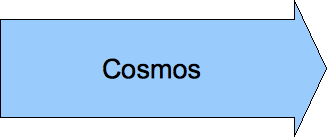
It is the entire cosmos, from the beginning of its existence and stretching onward through time: open space, galaxies, stars, planets, oceans, continents, plants, animals, and us. Some would be content to leave it at that. But as Christians, we believe that this grand expanse is the result of an act of creation ex nihilo, from nothing, by God the Creator. What does that mean?
The following diagram represents a view that’s quite common; it’s certainly the mental image I grew up with:

Here, God created the world, with all of its natural laws, and set it to going back at the beginning of time. Since then it’s been running more or less on its own, ticking along like a well-designed clock, neither requiring (nor, in a strict view, allowing) further divine input. The strict form of this view is called deism, which, as it denies miracles, an orthodox Christian must deny in turn; but allowing for the possibility of miracles, I think most of us tend to think of creation in just this way.
And yet, this image is severely lacking. It implies that God exists in time, and that Creation, once created, is no longer dependent on God. But we know that God exists outside of time, in Eternity; that the entire universe, all that is, from the beginning of time on into the future, was created as a single divine act. Consequently, the following is a much better image:
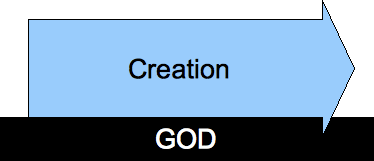
Here we see that God is not that which wound up the universe and set it going; rather, God is the ground of existence for everything that is, at every point in time. Creation is not something that happened “way back then”; creation is what allows the present moment to exist right now. The universe isn’t a clock, that ticks along on its own; the universe is a symphony, composed, scored, conducted, and played by the Lord. And he is present and active in every note.
The glory of man is that we are called to join the orchestra and play along: to allow Him to play through us.
 The View from the Foothills