The Idiot from Out of Town

Usually when there’s something we need to know, we go looking for an expert. These days, that expert is often on-line, and we often find him or her via Google, Wikipedia, or YouTube. There are a lot of experts on-line these days, and most of us have learned to be a bit cautious before deciding who we’re going to listen.

There’s an old maxim that says an expert is just an idiot from out of town. He’s supposed to know his business, and you don’t know anything about him, and you aren’t an expert in his field, so you assume he’s got the real goods. (This is probably a corollary of the Gell-Mann Amnesia Effect.)

But does he? Maybe not.

There’s a whole flock of new experts in town, these days. ChatGPT is the most famous, but there are a bunch of them based on the same Large Language Model (LLM) technology. Folks are expecting great things of these programs, and they are getting built into all manner of applications and websites.

But is ChatGPT actually an expert, or just an idiot from out of town? It’s called an AI, an Artificial Intelligence, and it’s pretty amazing; but it isn’t actually intelligent. It has no judgement; and as many folks have seen, it’s quite willing to make stuff up when it doesn’t know the answer.

And where does it get its answers? Well, from the data it’s been trained on. And where did that data come from? The Internet.

The Internet.

Think about that.

There are many fine pearls on the Internet, but those pearls are surrounded by cheap costume jewelry, all of which is embedded in hearsay, nonsense, and manure. How well did ChatGPT’s trainers do at weeding out the trash? We don’t know. And how did their biases affect their choices? We don’t know.

I’m not saying that apps like ChatGPT are without value. I expect that the day will come that they make fine research assistants—provided you’re willing to add the human judgement to their search results.

But experts? No more so than any other opinionated lore-master on the Internet.

____

Photo by Joshua Sortino on Unsplash

Retrospective: Mavica FD83

My second digital camera was a Sony Mavica FD83—that is, if I recall correctly; googling around, I see that it might have been an FD81. Either way it was a step up from the Mavica FD5 it replaced. At least, I thought it was.

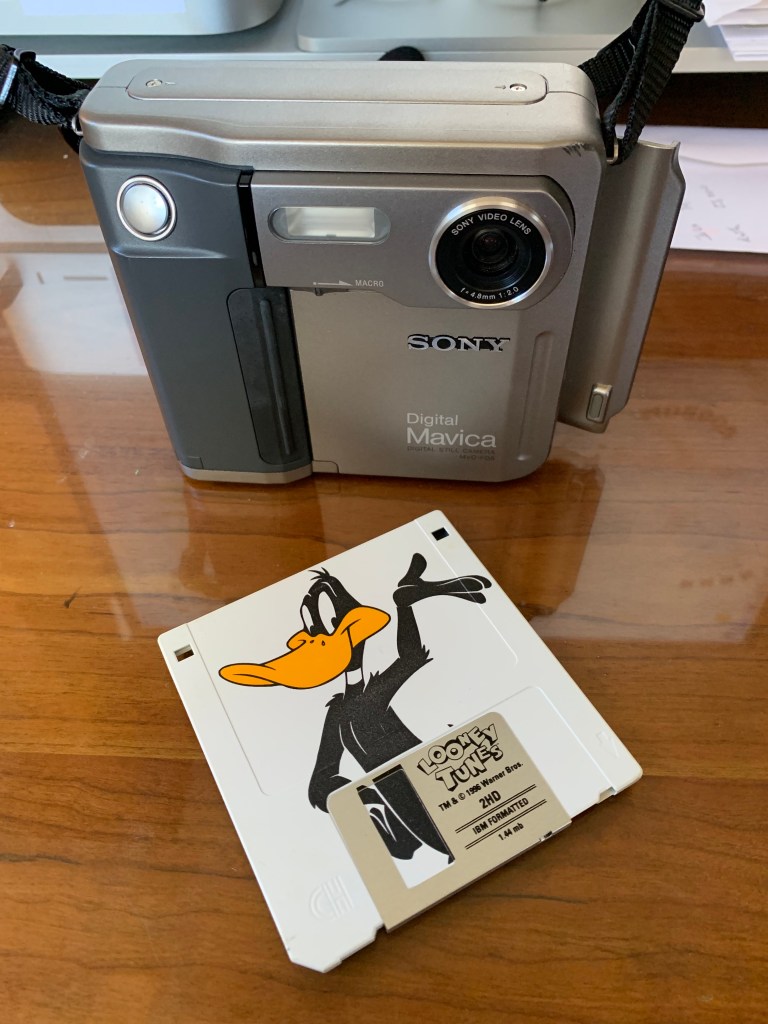
Sony Mavica FD83

Like the FD5, it saved JPEGs to an internal 3.5” floppy drive; but the FD83 had two big improvements.

  • It had a 10x zoom, which was amazing.
  • It took 1-megapixel images! Three times as many pixels!

Alas, it was the increase in resolution that was its undoing. The FD5 could get 24 or 30 shots on a single 3.5” floppy disk; at its best quality setting, the FD83 could get maybe 7 shots.

To put it another away, I could pack up the FD5 for a day of shooting, bring 10 floppies (I had a little belt pouch for them) and bring home up to 300 or so pictures. Shooting with the FD83, I could only bring home 70.

For vacation shooting, that was a real come down…so of course I turned the quality to its lower setting so I could get maybe 20 images per disk.

This, alas, was a huge mistake. I first noticed how bad a mistake it was at Bryce Canyon in Utah, when I took this beautifully composed shot.

You notice those wavy lines around the branches? The ones that look almost like heat haze? Those are JPEG compression artifacts. JPEG is a lossy format, and if you compress the image too far it looks lousy.

Or maybe you can’t see them; current software is making the picture look far better than than it has any right to. It didn’t look nearly that good back in the day. But here’s a close up.

I discovered this standing on the rim of Bryce Canyon, where I looked at the captured image on the back of the camera and tried to figure out what was wrong with my beautiful new camera.

Sigh.

Retrospective: Sony Mavica FD5

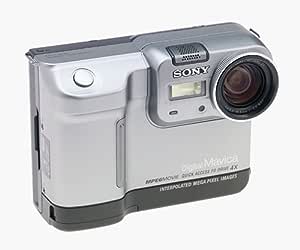
Sony Mavica FD5 Digital Still Camera

The first camera I ever bought for myself is the one in the picture above: a Sony Maniac FD5. I’d had film point-and-shoots before, Kodak Instamatics that consumed 110 film and flashcubes (remember flashcubes?), and for a brief while I used a 35mm point-and-shoot; but the Mavica was the first camera I spent any significant amount of time with.

The FD5 was one of the first truly popular digital cameras, and it’s easy to see why—if you’ve got a long memory and you squint a bit.

It was basically a video camera (notice the words “Sony Video Lens” on the lens) that had been modified to capture the current frame as a still and save it as a 640×480 JPEG file. Better still, it saved it to a 3.5” floppy disk.

640×480 pixels—that’s about a third of a megapixel. And 3.5” floppies. No real exposure control, though I do see a “MACRO” control there on the front, under the flash. You composed your picture on a small screen on the back (like many cameras to this day), and pressed the shutter. There are buttons on the back labeled “Brighter +/-“, but if I recall correctly they didn’t adjust the exposure, just the brightness of the screen.

Dirt simple; just a digital point-and-shoot.

(!) And yet, it was incredibly compelling. My friend Steve got one (actually, I think he had the FD7, which had a 3x zoom lens), and I couldn’t wait to get one of my own.

Mind you, my eldest child was 8 months old and about ready to start walking; that might have affected my decision.

David, teaching himself to stand on the lawn at the Huntington Gardens.
He never crawled, he just got up.

So what was so cool about the Mavica as opposed to other digital cameras of the day?

There were two things, and both of them came down to that 3.5” floppy in the foreground.

The first digital cameras stored your photos in on-board memory—which was strictly limited. And when you filled it up, you were done. You had to download them to a computer using a cable of some kind—let me repeat that, of some kind—and clear the camera’s memory before you could take any more pictures.

SD Cards, which are ubiquitous now, were years away. Sony eventually released something they called a MemoryStick, that shortly thereafter went the way of the Betamax, as did the CompactFlash cards everyone else used; but even those didn’t exist yet. (To make it painfully clear how far off these cards were, I’ll note that Sony eventually found it reasonable to sell a Mavica with a built-in CD-R drive. Yup, it recorded your photos to a CD-ROM.)

So if you bought one of these other cameras, you were going to be connecting a cable to your computer. And that was the second problem.

In those days most computers had two kinds of interface: serial and parallel. These were mostly used for connecting printers. If you wanted to connect something different, you often need a special interface card, which you added to the expansion bus in your computer’s tower case. Or, if you had a laptop, and if your laptop had a PCMCIA slot, you might be able to get a PCMCIA card that would provide the necessary connection.

So let’s recap:

  • You could only record a few pictures before going back to your computer.
  • You probably needed some weird kind of interface adaptor to connect it up.
  • And given that, you might only be able to connect it to a single computer.

In short, the Mavica’s competitors did not seem (to me, at the time) like cameras I’d want to bring along on family excursions and vacations.

But the Mavica recorded to 3.5” floppy disks…which were cheap. And you could read them on pretty much any computer of the day (and pretty much any computer going forward, for all that we knew). They were like rolls of film, only better: you didn’t have to send them to a developer for processing. And you could easily bring enough along for a long vacation, or buy more if you needed them. And then, once you’d copied the photos to your hard disk you could reuse the floppies!

I took a lot of pictures with the Mavica, and kept a lot of memories. If I’d used a film camera to capture that shot of David standing for the first time, the picture would probably be in a drawer somewhere. But this picture is still on my hard drive; I was able to pull it up in just a few moments.

Mind you, the image quality isn’t all that, not even compared to cameras that came just a few years later; but hey, a lot of Instamatic snapshots weren’t that great looking either. As it is, the Mavica got me started with photography as a serious hobby, and though I can’t imagine using it now I’ll always be fond of it.

Learning to Show

I returned to photography last April after a six-year hiatus, and I find my focus has changed. I wrote recently about Learning to See, about seeing pictures as I walk about the world. The next step, then, is learning how to finish the image so that others can see what I saw.

Here’s an example. At the entrance to the Getty Center on top of the hill there’s a terraced slope; and on that slope there’s a sculpture of a boy holding a frog by the leg. I took a few pictures; here’s what one of them looked like straight from the camera.

Boy with Frog, Initial shot — OM-1, 14-150mm

The thing about the sculpture is that it is shockingly white, even in the context of the Getty Center where the white of travertine marble is the defining architectural element. It’s so white it seemed to glow in the sun as people streamed by on their way up the stairs from the tram stop.

The eye and brain have an uncanny ability to focus in on the thing of interest, and ignore the rest of the scene; the camera isn’t so blessed.

Back in the day, Ansel Adams wasn’t simply skilled at shooting scenes; he was a skilled print maker. Making a classic print is more than just putting a negative in the enlarger and shining a light through it onto some photo paper. Adams had many techniques he could use to make certain parts of the image stand out and other parts recede, and he usually knew when he exposed the negative just what he would want to do in the darkroom to produce the picture he saw in his mind’s eye.

It was a lot of work; and he had to repeat those steps for every single print he made, which makes my mind boggle.

The digital photographer has the same task, except that he only has to do it once: develop the picture so that it shows what he saw.

In this case I wanted to show the glow, as it were; and I wanted to emphasize the sculpture.

First I reframed it. I try to get the framing right in camera, but the right framing isn’t always obvious in the moment (I ain’t Ansel Adams). Then I darkened the whole thing to extend the range on tones on the sculpture, and to de-emphasize the visitors in the background without quite eliminating them. That left a few bright spots that I found distracting—sun on the handrail and on one woman’s hair—so I masked and darkened those.

And here it is. Here’s what I saw, in the busyness of the visitors and the brightness of the day.

Boy with Frog, Final shot — OM-1, 14-150mm

I’ll never be Ansel Adams; but I’m beginning to learn how to “print”.

Learning to See

Some photographers work in the studio, using elaborate lighting setups. Some photographers work in the wilds; their decisive moment is when the sun crests that hill right there. Me, I like to go for walks and see what I see.

Normally when I go for a walk I spend it deep in thought—but with a camera in my hand everything changes. With a camera in my hand I start looking, seeing what’s there.

St. Francis — Fujifilm X10

St. Francis, there, drew me back into photography after a six-year hiatus. I saw him standing there in the morning sun, surrounded by flowers, and wanted to keep him. I took down a camera that had been sitting on the shelf for six years—I had to charge the battery—and the next morning I got the shot.

Serendipity is the name of this game. As I walk, eyes open, I see what might be an interesting composition. It might be a new angle on something familiar. It might be a tree with an interesting arrangement of branches. It might be an object, deeply in need of a pair of googly eyes.

Grommit — Olympus OM-1, 14-42mm

And then I’ll switch on my camera and do my best to capture this thing that I see, whatever it is. I might take a quick snap or two, or I might work the subject for a while.

Most pictures, by the nature of things, turn out not to be all that interesting when I get them home and take a look at them. Sometimes that’s all on me: I bungled the framing or the exposure or some such. Sometimes the scene just isn’t as interesting as I thought. Sometimes I just failed to capture the interesting bit.

But sometimes it all works out.

Accidental Heretics and the Power of N

Last week I wrote a post in which I purposely used the emotionally loaded term “heresy” in its precise technical sense. And I did this not because I wanted to slam Evangelicals (I like Evangelicals) but because it’s a useful word, and I because I planned to say more about it.

The essential thing about a heretic isn’t what they deny, but what they affirm. Bishop Arius held that the Son wasn’t of one being with the Father, but was the first and greatest creature in all of creation. In saying this, he wasn’t so much trying to drag Christ down, but rather to protect the status of the Father as the one true God. He was mistaken; but he was mistaken because he took the part of the Gospel that he understood best and judged to be the most important and upheld to the exclusion of other Gospel truths.

I think we are most of us in the same position, even those of us who have every desire not to dissent from Church teaching. I think it’s unavoidable. We are parts of the Body of Christ, and different parts of the body have different functions. (I have sometimes thought that the Catholic blogosphere is the spleen of the Body of Christ.) And each body part is naturally most concerned with its function. You can’t blame a hand for being all about grasping. You can’t blame a nose for smelling.

Given that each of us has a call and particular gifts in support of it, we naturally emphasize it, and the theology that goes along with it. And that will naturally lead us, if we aren’t careful, into a kind of accidental heresy. I don’t mean anything intentional, mind you: but there it is. And when birds of a feather flock together, as they so frequently do, we can be strengthened in our accidentally heretical views of the world. I believe it was Chesterton who described orthodoxy as a kind of balancing act: and keeping your balance can sometimes be next to impossible.

So let’s think about this from Jesus’ point of view. You’ve come to Earth as a man, God-incarnate. You are, yourself, the fullest revelation of God to his people. You bring the Deposit of Faith, with the intent that it be passed down from generation to generation. And you’re dealing with people who are inclined to go off of the rails, even when they give you all of their love and devotion. What do you do?

What Jesus did was, he gave it to a group. And those apostles appointed successors, the first bishops, and passed on the Deposit of Faith to them. And they passed it on to their successors.

Now, each of these men was just a normal human being, and each of them had the same tendencies I described above to emphasize the parts that were most important to them, personnally. So how is it that the Deposit of Faith gets passed down without error? The Holy Spirit, of course, ensures that it will be; we’ve been promised that. But I’ve noticed that Jesus likes to work through simple human things. And here’s the thing about a group: individually, the members might go astray, but collectively they can correct each other. Bishop X emphasizes this while Bishop Y emphasizes that, and so both points of view are preserved. And when Bishop A goes too far and leaves the rails, bishops B through Z can call him on it.

It’s rather like a radio tower with guywires on all sides. Each wire pulls the tower in its direction, but collectively the tower stands vertically and can withstand the winds. Our natural tendency to emphasize one thing and ignore another becomes not a source of division, but a source of strength. I love it when that happens.

The Heresy of Evangelicalism

OK, so you’ve read the title of this post and gotten entirely the wrong idea. That’s the problem with provocative titles; you lose people. So lemme ‘splain.

Heresy, properly understood, isn’t simply doctrinal error. Buddhists disagree with Christians about all sorts of things, but Buddhists aren’t heretics. More precisely, Buddhists aren’t Christian heretics: to be a heretic, you have to be a heretic with respect to something. Given that I’m a Catholic, and therefore believe in the Catholic Church’s teachings as the norm for Christian orthodoxy, Christians who dissent from the Church’s teachings are to some extent heretics. (That’s a technical description I’m making, not a moral judgement. The one person I’ve met who struck me as possibly being a genuine saint was an evangelical Anglican. She ate, drank, and slept intercessory prayer in a quite remarkable way. It really is who she was.)

But even in that context, heresy isn’t simply doctrinal error; it’s a particular kind of doctrinal error. Heresy involves taking one part of the truth to extremes, so that you abandon some other part of the truth. The Arian heretics emphasized the glory of the Father to such an extent that they refused to believe that Christ was truly God; rather, he was the greatest of all created beings.

In short, the interesting thing about a heresy, and the thing that drives everything else, isn’t so much what the heresy gets wrong, but what the heresy gets right.

In reading Sherry Weddell’s Forming Intentional Disciples, and in interacting with others who have read it, it’s clear that Evangelicalism is doing something right. Catholics who leave the faith usually leave either for no faith at all, or for some variety of Evangelicalism; and the latter usually leave because they’ve had a personal encounter with the rised Christ and nobody around them in church seems to get it. Then they meet an Evangelical, and personal encounters with Christ are a thing for them. They get it.

And then, many converts to Catholicism (or reverts, like me) have been greatly influenced by Evangelicalism. The Episcopal (later Anglican) congregation to which I belonged had a very Evangelical flavor to it, and my formation as a disciple owes a great deal to that. It’s through that experience (and others like it, earlier in my life) that I came to understand the importance of being a disciple. Mind you, I don’t feel like I met much success at it until I returned to the Catholic Church, and found all of the needed tools (the Divine Office, the aid of the saints, and most especially the Eucharist) ready to hand. It’s as though God’s using Evangelicalism to teach Catholics what discipleship means.

And so I think that discipleship is the truth that Evangelicalism is based on, the truth that gets emphasized so much that other truths are suppressed, or, at the least, ignored. They get discipleship right—very, very right. It’s a tribute to the loving power of Christ that it works so well for them in the absence of the helps I mentioned above. And it’s equally a tribute to the loving power of Christ that the Catholic Church is doing as well as it is without a strong emphasis on discipleship. I hope that with Christ’s help we’ll be able to change that.

On Kerfuffles

So recently there’s been a kerfuffle in the Catholic part of the blogosphere. Somebody made some harsh and uncharitable remarks about a Catholic organization that’s doing good work. Someone else called the first party on their harsh and uncharitable remarks, and defended the Catholic organization. Others are now criticizing the second party for his criticism of the first party, and anyway the second party hates Catholics like the first party and the Catholic organization is icky.

You’ll note that I’ve not given any names or links here, first because I don’t want to add to the feeding frenzy, and second because while I have my own sympathies with certain of those involved I have very little information of my own about the actual circumstances, and would be just repeating hearsay.

And third, and most important, I could have written the above two paragraphs at almost any time in the last five or ten years. This sort of thing goes on all of the time. And that’s what I want to write about: not the facts of this case, but about an attitude that can be spiritually corrosive.

Many years ago my then pastor told a story about a government agent who investigated counterfeiting operations and gave a talk about it. Someone suggested to the agent that he must spend a lot of time studying counterfeit bills. He said, no, he didn’t. Counterfeit bills are all different. Instead, he spent his time studying real bills so that he could readily see any differences.

My then pastor drew the moral that if we want to be able to spot falsehood we have to be thoroughly familiar with the truth. And that’s good advice, I think, but I want to extend it a little further.

As on-line Catholics, we can spend our time writing about what is true, good, and beautiful, or writing about what is false, bad, and ugly. We can look for uplifting links to share or for horrible things to castigate.

I’d like to suggest that we only do the former—but I won’t. We need to stand against error where we find it, and that will sometimes involve being critical. Standing against error isn’t spiritually corrosive.

But I would suggest that a constant and single-minded pursuit of error in order to stand against it can be. It can lead you to see error where there is none, or at the least to magnify molehills into mountains if it’s a slow news day. And if you’re spending all of time looking for errors, you can begin to forget what the truth looks like.

Don’t just stand against the false, the bad, and the ugly. Stand for the true, the good, and beautiful, not simply in principle but also in practice. It’s better for you, and you’ll have less to repent of.

On the Proper Use of Terms

I was reading a thread on a Catholic forum about how the various people on the forum came to the Catholic Church. One lady objected to the use of the term “convert” as a general term for people entering the Catholic Church. In her view, only those who have never been baptized before are truly “converts”; those who were baptized in another Christian denomination are “entering full communion,” but are not converts. In other words, you can’t convert from Christianity to Catholicism because Catholics are Christians.

Now, I take her point—and I must emphasize that she was not at all strident about it. She just thinks that it’s a good distinction to keep in mind, and I agree, it is. The trouble is, the word “convert” has multiple meanings in the religious context, and one of the most common ones is “a person who entered the Catholic Church as an adult”, without regard to the tradition from which they came. Any attempts by a single person to redefine the word to suit themselves are going to lead only to frustration.

I saw a similar phenomenon on a blog I stumbled across a few weeks ago. The blogger was distressed because Pope Francis had referred to “gays”. In her view, the word “gay” means not only homosexual preferences, but also participation in a sinful lifestyle. The proper word for a Catholic to use when speaking of the former but not the latter, according to her, is “same-sex attracted”, and somehow by using the word “gay” in the way he did the Pope had stepped over some kind of line. (I’m not at all sure I completely understood her reasoning.)

When you’re writing an essay or an article or a blog post or a book, you’re naturally free to use terms however you like, provided that you’re careful to define your terms. In philosophy this is particularly common, and particularly necessary, because so many of the terms are heavily overloaded. (Note to atheists: when St. Thomas Aquinas proves the existence of God from motion, the word “motion” doesn’t mean what you think it does.)

And the same applies to commenting on forums or in comment threads: if you want to be understand, and you use a fuzzy word, you need to make it clear what you mean.

But to insist that a word in colloquial use must always have your preferred idiosyncratic meaning, and to stand athwart the world and cry “Stop!” when others use it in the normal colloquial way, is simply a waste a time.

(Oh, and a note to all of the entomologists out there: spiders are bugs. So are bees, scorpions, silverfish, millipedes, centipedes, and anything else creepy-crawly with more than four legs. Deal with it.)

Perverse Aesthetics

I’ve got a couple of nephews who delight in “bad” movies. It seems that they’d rather watch “bad” movies to the exclusion of good movies, and in the last few weeks we’ve had a sequence of Saturday afternoon film-festivals at my house in which one of the nephews shares his favorite “bad” movies with my two boys and my friend Ian, and vice versa. And so I’ve been pondering the notion of “bad” movies and of enjoying “bad” movies. by “bad” movies, of course, I don’t mean morally bad; I mean poorly executed or poorly conceived, MST3K-style bad, Plan 9 from Outer Space bad, Attack of the Killer Tomatoes bad.

I don’t have any finished conclusions, mind you. I often have to write stuff down to figure out what I think. But I’ve got some ideas and some questions about aesthetics, and where the goodness in movies is found, and what it means to enjoy a movie, especially a bad one. Please forgive me in advance if I go on a bit.

Let me climb up on my high horse for a moment. I promise I’ll climb back down afterwards, and if you leave me up there in the saddle you’ll go away with the wrong impression.

I’m somewhat bothered by the idea of habitually watching movies simply to make fun of how ineptly they are acted, directed, or conceived. It seems to me that rejoicing in another’s lack of skill or understanding is, in the long run, spiritually and morally corrosive. It ain’t good for you. It’s like schadenfreude: we all give into it sometimes, but if we were better people we wouldn’t. And there’s an attitude that goes with it: a determination to find things to belittle and mock.

I’m reminded of Uncle Screwtape’s division of the sources of laughter into Joy, Fun, the Joke Proper, and Flippancy. Of these, flippancy is the problem: it’s laughing at something for the sake of laughing at it, of treating it as funny whether it’s funny or not. It’s a laughter that masks something darker:

Among flippant people the Joke is always assumed to have been made. No one actually makes it; but every serious subject is discussed in a manner which implies that they have already found a ridiculous side to it. If prolonged, the habit of Flippancy builds up around a man the finest armour-plating against the Enemy that I know, and it is quite free from the dangers inherent in the other sources of laughter. It is a thousand miles away from joy: it deadens, instead of sharpening, the intellect; and it excites no affection between those who practise it.

Time to climb down. That doesn’t seem to be what my nephews are doing. As I watch them watching movies with my kids, they all seem to be having a good time. The laughter isn’t forced; they see things on the screen and are honestly moved to laughter. There seems to be a good deal of Fun in the air:

Fun is closely related to Joy— a sort of emotional froth arising from the play instinct.

And maybe even some Joy, too. Certainly it is exciting genuine affection between my nephews and my sons, and on Lewis’ definition it avoids the charge of flippancy.

So what’s going on, then?

First, it is beyond question that my nephews are watching these movies and enjoying them. And that means that there’s something there to enjoy: the movie, though a “bad” movie, has some goodness to it. Clearly it’s not the goodness the movie-makers intended, but there’s something there that is genuinely funny or entertaining, if you have eyes to see it.

…if you have eyes to see it. Now I think we’re getting closer.

Some twenty years ago, I remember being in a Usenet discussion of what it means for a book to be a good book. The notion of there being any kind of absolute scale of literary goodness was swiftly eviscerated by the other participants; beauty, I was told, is in the eye of the beholder. What you like is what you like; don’t try to make more of it than that.

I didn’t understand, then, that there is an absolute standard of beauty, God himself; things are beautiful to the extent that they express some aspect of his majesty and glory. But I digress; that’s a big topic, too big to shoehorn in here. I’ll simply note that I’m not saying that art is beautiful only insofar as it is explicitly religious. Far from it.

What was clear to me at the time is that each genre has its own aesthetic. A mystery novel is a good or bad mystery novel based on the aesthetics of that genre. A whodunnit in which the murderer is not found and the crime is never solved isn’t much of a whodunnit, though it might be a successful novel on other grounds. And similarly, a novel might be very successful as a whodunnit even if it fails purely as a novel. Some whodunnits are simply carefully contrived logic puzzles; plot and characterization are secondary. (I tend not like these, myself.)

And then, of course, some authors write gloriously well, some write adequately, and some are so awful you wonder how they got published. (In the interests of not being flippant, I’ll name no names.) There is a scale of goodness; in fact, there are multiple axes of goodness.

The point is, though, that when addressing the quality or lack thereof of a creative work, you need to consider which aesthetic to apply—and especially, you need to consider the aesthetic used by the creator. It’s no use criticizing a book according to the aesthetics of the romance genre when the author was intending to write a sci-fi thriller. Science fiction novels are notorious for whirlwind romances, where proximity leads to true love in next to no time, but that’s just to add a little love interest to a book that’s about something else.

Nevertheless, some books do succeed according to multiple aesthetics. One could list many, many works of genre fiction that are not only outstanding science fiction or mystery or romance novels, but are simply outstanding novels. If it makes no sense to ignore the creator’s aesthetic, it also makes no sense to ignore other aesthetics, if they apply.

So back to “bad” movies. The director had some aesthetic in mind (one hopes) and for whatever reason failed to achieve it. Perhaps he was too ambitious. Perhaps he was incompetent. Perhaps he was bored and careless. Perhaps he was simply meeting a contractual obligation. Perhaps he did the best with what he had. Perhaps he simply set his sights very low, and excelled at meeting his goals. (I understand that the original Little Shop of Horrors got made that way.)

And then, my nephews are applying a different aesthetic, and enjoying the movie because of how well that aesthetic applies. So what does that aesthetic look like?

In The Producers, Zero Mostel and Gene Wilder famously try to produce a Broadway show that is so horrible that it will close after the first night, leaving them with all the dollars. Instead, it’s a hit. The audience assumed that it was meant to be a campy comedy, and judged it as a campy comedy, and judged it hysterical. The producers failed of their aim, but produced a show that succeeded according to a normal aesthetic. They meant to be painful, and succeeded at being funny.

That doesn’t seem to be what’s going on here, though. My nephews truly seem to delight in these films not because of their successes, but precisely because of how they fail. There’s a sort of perverse aesthetic involved here: the movie is enjoyable precisely because of how far it falls short. It seems to be a rejoicing in what is truly bad rather than what is good.

And so I’m left to wonder: is that mean-spirited? Is over-indulgence in this spiritually corrosive? And if so, is occasional indulgence spiritually corrosive? Or is this all good clean fun?

Don’t get me wrong; I’m not looking for reasons to drop the hammer. I’m simply a bit puzzled.