
Under Enemy Colors

Sean Russell, author of The Swans’ War series among other fantasy novels, has begun to turn his hand to historical fiction under the name S. Thomas Russell. His first outing is Under Enemy Colors, a tale of the Royal Navy in the age of sail.

The tale begins shortly after the French Revolution has devolved into a Reign of Terror. The protagonist, Charles Saunders Hayden, is a lieutenant in the Royal Navy. Born of an Englishman and his French wife, Hayden was raised in both England and France and speaks both languages as native tongues. He was in Paris in the days of the revolution, and supported it with joy…until he saw the mob chasing down and killing men guilty only of the slightest rumor of wrong-doing.

Hayden’s English father is long dead; he has no patron; and so his naval career is stalled. Given his skills and accomplishments (he is, of course, a consummate seaman) he should be made a captain; instead, he is offered a position as First Lieutenant to the incompetent, wrathful, and cowardly Captain Hart, whose crew is on the verge of mutiny.

All of this is familiar territory. The question is, how does Russell stack up against those who have ploughed the same stretch of water?

The plot is perhaps somewhat hackneyed: incompetent and detested captain, check, competent and admired subordinate, check, surly, dissatisfied crew, check, the Rights of Man, check, mutiny, check, heroic deeds, check, court martial, check, vindication, check; given the premise, it could hardly go any other way. When one sits down to a book of this kind, one knows what one is getting. But not all sea voyages from hither-to-yon are created equal, and it’s the scenery and incident along the way that make the trip.

On the whole, I have to say that I think he’s a better writer than C.S. Forester. Hayden strikes me as a more complex character than Horatio Hornblower; with his mixed parentage he is indeed a kind of composition of Jack Aubrey and Stephen Maturin. He’s also better, I think, than Alexander Kent, author of the Bolitho series. On the other hand, he’s not Patrick O’Brian…but no one is, so that’s hardly surprising. (NB: I read O’Brian before I read Forester; perhaps if I’d read them in the other order I’d have a higher regard for Forester. As it is, I found him lacking.)

The second book in the series, A Battle Won, is due to be released in hardcover this August. I’m looking forward to reading it, though probably not until it comes out in paperback.

Victorious

Jack Campbell has at last finished his Lost Fleet series with The Lost Fleet: Victorious, and yes, he sticks the dismount.

It’s hard to review the last book in a series without giving important details away, but I shall try. First, since I’ve not reviewed most of the intermediate books, the premise. As the first book begins, the Alliance Fleet arrives in the capital system of the Syndicated Worlds, intending to take them by surprise, destroy their fleet, and end a war that’s been going on for the past century. But it’s a trap. The Syndics are expecting them, and most of the Alliance fleet is wiped out, along with its admiral. The captain with the greatest seniority is one John “Black Jack” Geary. But Geary’s situation is a little unusual.

In one of the opening battles of the war, Geary, then a lieutenant, takes acting command of his heavily damaged ship after the captain is killed. He sends off most of the crew into escape pods, and keeps fighting the ship until the last possible moment. He barely manages to reach an escape pod, which puts him into hibernation until such time as he can be recovered. But the Alliance was forced to flee the system, and in fact his pod is not recovered until a century later…by the Alliance Fleet on its way to the Syndics’ capital system. During his hundred year sleep, he discovers, he has been promoted to captain, and turned into a legendary hero. He’s the senior captain, all right: 100 years of seniority. But he has only commanded a ship for a matter of hours.

And yet, with all his inexperience he’s in many ways more experienced than anyone else in the fleet. Casualties have been so heavy for so many decades that most of what was once known about how to handle fleets in battle has been lost: those who knew it died in battle, and those who came after had no time to learn. Geary, though, was trained when the Alliance Navy was at its peak.

Following the debacle in the Syndic home system, Geary must try to get the remnants of the Alliance Fleet back home. The route used for the sneak attack is closed to them; it’s going to be a long, hard journey. “Black Jack” (a name he despises) has his work cut out for him.

The Fleet arrives home at the end of the fifth book—that’s not really a spoiler, narrative causality dictates that it was going to happen eventually—but there’s more to be done. Will Geary attempt to ride his success to control of the Alliance government? What about the war with the Syndics? And then, there have been signs of potentially deadly aliens on the far side of Syndic space, aliens who might have more to do with the Alliance than any of the Alliance leaders realize. And how about Geary’s love life? There are quite a few loose threads, and Campbell ties them all off for us.

Taken as a whole, the Lost Fleet books aren’t quite as entertaining as David Weber’s Honor Harrington tales are at their best (though some of the more recent of those have been dreadful). But Campbell keeps up the quality all the way through; if you like the first one, The Lost Fleet: Dauntless, you’ll enjoy the rest of the ride.

Papa Married A Mormon

Papa Married A Mormon, by John D. FitzGerald, is a fascinating book on a number of counts. Those who have read The Great Brain series as a kid (or to their kids) will recognize the author’s name; but rather than fictionalized version of his childhood, here FitzGerald is writing a book of family history: the story of where his grandparents and parents came from, and how they ended up in the town of Adenville in Utah. Many of the characters are familiar from the The Great Brain, but many are not—John and Tom had an older sister (who knew?), and their Uncle Will owned the biggest saloon in the vicinity.

But though John and his siblings appear, it’s really about John’s parents, Tom and Tena. Tom was a Catholic, a journalist from Pennsylvania, who followed his black sheep brother Will to Utah to fulfill his dying mother’s last request. Tena was a Mormon, the daughter of the owner of the general store in the neighboring town of Enoch. It was love at first sight on Tom’s part, evidently, and it led to no end of incident. It’s also the story of Silverlode, a mining town that grew up next door to the prosperous Mormon town of Adenville, a rambunctious dangerous place whose denizens were forbidden to enter Adenville without permission.

So the book is a treat on several levels. First, it’s a neat piece of history; second, I was fascinated to see how Tom and Tena and their families worked out their mixed marriage; third, the FitzGeralds are genuinely interesting people; and fourth, it’s often laugh-out-loud funny, one of those books that you can’t help reading passages out of to anyone who’s in the room. And fifth, there’s a goodness about the whole thing that’s truly compelling. There are also some surprises; the Great Brain books are more highly fictionalized than I had realized.

Highly recommended.

Paul: Tarsus to Redemption

I’ve read a fair number of books that Julie has recommended, but she’s just put a new spin on it.

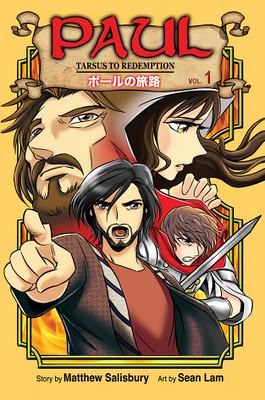
Paul: Tarsus to Redemption, Vol. 1 (story by Matthew Salisbury, Art by Sean Lam) is a fictional take on the life of St. Paul…presented as a manga-style comic. Julie mentioned on her blog that she’d gotten a review copy from the publisher, and that it looked interesting. A few days later, I got an e-mail from the publisher saying that Julie had mentioned to them that I might like it, and would I like a copy? I said, “Sure”, and it arrived yesterday. So now, not only has Julie recommended it to me, she’s arranged to have the publisher supply me with it. How cool is that?

paul.jpg

As I say, the book is a manga re-telling of the life of Saul of Tarsus. The very notion kind of filled me with dread. It gave me visions of something painfully earnest, with characters who smile too much and are filled with warmth and growfulness—sort of like a Japanese version of the old “Davy and Goliath” TV show. I feared it would be both tedious and didactic.

In fact, it’s nothing of the kind. As the book begins, Saul, with help from his buddy Septus and some others, kills a pair of Christians and burns their home to the ground. He has dedicated his life to rooting out this pernicious “sect”. Septus, his helper, is a Roman centurion, a convert to Judaism; he’s even more zealous than Saul. He’s exactly the sort of person Jesus talks about when he says,

Woe to you, scribes and Pharisees, hypocrites! for you traverse sea and land to make a single proselyte, and when he becomes a proselyte, you make him twice as much a child of hell as yourselves.

Then, of course, Saul has his encounter on the road to Damascus. He changes in ways that Septus cannot accept. And he learns the heroism to stand up for the Lord when it isn’t safe to do so: to stand up when it might mean your life, rather than seeking to take the lives of others. The authors have done something interesting here. They make Saul’s conversion realistic; they make his repentance real, and gripping; and they show how much he has given up.

So the story works for me. On the other hand, I thought the book was a little too long on purely visual story-telling; I’d have like a few more words. And there were a few places where I was honestly puzzled by the words that were there; places where the dialog didn’t seem to flow quite right. Of course, I’m not usually a manga reader; there are probably some conventions that I’m unaware of that would make it clearer.

Also, it’s rather short. I got through it in about half-an-hour, and my son David raced through it over breakfast this morning. But all that said, I liked it well enough, and David’s eager to read Volume 2, which is supposed to be out this summer. As Paul is intended for readers of age 12 and up, I’d say the authors have accomplished what they set out to accomplish. ‘Nuff said.

Writing Jane Austen

Once in a while I still get review books from Simon & Schuster, and the latest is Writing Jane Austen, by Elizabeth Anston. I’d never heard of Anston before, but she seems to have written yet another series of Pride and Prejudice sequels, beginning, I gather, with Mr. Darcy’s Daughter. (One day, I predict, Pride and Prejudice sequels will have their own section in the bookstores.) This, however, is a contemporary novel, written in a contemporary voice.

Georgina Jackson is a critically acclaimed author. She’s written precisely one book, Magdalene Crib, an historical novel set in the late Victorian era, concerning a woman who has a hellish life from childhood on, all because of the horrible social conditions of the time. The word “patriarchy” doesn’t appear in the descriptions of Magdalene Crib, but I could hear it floating about. The critics lauded it, but the readers weren’t so enthused; and possibly neither were the critics. When Jackson meets one, and asks whether he enjoyed the book, he replies, “Was I meant to?”

But Georgina’s efforts to write a sequel have come to nothing…until her agent, a nasty piece of work, browbeats here into signing a non-disclosure agreement and a contract—to complete an unfinished Jane Austen manuscript (one chapter only) of a novel called Love and Friendship. The difficulties are immense: not only did Austen write during a much earlier period, one that Georgina’s not familiar with, but Georgina holds Austen in utter contempt for writing frivolous books about girls who can’t think about anything but marriage. Not, of course, that she’s actually read any of them…. She doesn’t want to write the book, but on the other hand if she doesn’t she won’t be able to afford to remain in England, which she loves. Oh, help!

It’s a fun premise, and I enjoyed it, more or less, the more so as I had held a similar opinion of Jane Austen until I actually read something of hers. The first part of it is also the funniest, as Georgina keeps running into people who love Jane Austen while avoiding reading anything by or about her, but it’s also the part I had the most trouble reading. Georgina has very little time to write the book, and she keeps wasting it, and the sense of impending doom gets to me.

In the end, of course, and despite the dragon lady of an agent and her horrible publisher, and with much Love and Friendship, Georgina triumphs. Better still, by the end she’s no longer the kind of person who’d write a book like Magdalene Crib.

Writing Jane Austen is a fairly light and frothy book, and an imperfect one; the ending’s a little weak, if ultimately satisfactory, and some of the threats from earlier in the book fizzle out rather than really paying off. But there are some genuinely funny moments, and if you like Jane Austen you might find it a pleasant afternoon’s entertainment.

Recuperation

Had a bad case of bronchitis the week before last, that I’m still getting over. In search of Comfort Reading™ I re-read all of Steven Brust’s Khaavren tales; and then, not yet satisfied, I took Patrick O’Brian’s Master and Commander from its place of honor on the bookshelf. It was followed by Post-Captain, and yesterday I finished H.M.S. Surprise. And now that I’m started, well. I’ve got some good reading ahead.

Time Spike

Time Spike, by Eric Flint and Marilyn Kosmatka, is the latest outing in what the cover refers to as the “Ring of Fire” series, and which Flint has elsewhere referred to as the “Assisti Shards” series (IIRC). I picked it up because I generally like Eric Flint’s work; and since collaboration is a normal mode of operation for Flint, the fact that this one is a collaboration didn’t faze me.

And then I started trying to read it. Oh, my.

First, a bit of background. The book begins present day, in a United States in which the town of Grantville had mysteriously disappeared a few years before. A few dedicated researchers have been trying to discover how, and as the book beings they are detecting something interesting, and of greater magnitude (they think) than the Grantville event. (For those who came in late—the book 1632 has the entire town of Grantville being transported to Germany in 1632.) At the epicenter of the new event is a grossly understaffed maximum security prison—that gets transported to the age of the dinosaurs. They aren’t the only ones, either. Joining them are a bunch of Cherokees, some Spanish conquistadors, and some prehistoric men, and maybe a few others. Meanwhile, the scientists are running around present day, trying to figure out what happened.

It’s no sillier a premise than that of 1632, and it looked like it might be fun. But frankly, it’s awful. As I said to Jane, “Verily it sucketh.” The premise might be OK, but the writing and characterization are just plain clumsy. I sometimes couldn’t keep track of who was who from one page to the next.

I gave up after forty or fifty pages, something I almost never do; and then I handed it to Jane, just so that she could see how bad it was. She worked her way through it one day; her assessment: it was barely adequate, for a day when she’d been up with a sick kid half the night, and when moreover she’d neglected to take her thyroid medication and consequently was feeling particularly dopey. The bar was very low, is what I’m saying. And even then she skimmed it, skipping pages freely.

I don’t like panning books, in general. But Flint’s a popular author, and his readers should be warned, and he himself should be more careful what gets published under his name.