
The Name of the Wind

The Name of the Wind is, so far as I can tell, the first novel by a new author named Patrick Rothfuss; and I enjoyed it considerably.

The novel begins, as fantasy novels so often seem to, in the bar of an small inn in a little village in the back of beyond. The hero, oddly, is not one of the patrons, nor a passing stranger, but the innkeeper himself, a man named Kote. As the action begins, a demon, a spider apparently made of black stone, has attacked one of the locals and fairly sliced his cart horse to ribbons. The local seeks shelter in Kote’s inn, where he breaks in on a drinking party consisting of all of the regulars.

Kote, a quiet man who doesn’t usually intrude himself on his customers, turns out to know something about these demons; and as the action continues and the regulars head off home we discover that Kote is not who he seems. As Kvothe the Bloodless, Kvothe King-Killer, and other lurid names he’s a legend in his own time, and like the famous gunslinger has found that the legend is unpleasant to live with. He’s come to this backwater and changed his name in an attempt to outlive his past. Or not; perhaps he’s just come to die in peace.

So far, so good. Mysterious hero; evil creatures invading sleepy village; clearly Kote is going to have to reveal himself and save the village, and possibly (this being a fantasy novel) the entire world. No sweat. But here the book takes an abrupt left turn.

It seems that an author, a well-known writer of non-fiction books intended to debunk popular misconceptions, has tracked down Kote to his lair, and wants his story. And after a certain amount of discussion, Kote—Kvothe—chooses to tell it. And most of the rest of the book is Kvothe’s first person account of his life.

The Name of the Wind is the first book in a trilogy, unsurprisingly, and so we only hear about Kvothe’s early life, from his earliest days as a member of a family of traveling players through a period as a street urchin (a common trope these days, but well-handled) to his time at the Academy where he studies to be an “arcanist”, i.e., a wizard. And through his story we begin to learn the background of his world, its secret history, and of his enemies the Chandrian, and of his quest to learn the Name of the Wind, the name that will allow him to control the elements of the air.

It’s an odd way to structure a novel, but it works perfectly well; and clearly by the time we reach the end of Kvothe’s story it will be time for him to take action against the demons. I’m rather eager to read the next book.

I’ve discussed the dominant religion in Kvothe’s world, the Church of Tehlu, in the first of my “False Religions” posts.
False Religions: The Church of Tehlu

The Church of Tehlu appears in Patrick Rothfuss’ novel The Name of the Wind. It is the established religion in the regions in which the story takes place.

Rothfuss tells us fairly little about the Church of Tehlu as an institution. We know that there are priests, and that the priests have the support of the rulers. There are persistent rumors about pedophilia among the priesthood; in one city, the street urchins sometimes accept help from the priests of Tehlu, but run when invited to come inside the church. We also know that some of the priests are zealous to seek out and arrest heretics. The general notion is of a corrupt and venal priesthood: Priests Behaving Badly. We do meet one saintly man, one who lives with and cares for the street children, especially those with special needs; and it is hinted that he might once have been a priest of Tehlu. Thus, we have the sense that if there are saints, they are not found in the church.

Rothfuss tells us nothing about the practice of the church. Not only is the main character pretty much unconcerned with religion, there’s little sense of religion playing any significant part in the day-to-day lives of the people he runs into. If there’s a regular day of worship, or any usual sacrifices or tithes, or any daily practice of religion, we are not informed. We do meet one street bully who’s concerned not to anger Tehlu, and we gather that the country folk are more religious (read, more credulous) than the city folk.

There is a yearly festival that is celebrated all across the land that celebrates Tehlu, who delivered mankind from fierce demons.

Tehlu, it seems, is the creator of all that is and of mankind in particular. Tehlu looks down upon earth and sees mankind behaving badly all across the land. In all the world, he finds one good person, a woman whose name I don’t remember, and he speaks with her, and asks petulantly why he shouldn’t destroy mankind for their sins? She argues with him, and asks him how he expects mankind to act, when they are so plagued with demons? They have no time to be good, being so afflicted. Tehlu then incarnates himself in her womb, is born as a man, and grows to adulthood in a matter of months. Declaring himself to be Tehlu, he travels the world hunting down and killing the demons. (As so often in fantasy novels, demons are portrayed as corporeal entities who can be slain.) At last Tehlu gives his life to slay the last of the demons, using a vast iron wheel to cook the demon to death, and returns to the heavens. Hence, the symbol of Tehlu worship is the wheel—which, surprisingly, does not appear to be a symbol of the wheel of time.

The festival celebrates Tehlu’s victory over the demons. During the festival, which lasts a week, the young and young at heart in each town dress as demons and roam about, wreaking havoc, except to those that invoke Tehlu; and one man dresses as Tehlu and roams about banishing the demons one by one.

The essential question to ask about any religion, fictional or otherwise, is “Is it true?” Some fictional religions are intended to be true within the fictional world, and some are not. I’ll use the world theosphere to connote the supernatural reality of a fictional world.

So, is the Church of Tehlu true within the theosphere of Rothfuss’ world? It would appear not. At least, the main character, a man of wider experience than most, thinks that the church of Tehlu is simply a convenient fiction that most people use to explain a world they do not understand. There are no demons; but there are creatures that it’s convenient to call demons when dealing with the simple (i.e., almost anyone but the main character). The true nature of Rothfuss’ theosphere remains opaque.

Thus, The Name of the Wind uses the following standard tropes:

  • Priests Behaving Badly: as explained above.
  • Esotericism: the ultimate truth about the world is veiled from almost everyone, and from the conventionally religious most of all. The hero, however, knows better.
  • Corporeal Demons: As is usual in fantasy, the line of demarcation between the physical and spiritual realms is muddy.
  • Heterodox Saints: saintly behavior is inversely proportional to orthodox church membership.
  • Absence of Practice: although religion is present in the book, practice of religion is conspicuous by its absence. It’s not clear, though, whether practice is absent from Rothfuss’ world, or simply from Rothfuss’ book.

The Riyria Revelations

The Riyria Revelations is a fantasy series by Michael J. Sullivan; four of the projected six novels are now available:

  • The Crown Conspiracy
  • Avempartha
  • Nyphron Rising
  • Emerald Storm

I picked up the first book on a recommendation from Amazon.com, based on previous purchases, and have since read the other three, and have been puzzling over what to say about them for some time now. But more of that anon.

The series is set in a fairly convention post-Tolkien world, and concerns the doings of two thieves, Royce Melborn and Hadrian Blackwater. These are the high-class thieves who take on the hard jobs for the nobility, not your mingy backstreet cutpurses. In the first book they get set up to take the fall for a royal murder, escape, and end up saving the kingdom. It’s clear that by the end of the series they are going to end up saving the known world. (Goes with the territory, I suppose.) Along the way they befriend a princess, work with an ancient wizard, are imprisoned and nearly executed any number of times, have a variety of existential crises, fight fabulous monsters, break into ancient elven fortresses, face their past sins, show surprisingly tender hearts, threaten a dwarf, learn to sail, and prove remarkably trustworthy for a pair of thieves.

The author’s stated purpose is as follows:

Eschewing the recent trends in fantasy toward the lengthy, gritty, and dark, the Riyria Revelations brings the genre back to its roots. Avoiding unnecessarily complicated language and world building for its own sake; this series is a distillation of the best elements of traditional fantasy—great characters, a complex plot, humor, and drama all in appropriate measures.

While written for an adult audience the Riyria Revelations lacks sex, graphic violence, and profanity making it appropriate for readers thirteen and older.

Sullivan has achieved at least part of what he set out to do. This is, indeed, a light, entertaining series. He kept me turning pages through four books, and he’s surprised me on a number of occasions. The series is also full of trite, hackneyed situations, settings, and plot elements, and lots and lots of just plain bad writing.

Some of the problems are simply due to poor editing. There are lots of places where commas are missing; and the pseudo-world “alright” shows up occasionally. Sometimes the composition is clumsy; toward the beginning of the first book he spends four or five paragraphs telling us what a particular city and castle look like…and only then lets it drop that our heroes are looking it over. Sometimes he just betrays a tin ear, as when he refers to the inhabitants of the village of Tur as “Turists”. I suppose “Tureens” might be worse, but “Turists”? The word “villagers” would have worked quite as well. Sometimes he telegraphs his moves so strongly that I know just what’s going to happen next; and then, once in a while, he takes me completely by surprise.

The first book was particularly bad, and I nearly stopped reading after thirty or forty pages. But there was a small vein of gold—or, perhaps, silver—running through the mass of broken quartz, and in the event I kept following it through that book and the next three. To be fair, the writing improves somewhat as the first book progresses, and he gets a better handle on his characters.

In short, I’m rather conflicted. The Riyria Revelations is no diamond, and its setting is very, very rough, and yet I’m enjoying them enough to come back for more. It’s an odd feeling. I can think of much better written books that I’ve liked far less; but I can’t think of any books so poorly written that I’ve liked as well.

I guess it’s kind of like breakfast at a greasy spoon. You have to work around the black, crunchy bits, and it’s all rather greasy, but you knew what you were getting when you ordered it, and for what it is, it isn’t half bad.
Clearly, Your Mileage May Vary.

Lord of the World

I’ve just read a remarkably odd novel, Lord of the World by Robert Hugh Benson. Published in 1907 and set in the distant future—our own day, more or less—it’s a classic science fiction tale of the “If this goes on…” variety. It’s also a tale of the coming of the Anti-Christ and the End of Time. Perhaps most remarkably, it’s written by a English Catholic priest from a very Catholic point of view. (I’d love to give a copy to the fans of the Left Behind series, just to watch their heads explode.)

In Benson’s book, Europe is technologically advanced and entirely at peace with itself. All materials wants have been abolished, thanks to the efforts of the communists/socialists, who came to power across Europe in the 1920’s. Religion, though not extinct, is withering away; only Catholicism remains, a tiny remnant. The one threat is the Empire of the East, a sort of amalgam of the Japanese and Chinese empires that encompasses all of Asia and Australia; the signs are that the East may wish to add Europe and Africa to its holdings. Then arises a mysterious figure named Julian Felsenburgh, an American of great charism, oratorical skill, and political acumen. The world watches as Felsenburgh leads a party of diplomats to the East and negotiates world peace. Those who meet him are awestruck: he seems to be the perfect embodiment of Mankind, of the Spirit of the Age.

We follow the action through three figures, all from England: Oliver Brand, a Communist and Member of Parliament, one of the rising men in Government, his wife Mabel, and a Catholic priest, Fr. Percy Franklin. Brand represents the thinking of the Brave New World and its faith in Humanity; Fr. Percy, the old Faith in Christ; and Mabel the tension between the two.

In writing Lord of the World, Benson asks what would happen if the Communists really were able to create a materialist “Kingdom of Heaven” here on Earth. What if it were truly possible for mankind to feed the hungry, clothe the poor and take care of the sick, not out of Christian charity but out of faith in Mankind itself? What if it were possible to abolish all war that all men might live in peace, without reference to Christian revelation? What would happen then? What would be the effect on mankind? What would happen to the Church?

In our day, the question might seem remote. Benson wrote before the horrors of the World Wars, and especially before the Russian Revolution; in his day the Communists had nowhere come to power, and many admired their goals and idealism. The mass killings of Stalin, Hitler, Pol Pot, and the like were unforeseen. And yet, the Western Europe of our day does have its reflections in Benson’s book. Soft socialism, not hard Communism, is the order of the day; euthanasia, driven by a misplaced sense of mercy, is becoming ever more common; religion is becoming the province of the few rather than the many.

And yet, even in Benson’s far future the materialist Perfectibility of Man is but a thin veneer. In our day it is not even that.

Benson was extremely popular in his day; the son of the Archbishop of Canterbury and a high-profile convert to Catholicism, he was regarded as one of the leading lights of English Catholic letters. Nowadays, few have heard of him. You can find some of his books at Project Gutenberg.

The Warded Man

The Warded Man, by Peter V. Brett, is the first book in a new fantasy series. My brother recommended it to me recently, and I read it over the last few days.

The tale takes place in a land plagued by demons who rise at dusk and kill anyone they can find until at dawn they sink back into “the Core”. A human being is no match for an average demon’s strength and ferocity, and anyone out at night is liable to be “cored”—torn to bits and eaten.

In order to survive, humans must live behind “wards,” painted or drawn or carven symbols that interact with the demons’ magic and prevent them from passing. There are a vast number of wards, each with its own specific effect; and they must be drawn in a particular and carefully calculated geometry to create an impassable net. All known wards are defensive, but it is common knowledge that once upon a time men knew offensive wards.

The war between the demons and the humans goes back into ancient history, but eventually, in the distant past, there arose a figure known as the Deliverer. The humans took the battle to the demons, and were winning…and one night the demons failed to rise. They did not return for 3,000 years. (It always amuses me the way fantasy authors throw around periods of time like 3,000 years or 10,000 years or 5,000 years. They seem to have no notion of how long 3,000 years really is.)

During that time, the humans, no longer united by the common enemy, fought among themselves, devising all manner of high technology. The wards were largely forgotten. And then the demons came back. High technology availed little, and much of human civilization was lost. The wards that were still known sufficed to keep a small, low-tech population alive…but as our story begins, some hundreds of years later, it is clear that human population is declining year by year.

The tale follows three characters as they grow into young adulthood: Arlen, a boy from a small village who longs to bring the battle to the demons; Leesha, a girl from a larger village who trains to be the village’s “Herb Gatherer”, and Rojer, a boy apprenticed to a drunken jongleur. Each has his or her encounters with human wickedness and frailty, and also with the demons; and in time their separate paths draw them together. Perhaps a new Deliverer has arisen.

On the whole, I enjoyed the book; the main characters are interesting, and adequately drawn, and they genuinely grow as the book proceeds. I’m curious about what happens to them next. On the other hand, there are a few scenes that I simply do not believe. One character, for example, is brutally raped by bandits…and after the fetal position, the crying, the cringing when anyone male comes near and the obligatory attempts to wash the stain from her body it’s as though nothing happened. Within two days she’s trying to jump another character’s bones. Huh?

I grow increasingly fascinated by the way the standards of our present-day world creep into books set in places that are entirely other. One of the things I liked about Ernest Bramah Smith’s “Kai Lung” books is that the values of the characters are Chinese values, not English values. Or, at least, they are an early 20th-century Englishman’s understanding of Chinese values. In modern fantasy, by contrast, one all too often finds the sympathetic characters hewing pretty closely to the Spirit of the Age in all of its politically correct glory, and I see some of this in Brett’s book.

The most egregious example is when we are told by Bruna, Leesha’s mentor in the art of Herb Gathering, that the Herb Gatherers (all women) are responsible for preserving and passing along what remains of the old technology…none of which they pass along to the men, because the men aren’t to be trusted with it. A world run by women would naturally be a world at peace. Nope, not buying it.

So, I enjoyed it with some caveats. I’ll most likely read the sequels. But Jim Butcher’s Calderon novels cover some of the same territory and are a lot more fun.

Kai Lung

Whilst searching the free e-books at FeedBooks.com, I happened to run into two books written in the 1920’s by Ernest Bramah Smith: The Wallet of Kai Lung and Kai Lung’s Golden Hours. Kai Lung is a traveling story teller in a China of long ago. The books consist largely of the tales he tales; but also of the scrapes he gets into, and how he uses his stories to get out of them.

The tales are often funny, and remind me somewhat of Barry Hughart’s Bridge of Birds, though they neither as fantastical nor as broad in their humor; but the real selling point is the language, which is both precise and beautiful. These are not books that you can skim; there are no wasted words, and if you miss any you’ll miss something important.

Here, Kai Lung describes a particularly pretty girl:

After secretly observing the unstudied grace of her movements, the most celebrated picture-maker of the province burned the implements of his craft, and began life anew as a trainer of performing elephants.

Here he examines the alternatives open to him:

“It has been said,” he began at length, withdrawing his eyes reluctantly from an usually large insect upon the ceiling and addressing himself to the maiden, “that there are few situations in life that cannot be honourably settled, and without any loss of time, either by suicide, a bag of gold, or by thrusting a despised antagonist over the edge of a precipice on a dark night.”

And here, he is telling of a grandfather who is advising his grandson on finding a bride:

“What suitable maiden suggests herself to your doubtless better-informed mind? Is there one of the house of Tung?”

“There are eleven,” replied Chang Tao, with a gesture of despair, “all reputed to be untiring with their needle, skilled in the frugal manipulation of cold rice, devout, discreet in the lines of their attire, and so sombre of feature as to be collectively known to the available manhood of the city as the Terror that Lurks for the Unwary. Suffer not your discriminating footsteps to pause before that house, O father of my father!”

Good fun, and not at all the worse for wear after all these years. Check ’em out.

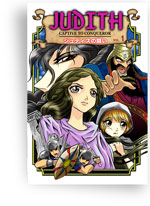
Judith: Captive to Conqueror, Vol. 1

The good folks at Atiqtuq have sent me a follow-on to their first graphic novel, Paul: Tarsus to Redemption, Vol 1. The new one is called Judith: Captive to Conqueror; it features the same artist as Paul, Sean Lam, and is written by Gabrielle Gniewek. Like Paul, it’s aimed at the middle-schoolers, 12 and up.

cover-judith-volume-1.jpg

The story is drawn from the Old Testament book of Judith, and focuses primarily on two characters: Judith, a devout young widow of the Judean city of Bethulia, and Holofernes, the commander of the armies of Nebuchadnezzar. It seems that Nebby has a problem with disrepect: all surrounding kingdoms must submit to him peacefully and worship him as a god, or he’ll grind them into the dirt…and then make the survivors worship him as a god. Holofernes is his chosen tool for the job—at least, once Holofernes knifes his predecessor to get it.

Bethulia is the only city standing between Holofernes and Jerusalem; he must be held there at all costs. But the people of Bethulia are inclined to trust more in Holofernes’ mercy rather than the Lord’s saving arm, so Judith has a bit of a job to do.

This is the first book in a series, and it is devoted to painting pictures of Holofernes and Judith and setting up the conflict between them. And I have to say, Holofernes is a real piece of work. He’s got long ropes of hair, and anime good looks; he likes to do his dirty work with a smile, preferably after persuading his victim of his benevolence. Outwardly warm, inwardly cold, he’s both ruthless and ambitious, and if I were Nebuchadnezzar I wouldn’t trust him any farther than I could sling a piano.

Judith, on the other hand, is generous, devout, God-fearing, kind, and disgusted with the leaders of her city; she’s surprisingly compelling for such a goodie-two-shoes.

On the whole, I enjoyed the book, as did my two sons, who are 13 and going on 11. I had a few problems with the continuity; there are some significant flashbacks that took me by surprise, and some of the scene changes were a little abrupt. I’ve not previously read the book of Judith, so I was a little unclear about the setting at first; in particular, I had no idea that Judith was somewhere different than Holofernes. Now, there’s this serving girl in Nebuchadnezzar’s palace that Holofernes winks at from time to time…or maybe it’s a succession of them, which is also possible…and for a while I thought that Judith might be the serving girl. In time, though, all became clear.

So, a quick, fun read, and I’d be glad to see the next volume.

The Founding of Christendom

The Founding of Christendom, by Warren H. Carroll, is the first volume in a projected six-volume series of the history of Christendom from the earliest days until the present. Five of the six volumes are now in print. By the term Christendom, Carroll harks back to the age when the Christian world was more or less united, first in both religion and politics, then in religion only—back to the birth, in fact, of Western Civilization. This volume covers the span from the beginning of time, more or less, up until the Emperor Constantine.

As such, he’s writing sacred history rather than secular history, and sacred history from an explicitly (and unabashedly) Catholic point of view. The difference is one of method. The secular historian, though he may be a believer, does not take the truth of his religion as part of the data he uses to explain and describe the course of history. The sacred historian does. Both methods are fraught with peril.

If Christianity is true, then the Incarnation is simply the central fact of all human existence. History which ignores this fact, then, runs the risk of missing the main point, and can also get into all sorts of knots. During the 19th and 20th century, for example, followers of the historical-critical method of scripture scholarship rejected the traditional dates for the writing of many of the books of the Bible, on the basis of “internal evidence”. The logic was often of this kind: this book contains statements that appear to prophesy this historical happening. Such “prophecy” must therefore have been written after the historical happening it describes. Therefore, the book wasn’t written when tradition says it was written, but fifty, one-hundred, two-hundred years later.

There is a hidden premise in this chain of reasoning: that historical events can never be prophesied in advance. And this use of the historical-critical method was driven by a secularizing desire to “de-fang” Christianity of its supernatural elements. But if Christianity is true, it is precisely those supernatural elements on which it insists. But whatever the cause, bad scholarship leads one to be build amazing houses-of-cards; and it’s my understanding that those houses are collapsing and scripture scholarship is returning more or less to the traditional dating for the books of the Bible.

So Carroll’s project is a worthy one; written from an explicitly Catholic point of view, he rejects the ideological incredulity that prevents us from seeing the Hand of God at work among us.

But there’s a great possibility of error on Carroll’s side, as well, the possibility of excess of credulity. His book is full of events and written sources that historians generally reject, for reasons, according to Carroll, like those I’ve described above, but that Carroll, doing his research with the eyes of faith has decided are likely true. And that’s the great difficulty with this book. I’m a bit of a history buff, but I’m not a historian; and if Carroll goes too far, I’m not sure how I’d know. Given that he rejects conventional wisdom so frequently, it seems likely that he does.

All that said, each chapter of the book is accompanied by many pages of end notes, citing sources, especially those of the authors who disagree with him. I cannot question Carroll’s integrity as a scholar; rather, he seems to be playing fair. It’s his judgement I’m unsure of.

So much for sacred vs. secular history; how is The Founding of Christendom as a book? How is it as a way to become familiar with the sweep of human history?

First, Carroll’s book is quite readable and informative. I learned a few things, and was told a number of others that I’m curious to look into further. It casts an interesting light on ages and events that I’ve already read a fair amount about. Sacred history usually focusses on the history of the Church; Carroll is focussing on the things that secular historians usually write about, but from a Christian slant. I like that.

The big question, though, is whether this would be a good first book on this period of time, for a reader who is unfamiliar with it, and I’m not at sure that it would. As I indicated above, some of Carroll’s conclusions strike me as being possibly rather idiosyncratic; and then, he seems to assume that the reader has at least a cursory familiarity with the broad sweep of things. Thus, it might be best to acquire that familiarity elsewhere.

I’ve not yet decided whether or not I’ll look up the second book in the series.

The Griffin Mage

Some time ago, Rachel Neumeier sent me a review copy of her first book, The City in the Lake, which I read, enjoyed, and reviewed quite positively. Consequently, when she contacted me recently and asked if I’d like to read her second book, Lord of the Changing Winds, I eagerly said yes.

As it happens, my response to it was mixed. I liked the beginning. I liked the ending. I liked the characters. The middle…I had some trouble getting through the middle. As I wrote to Rachel–we’ve been corresponding, in an extremely occasional and desultory fashion, for around ten years now, so I guess I can call her Rachel–after finishing it, though, I wasn’t sure whether the problem was the book, or an inability to concentrate on my part. (I got an iPhone that weekend. I’m a geek. So sue me.) Consequently, I held off on writing a review, as I didn’t want to review the book unfairly. Meanwhile, my 10-year-old son (who is reading at an 11th-grade level, according to a test they gave him last week) read the book. Well, I say he read the book; it would be truer to say that he devoured it, and wanted to know when we could get the second book in the trilogy.

Much to my surprise, yesterday afternoon I found Land of the Burning Sun (The Griffin Mage: Book Two) at our local Barnes & Noble. I brought it home, and started reading it earlier today. Well, I say I read the book; it would be truer to say that I devoured it, and wanted to know when we could get the third book in the trilogy. (December of this year, evidently.) So at this point, I’m willing to accept that my difficulties with the first book were due to the circumstances in which I read it, rather than with the book itself.

So, what’s it about, I hear you asking.

First, there are the griffins: beautiful, fierce, inhuman, unhuman. Griffins are creatures of Fire and the Desert, which they bring with them wherever they go. They are not comfortable companions for human beings, whom they scorn. The cold mages of the kingdom of Casmantium have maintained a low-level kind of war with the griffins over the centuries; the cold mages (and humans in general) are creatures of Earth, not of Fire, and between Earth mages and the Fire is antipathy and revulsion.

In Lord of the Changing Winds, the griffins come south from their home in the north of Casmantium to make a new home, evidently, in the kingdom of Feierabiand. And one woman, Kes, a peasant and a healer, is taken by the griffins and made to serve their needs. War comes, and Feierabiand and Casmantium must come to blows–with each other, and with the griffins. What does Kes want? And what of Lord Bertaud, trusted envoy of the King of Feierabiand? And what of Kairaithin, the last griffin mage?

Land of the Burning Sands picks up shortly after Lord of the Changing Winds leaves off, but in a different setting and largely with different characters (though Lord Bertaud and Kairaithin have important roles, and Kes appears briefly). The griffins have returned to Casmantium, and bid fair to destroy the kingdom. Gereint, former magic-bound slave and a gifted “maker”, must decide whether to aid the last cold mage of Casmantium against the griffins, at an unknown cost to himself.

What I especially enjoy about these books are the characters, who are complex, surprising, and not infrequently delightful; I especially liked the Lady Tehre, from the second book, a true absent-minded magic engineer and all around neat lady. And the second thing I like about these books are the difficult moral dilemmas the characters are faced with–and that, in general, rather than making the “hard” decisions that work out to their own benefit, they make the truly hard, and right, decisions that require real self-sacrifice and great personal cost.

Rachel’s first book was published for the teen market; these next two are simply labelled “Fantasy”, but there’s nothing in them that would prevent me from giving them to my kids; and there’s a lot of food for thought for them between the covers, as well as a galloping good read.

(On the off-chance that the middle section of Lord of the Changing Winds really is a little slow, stick with it. The ending is worth it, and the second book is definitely good all the way through.)