Unknown's avatar

About wjduquette

Author, software engineer, and Lay Dominican.

An Announcement

On April 24th, at St. Dominic Catholic Church in Eagle Rock, California, I will be received into the Dominican Order as a lay member.

At this point, most of you are probably scratching your heads, and saying, “Huh?” I can see that I’ve got some explaining to do—too much for one blog post. I’ll have to work on it over time.

To begin with, though, the Dominican Order, also known as the Order of Preachers, was founded in 1205 by the man we now call St. Dominic, a contemporary of St. Francis of Assissi. There are three branches of the Order of Preachers: the friars, the sisters, and the lay; it’s into this last branch that I will be received. In other words, I’m not becoming a monk, or a priest; Jane would have something to say about that, and rightly so. In fact, I’ll mostly be doing the same things I’m doing now: raising my kids, providing for my family through my work at JPL, and so forth.

But, I will be trying to live a Christian life in the Catholic faith in the manner of St. Dominic. I’ll have more to say about that later.

As I’ve said, I will be “received” into the order. This is a technical term—it means that I’m being accepted into a chapter of the Dominican laity to participate in the life of the chapter and to attempt to follow the rule of St. Dominic, but that I am not yet being asked to make any promises. This is a trial period, as it were.

Why would I do such a thing? I’ll have more to say about that as well; but for now I’ll simply quote the Blessed Mother:

…my spirit rejoices in God my Savior, for he has looked with favor on his lowly servant.

More later. If you have questions, please feel free to leave a comment.
Recuperation

Had a bad case of bronchitis the week before last, that I’m still getting over. In search of Comfort Reading™ I re-read all of Steven Brust’s Khaavren tales; and then, not yet satisfied, I took Patrick O’Brian’s Master and Commander from its place of honor on the bookshelf. It was followed by Post-Captain, and yesterday I finished H.M.S. Surprise. And now that I’m started, well. I’ve got some good reading ahead.

Dad/Daughter Dance

I’ve got a Dad/Daughter Dance tonight with my older girl. It’s 80’s-themed. So happens, I was there: the decade encompasses my high school graduation, my college graduation, and my wedding.

Which leaves the question: do I dress according to what was fashionable, or according to what I actually wore?

(Answer: I’m making a very weak attempt, within the confines of my current wardrobe, to sort of vaguely mimic the “Preppie” styles that were popular when I was in college. In a mild sort of way. Which is to say, I’m pretending to wear what was fashionable then while really wearing what I actually wear now.)

On Creation

When we say, “God created the heavens and the earth,” what does that mean?

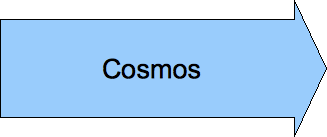
For the sake of simplicity, let’s talk about just that part of creation that’s apparent to us: the universe that surrounds us. We can diagram it like this:

Cosmos1.gif

It is the entire cosmos, from the beginning of its existence and stretching onward through time: open space, galaxies, stars, planets, oceans, continents, plants, animals, and us. Some would be content to leave it at that. But as Christians, we believe that this grand expanse is the result of an act of creation ex nihilo, from nothing, by God the Creator. What does that mean?

The following diagram represents a view that’s quite common; it’s certainly the mental image I grew up with:

Deism.gif

Here, God created the world, with all of its natural laws, and set it to going back at the beginning of time. Since then it’s been running more or less on its own, ticking along like a well-designed clock, neither requiring (nor, in a strict view, allowing) further divine input. The strict form of this view is called deism, which, as it denies miracles, an orthodox Christian must deny in turn; but allowing for the possibility of miracles, I think most of us tend to think of creation in just this way.

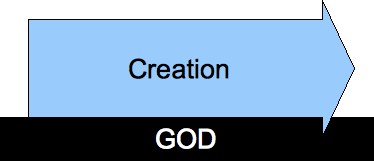
And yet, this image is severely lacking. It implies that God exists in time, and that Creation, once created, is no longer dependent on God. But we know that God exists outside of time, in Eternity; that the entire universe, all that is, from the beginning of time on into the future, was created as a single divine act. Consequently, the following is a much better image:

Theism.gif

Here we see that God is not that which wound up the universe and set it going; rather, God is the ground of existence for everything that is, at every point in time. Creation is not something that happened “way back then”; creation is what allows the present moment to exist right now. The universe isn’t a clock, that ticks along on its own; the universe is a symphony, composed, scored, conducted, and played by the Lord. And he is present and active in every note.

The glory of man is that we are called to join the orchestra and play along: to allow Him to play through us.

Why Metaphysics is Hard

James Chastek has an excellent post on why metaphysics (in the philosophical sense, not in the metaphysical bookstore sense) is so hard. About metaphysical proofs for the existence of God, he says:

Theist proofs that attempt to be scientific might have some value- I have little ability to judge them. They seem far too human to me. They occur in the comfortable human world of the most reasonable explanation. The metaphysical proofs are like staring at the sun or trying to hold your breath and explore deep underwater. Things are there, and there is occasional clarity; but much is blurry, you can’t see it for long, and you have to keep going down again and again to get a clear view of even relatively shallow things.

Read the whole thing; it’s short, and (unlike metaphysics) both clear and straightforward.