Unknown's avatar

About wjduquette

Author, software engineer, and Lay Dominican.

On the Third Day

Melanie Bettinelli at The Wine Dark Sea has been hosting a series on meditations on phrases from the Creed, in honor of the Year of Faith. I was fortunate enough to be able to contribute the meditation on the phrase, “on the third day“; you can find it there.

You might also offer up a prayer for Melanie’s dad, who suffered a stroke a few days ago. He seems to be doing much better, but prayer is always good.

Lawn Chair Catechism, Session 2

LawnChairCatechismSquare This summer, CatholicMom.com is hosting an on-line book discussion group for Sherry Weddell’s Forming Intentional Disciples. Each session will focus on one chapter of the book, and yours truly is participating. Hit the link above to see all of the participants, and to find the discussion questions.

Sessoion 2 of Lawn Chair Catechism is looking at Chapter 1 of Forming Intentional Disciples: “God Has No Grandchildren”. Or, just because you’re Catholic, that doesn’t mean that your kids will necessarily be Catholic. Sherry talks about the demographic changes in the Church, and about the two major groups of people who leave the Catholic Church: those who just drift away, and those who join some other Christian group, usually Evangelical, because they have met Christ there in a way that they hadn’t before.

I have some sympathy with this latter group. I was on the verge of “drifting away” in high school; only my desire to avoid a confrontation with my parents kept me going to mass with them. I remained in the Church largely because of my Presbyterian ex-girl friend, the outreach of an Evangelical megachurch, and the youth group at the local Episcopalian church. Six years later, still Catholic, I married one of the girls from that youth group, and became an Episcopalian. Almost six years ago, after several years of study and discernment, we came back to the Catholic Church.

Was it right for me to leave the Church when I did? I would have to say no; and yet God has certainly put those choices of mine to good use. I am much more involved and much more intentional about my faith now than I fear I would have been had I never left.

So…on to the discussion questions.

Have you always been Catholic? I think I’ve answered that already.

How did the instruction and mentoring you received help you—or prevent you—from having a personal relationship with God? I won’t say that the idea never came up during the instruction I received at Church when I was a kid…but I can’t say for sure that it ever did, either. I do remember old Fr. Barry asking the kids in my CCD class when we had last sat down and had a good chat with the Virgin Mary. That, of course, was the first time anyone had suggested to me that such a thing was possible, and though I think I might have tried it once I don’t recall having any success.

If you were raised in a Catholic home, are your family members all still Catholic? What events among your friends and family seem to explain why some are Catholic and others are not? I was, and of my siblings one is Anglican and the other two are not religious so far as I’m aware. And I think our family situation had something to do with it. My mother was Methodist, and active in her congregation; it was important to her, but she didn’t talk about it with us much because she had promised that her kids would be raised Catholic. Dad made sure that the family all went to mass every Sunday, and he continued going to mass every Sunday for the rest of his life, but he never talked about it.

And so far as Catholic culture goes, there wasn’t that much of it in our house. We said grace before dinner (when we were at home). We abstained from meat on Fridays (until that requirement was lifted). We were every Sunday Catholics but we most definitely weren’t Holy Day of Obligation Catholics; and I remember one Easter Dad took us to the Saturday evening mass so that we could drive to some relative’s house first thing in the morning. The Great Vigil with all of its readings took him completely by surprise. And because Dad wasn’t very social (Mom was the social one) we weren’t particularly involved in parish life and didn’t know anybody. (Ironically, after Mom died the people outside of the family who were the biggest comfort to Dad were the folks from her church.)

You might say that my Dad modeled (some of) the requirements of religion, without revealing any of its consolations, or the reasons for putting up with it.

In your parish: How’s your retention rate? What percentage of 8th graders in your parish are still practicing the faith at age 18? At age 24? Do young adults in your parish stay in touch with their childhood faith community, or do they drift away to an unknown fate? I’m not really in a position to know for sure, especially as we’ve only been in active in the parish for about six years. As I indicated last week, though, the parish LifeTeen community seems to be going great guns; and there are certainly at least few young adults from that program that I see regularly at mass.

Lawn Chair Catechism, Session 1

LawnChairCatechismSquare This summer, CatholicMom.com is hosting an on-line book discussion group for Sherry Weddell’s Forming Intentional Disciples. Each session will focus on one chapter of the book, and yours truly is participating. Hit the link above to see all of the participants, and to find the discussion questions.

How would you describe your lived relationship with God to this point in your life?I’m a Lay Dominican, and so making God part of my daily life is simply something I do. That includes regular times of prayer, as well as cultivating an awareness of the presence of God as I go about my day.

What does the word “discipleship” mean to you? To be a disciple is to accept a teacher’s discipline, or way of life. We are to be disciples of Christ, and to follow his ways.

Do you perceive a need in the Church today to help lay Catholics become more fervent followers of Jesus Christ? Absolutely. We Catholics are generally happy to pitch in to help others, and so follow the second of the two great commandments; but the first great commandment is to love God with all of our heart, soul, mind, and strength, and we mostly haven’t been taught what that means.

How would you describe your parish’s current efforts at discipleship? A hotbed of discipleship? A weekly gathering of spiritual sleep-walkers? Or perhaps something in between? It’s hard for me to say, precisely, because of my involvement with my Lay Dominican chapter, which is at another parish altogether. But there are some things I have seen happening over the last several years:

  • For the last year or so, we’ve had an adult faith formation program up and running. Due to our family’s schedule I’ve not generally been able to participate, but I hear good things about.
  • Our pastor has been preaching heavily on the subject of discipleship over the last sixth months; this past Sunday he actually used the phrase “intentional disciple” in his homily.
  • We have quite an active Lifeteen program at our parish, which I’ve been somewhat tangentially involved with. It’s been running for seven years now, and I gather we have a number of young men discerning a call to the priesthood, and at least one young woman discerning a call to religious life.
  • The bishop over our region in the archdiocese has been a strong supporter of the work of the Catherine of Siena Institute for quite a while now (if I remember correctly, he’s mentioned by name in the book).

So things are looking good for the future.

Action is the Measure of Love

A few days ago, I wrote, “If you don’t feel pain when they hurt, you don’t love them.” Upon reflection, I have to correct that.

Depth of feeling is not the measure of love. Action is the measure of love. It is not essential that I feel anything at all when someone I love is hurt; what is essential is that I am moved to action.

When my daughter falls down and skins her knee, yes, I feel bad; but I also comfort her. When I hear of massive earthquakes in Haiti or tornadoes in Oklahoma, I might or might not feel bad; some people have a lot of empathy, and some don’t. But even if I do not feel bad, I can still love those harmed by the catastrophe. I can still choose to take action: to pray, to send aid. These actions, done for the good of the victims, constitute love. Conversely, I can feel bad, very, very bad, and tell everyone how bad I feel about the victims of the catastrophe…and not love them at all in any objective way.

Action is the measure of love.

Feelings are called emotions precisely because they move us. Feelings of hunger move us to eat. Feelings of pity move us to aid or comfort. Feelings of anger or lust all too often move us to sin. The emotions themselves are not good or bad; only the actions that result from them (or the inaction despite them) can be good or bad. (We here in America spend a lot of time consuming media that moves us inwardly but without moving us to real action. We complain or we chuckle or we sigh, but do nothing. The emotions are short-circuited, as it were. This might be a problem.)

Action is the measure of love.

But if that is so, how can we truly love God? True love drives us to action. But He is perfect, omnipotent, infinite; he needs no help or comfort from us. How can we love him?

Jesus has given us the answer. He asks us, how can we love the God we have not seen, if we do not love the neighbor we have seen?

Action is the measure of love. That action might only be a prayer, an invocation of God’s help. (Only a prayer! Hah!) It might be more than that, depending on our means and on the proximity of the neighbors in question. But action is the measure of love.

Making Love

Strange Gods: Unmasking the Idols in Everyday Life In Strange Gods, her new book on the idols present in every day life, Elizabeth Scalia has this to say about the words “peace” and “love” and growing up in the ’60’s:

During that time, the word love—a deep word communicating all kinds of messages about permanence, commitment, self-abnegation, and sacrifice—began to be used to describe situations and encounters that were shallow, short-lived, casual, and self-serving. Simultaneously, the word peace, an equally deep word that, especially when partnered with love, gets to the heart of contentment, serenity, gratitude, and joy, was hauled into the shallows, where it came to mean mostly an “absence of war” and nonjudgemental permissiveness….

…in truth, peace and love, either conceptually or spoken, if applied at critical moments, can do the work of God and the angels. Overused, misapplied, or simply bandied about, they become as meaningless as scrap paper; and when we render words meaningless—especially powerful words like peace and love—our understanding of them becomes warped. Then, as when a teenager flings his stuff thoughtlessly and lazily about the house—disorder follows.

Yes. Yes. Yes.

Love isn’t something easy, something you just fall into. And words are not just noises meant to invoke a warm cluster of feelings. They have meanings. Love is something you have to make—something you have to build, every day. If you are not willing to sacrifice your time and effort for someone, you don’t love them. If you don’t feel pain when they hurt, you don’t love them. If you simply feel a strong desire to have sex with them, you don’t love them. When you have casual sex with someone, you are not making love. (But I digress; this is a post about words, not about marriage.)

Words have meaning. Humpty Dumpty was a liar.

The Latest Stuff

Just an update on what’s been going on.

First of all, April was lousy. No major tragedies, mind you; just of a lot of little grinding unpleasantnesses, including the joy and pleasure of getting a tooth crowned for the first time.

Some people find that they feel pretty good the day after getting a tooth crowned. Other people might find that the pain lasts for couple of months. I am not the former, alas, but also not the latter (and there was great rejoicing). And you know how toothaches seem to move around in your jaw, so that it’s not always clear which tooth is actually the culprit? I was more or less convinced for a week or so that I’d be getting a second crown immediately after the first one. This now seems not to be the case (and there was great rejoicing).

All of my hopes for Erasmo Leiva-Merikakis’ book Fire of Mercy, Heart of the Word. I’ve been getting up early every day to spend time in study ever since Easter Tuesday (including Saturdays and Sundays!), and I’m regularly astonished by the blindingly obvious things he pulls out of each line of the text—blindingly obvious after you’ve seen them—that I had never noticed before. I’m keeping notes of my reflections; some of them may appear here in the future. (As some kind of indication of the depth of Erasmo’s writing…50 days after Easter, I’m not quite to the end of the third chapter of Matthew’s gospel.)

Finally, I’m still working George’s Saga, my RPG, in which George, a naive but promising young man of low birth and high destiny, encounters such characters as the grim Sir Fred, Hogworth the peasant, Cyneros the dark wizard, Magister Mayhem, and Princess Floribunda. The game is becoming increasingly goofy. When George applies to Magister Mayhem for quest, he is told:

Magister Mayhem looks at you sourly. “Another adventurer,” he says.
“Just what I needed. Well, at least the Sewers have been restocked.”

He harrumphs a bit more, and then says, “OK, let’s take it from the top.

“The town of Floobham is in desperate straits. I’ve not had breakfast,
and everyone knows that I get nasty when I’m hungry. So you just go
down to the sewers, and see if you can find me a Tasty Egg Maguffin
in one of the chests. Bring it back to me, and I’ll see what else I
can think of.”

He doesn’t look enthused at the prospect. As you turn to go, he adds,
“I’m sure a naive but promising young man like you will have no trouble
finding the entrance to the sewers. You can, heh, keep anything else
you find down there.”

Later, George travels the short distance to Floob Castle, where Princess Floribunda is in dire straits. George goes speedily, eager for a quest that doesn’t involve sewers.

It seems that one of her father’s guests has unleashed cosmic evil within the castle. The princess could resolve the problem easily, she says, had she her magic ring…but she dropped it, and it fell down a grating, and, well, it’s in the palace sewers:

Sewers. More dirty, stinking, filthy, rat-infested sewers. Just what you
needed. You take a deep breath, out here where the air is clear.

“Very good, your Highness. So how do I get into the sewers?”

“Well, that’s the problem,” she says, still staring at the grating.
“I’m afraid you’re going to have to go through the palace.”

She turns to look at you.

“Good luck,” she says. “You’ll need it.”

Truth, Beauty, et Al

Today Julie reviewed a book called The Church Building as a Sacred Place; y’all can go read her review, because I’m not going to talk about it as such.

But she talks about the importance of beautiful churches, which triggered some reflections.

According to St. Thomas Aquinas, all of the transcendentals (the True, the Good, the Beautiful) are all essentially the same thing, which is to say God, the ground of all Being. (Bear with me here.) Me, I’m a programmer; I juggle thoughts for a living. I came back to the Catholic Church because I determined that it was True, and since then I’ve very much approached God along that axis.

In the introduction to Ratzinger’s Faith, Tracy Rowland notes that Pope Benedict thought that the neo-Scholastics who dominated pre-Vatical II Catholic theology were too focused on the intellect; and while not thinking them wrong, always chose to emphasize God as Love, as the perfectly loving and the ultimately lovable.

So here’s the thought I had. We cannot, in our human fraily, truly understand God. And though we can know that the True, the Good, and the Beautiful are all one thing, are all God underneath, nevertheless they are different to us. And so it seems to me that as Christians, to approach God, to know him as best we can and love him as best we can, we have to approach him along all three axes.

(Obvious, perhaps, but I still need to hear it.)

A Primer on Philosophy and Education

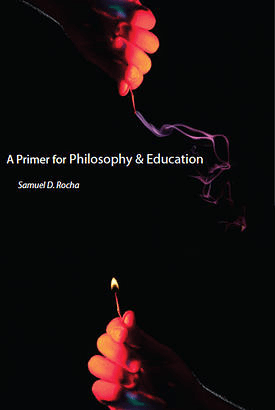
NewImage A few weeks ago I had the pleasure of reading a pre-release review copy of Sam Rocha’s new book, A Primer on Philosophy and Education. The book is not (nor does it pretend to be) a general introduction to Western philosophy; rather, it’s an introduction to philosophical thinking, especially as it applies to education—and here Rocha has a bit of fun.

Rocha is a philosopher of education, and from that and the title of the book one might think that this is a book about schools, teachers, and chalkboards. On the contrary: Rocha refers to all of that as “schooling”; by education he means “learning”, or more precisely, the ability to learn for one’s self, and to go on doing so all one’s life. But that precise meaning only emerges in the course of book. (Whoops! Spoilers. Sorry, Sam.)

The day I read this I was at home sick with a cold, and so it’s a fairly strong statement to say that I enjoyed it and that it held my attention. That said, I find I can’t judge the book fairly, as I’m really not a member of Rocha’s intended audience: his students, and others at a similar level. I don’t claim to be a philosopher of any stripe, but I’ve been delving into it long enough that at least I’m no longer a beginner (perhaps I’m a philosophomore). Whether I’d have found this book helpful when I was beginning that journey, I don’t know. But it all made sense to me, and as I say I enjoyed it.

Dominican Friars and Lutheran Wives

Jane found this article, which looks at the problem of loneliness among celibate clergy and the advantages of community life, as exhibited by the Dominicans; and surprisingly, has some suggestions for Protestant pastors.

In passing, the author links the Dominican order to the Inquisition, which is unfortunate; it’s true that Dominicans were involved (among others), and that the Inquisition was largely a Bad Thing, but it’s also true that the Hollywood portrayal of the fiendish, sadistic inquisitor is largely a myth. The truth is considerably more complicated, and as the Inquisition really has nothing to do with the rest of the article, I rather wish he’d left it out. Barring that, though, I found it quite interesting.

Anathem

Anathem Anathem, by Neal Stephenson, is that most odd of things: philosophical science fiction. By which I mean that in order to enjoy it fully, you really need to have at least a passing acquaintance with the history of Western philosophy from Thales on down; and the more you know, the more you’ll enjoy watching it play out. Not that this is a book of philosophy, or that you have to be a philosopher to read it. There’s plenty of action, interesting characters, and the like.

It is also a difficult book to describe without giving the game away. Heck, it’s a difficult book to describe even if you dogive the game away. But Stephenson has too much fun doling out the information for me to want to spoil it.

The book takes place in a world that is, we are assured, not our own, though there are many points of similarity. Our protagonist is one Fraa Erasmus (“Raz” to his friends) who lives an ascetic sort of life in something that seems very like a monastery, but isn’t, the Concent of Saunt Edhar.

No, I didn’t mispell that. “Saunt”, in Erasmus’ world, is a corruption of “savant”. Edhar was a great and noted thinker in his day, and the Concent, a stronghold of the “mathic world”, was founded to be a place where thinkers could do their work in seclusion, safe from the turmoils and upheavals of the Saecular World outside. Erasmus is a young fraa when we first meet him, winding (with three partners) the great clock that occupies the central tower of the Concent; he is still learning, and has yet to choose his mathic order, the path that he will follow for the rest of his life. He, like all other fraas and suurs, is free to think, to create, and to learn, but he is limited to the most basic technology (called praxic in his world): his bolt, a length of cloth that can become longer and shorter, thicker and thinner at need, that he wears as a garment; his chord, a rope-like object that can also change size, used to keep his bolt from coming off (among other things); and his ball, a soft round object that can be as small as a tennis ball or as large as a truck, but which is mostly used for sitting on. The ball can also glow to provide light.

The fraas and suurs live in almost complete isolation from the Saecular World, coming into contact with the extramurals, or “extras”, those from outside the walls, only during the time of Apert, a week-long festival that occurs once a year…or once every ten years…or once every hundred years…or once every thousand years…depending on who you are. Fraa Erasmus lives in the Decenarian Math, meaning that for him Apert will come every ten years. And as the book begins, Apert is coming; and what will it bring? Therein lies the tale.

I don’t want to say too much more, but I will say this. First, Stephenson’s world-building is phenomenal. I am literally in awe. Second, though there were one or two slow parts I enjoyed the book considerably; it’s the kind of book I’d like to read again for the first time. Third, the intellectual climax of the book is so audacious I can hardly prevent myself from giving it away. Fourth, although Erasmus and his friends have definite, strongly held points of view, with which I sometimes disagree, it never feels like Stephenson has an axe to grind. That impresses me as much as anything.

The only other book by Stephenson that I’ve read is Snow Crash, which had its moments but which I’ve never felt any need to re-read. Anathem is much, much better.

If anyone is interested, I’d gladly discuss my further thoughts about the book down in the comments.