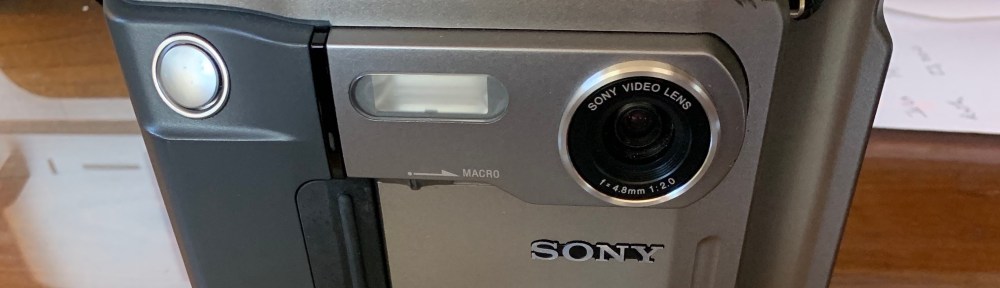
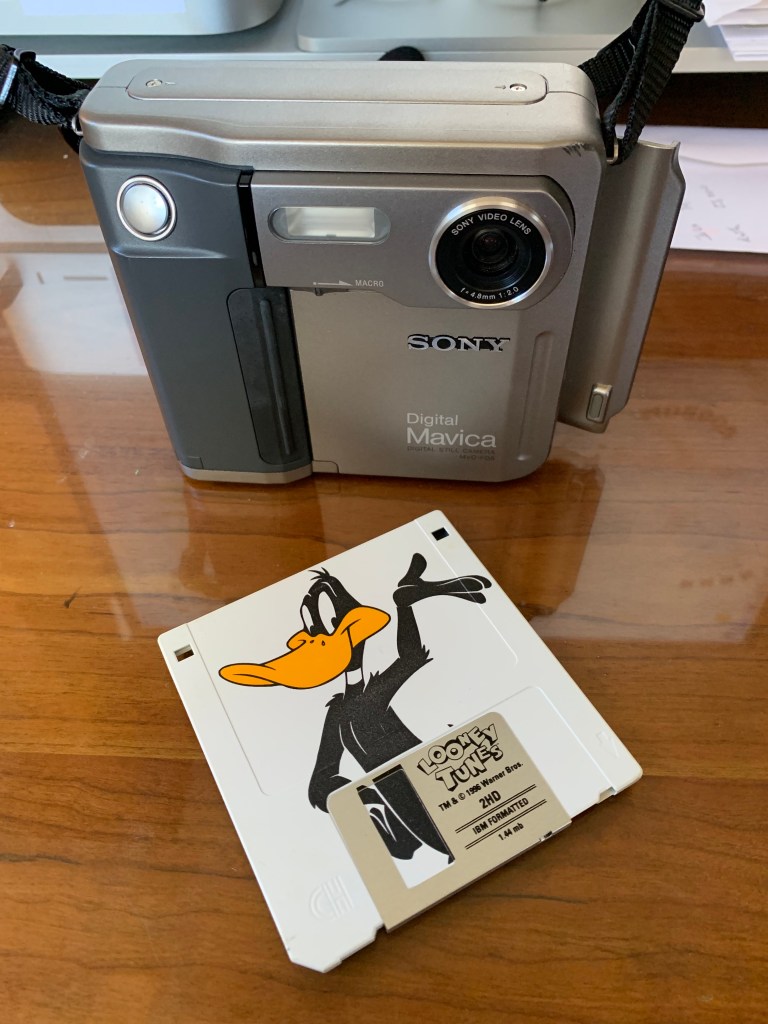
The first camera I ever bought for myself is the one in the picture above: a Sony Maniac FD5. I’d had film point-and-shoots before, Kodak Instamatics that consumed 110 film and flashcubes (remember flashcubes?), and for a brief while I used a 35mm point-and-shoot; but the Mavica was the first camera I spent any significant amount of time with.
The FD5 was one of the first truly popular digital cameras, and it’s easy to see why—if you’ve got a long memory and you squint a bit.
It was basically a video camera (notice the words “Sony Video Lens” on the lens) that had been modified to capture the current frame as a still and save it as a 640×480 JPEG file. Better still, it saved it to a 3.5” floppy disk.
640×480 pixels—that’s about a third of a megapixel. And 3.5” floppies. No real exposure control, though I do see a “MACRO” control there on the front, under the flash. You composed your picture on a small screen on the back (like many cameras to this day), and pressed the shutter. There are buttons on the back labeled “Brighter +/-“, but if I recall correctly they didn’t adjust the exposure, just the brightness of the screen.
Dirt simple; just a digital point-and-shoot.
(!) And yet, it was incredibly compelling. My friend Steve got one (actually, I think he had the FD7, which had a 3x zoom lens), and I couldn’t wait to get one of my own.
Mind you, my eldest child was 8 months old and about ready to start walking; that might have affected my decision.

He never crawled, he just got up.
So what was so cool about the Mavica as opposed to other digital cameras of the day?
There were two things, and both of them came down to that 3.5” floppy in the foreground.
The first digital cameras stored your photos in on-board memory—which was strictly limited. And when you filled it up, you were done. You had to download them to a computer using a cable of some kind—let me repeat that, of some kind—and clear the camera’s memory before you could take any more pictures.
SD Cards, which are ubiquitous now, were years away. Sony eventually released something they called a MemoryStick, that shortly thereafter went the way of the Betamax, as did the CompactFlash cards everyone else used; but even those didn’t exist yet. (To make it painfully clear how far off these cards were, I’ll note that Sony eventually found it reasonable to sell a Mavica with a built-in CD-R drive. Yup, it recorded your photos to a CD-ROM.)
So if you bought one of these other cameras, you were going to be connecting a cable to your computer. And that was the second problem.
In those days most computers had two kinds of interface: serial and parallel. These were mostly used for connecting printers. If you wanted to connect something different, you often need a special interface card, which you added to the expansion bus in your computer’s tower case. Or, if you had a laptop, and if your laptop had a PCMCIA slot, you might be able to get a PCMCIA card that would provide the necessary connection.
So let’s recap:
- You could only record a few pictures before going back to your computer.
- You probably needed some weird kind of interface adaptor to connect it up.
- And given that, you might only be able to connect it to a single computer.
In short, the Mavica’s competitors did not seem (to me, at the time) like cameras I’d want to bring along on family excursions and vacations.
But the Mavica recorded to 3.5” floppy disks…which were cheap. And you could read them on pretty much any computer of the day (and pretty much any computer going forward, for all that we knew). They were like rolls of film, only better: you didn’t have to send them to a developer for processing. And you could easily bring enough along for a long vacation, or buy more if you needed them. And then, once you’d copied the photos to your hard disk you could reuse the floppies!
I took a lot of pictures with the Mavica, and kept a lot of memories. If I’d used a film camera to capture that shot of David standing for the first time, the picture would probably be in a drawer somewhere. But this picture is still on my hard drive; I was able to pull it up in just a few moments.
Mind you, the image quality isn’t all that, not even compared to cameras that came just a few years later; but hey, a lot of Instamatic snapshots weren’t that great looking either. As it is, the Mavica got me started with photography as a serious hobby, and though I can’t imagine using it now I’ll always be fond of it.
 The View from the Foothills