
I returned to photography last April after a six-year hiatus, and I find my focus has changed. I wrote recently about Learning to See, about seeing pictures as I walk about the world. The next step, then, is learning how to finish the image so that others can see what I saw.
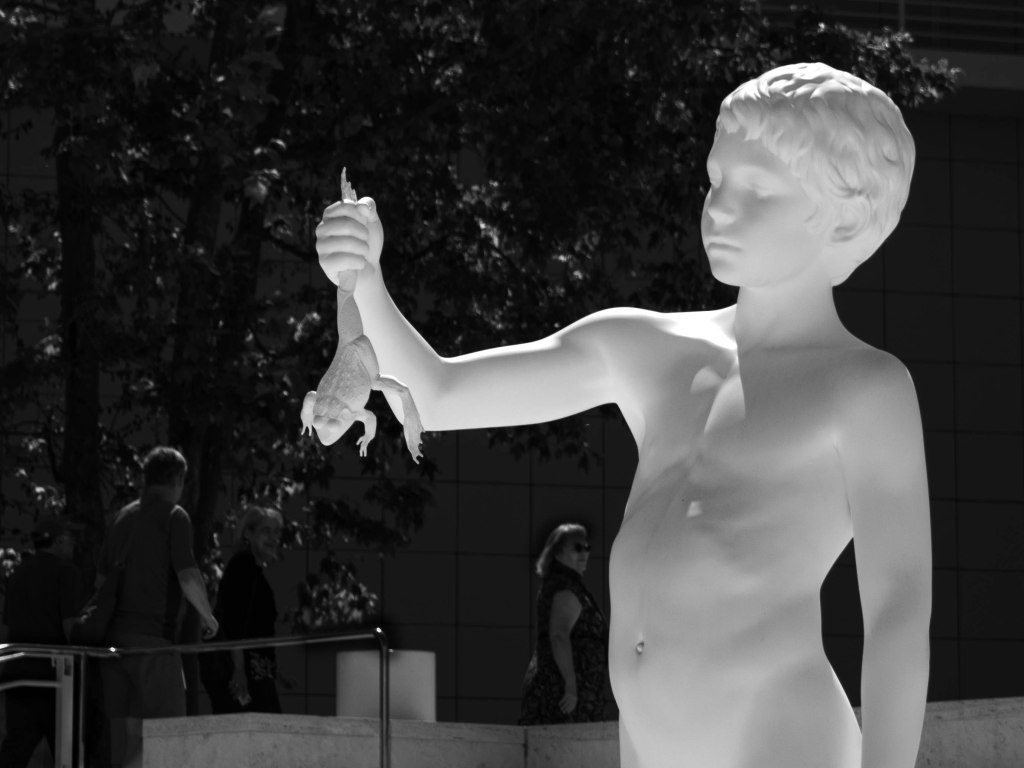
Here’s an example. At the entrance to the Getty Center on top of the hill there’s a terraced slope; and on that slope there’s a sculpture of a boy holding a frog by the leg. I took a few pictures; here’s what one of them looked like straight from the camera.

The thing about the sculpture is that it is shockingly white, even in the context of the Getty Center where the white of travertine marble is the defining architectural element. It’s so white it seemed to glow in the sun as people streamed by on their way up the stairs from the tram stop.
The eye and brain have an uncanny ability to focus in on the thing of interest, and ignore the rest of the scene; the camera isn’t so blessed.
Back in the day, Ansel Adams wasn’t simply skilled at shooting scenes; he was a skilled print maker. Making a classic print is more than just putting a negative in the enlarger and shining a light through it onto some photo paper. Adams had many techniques he could use to make certain parts of the image stand out and other parts recede, and he usually knew when he exposed the negative just what he would want to do in the darkroom to produce the picture he saw in his mind’s eye.
It was a lot of work; and he had to repeat those steps for every single print he made, which makes my mind boggle.
The digital photographer has the same task, except that he only has to do it once: develop the picture so that it shows what he saw.
In this case I wanted to show the glow, as it were; and I wanted to emphasize the sculpture.
First I reframed it. I try to get the framing right in camera, but the right framing isn’t always obvious in the moment (I ain’t Ansel Adams). Then I darkened the whole thing to extend the range on tones on the sculpture, and to de-emphasize the visitors in the background without quite eliminating them. That left a few bright spots that I found distracting—sun on the handrail and on one woman’s hair—so I masked and darkened those.
And here it is. Here’s what I saw, in the busyness of the visitors and the brightness of the day.
I’ll never be Ansel Adams; but I’m beginning to learn how to “print”.
 The View from the Foothills