
OK, it’s not so bad. We’re not starting construction for three weeks, not two. (Long sigh of relief.) I mean, that’s 50% more time before my world gets turned upside down.
Monthly Archives: January 2012
Philosophy and Me, Part II: Hume
This is the second in a series of posts on my own philosophical journey; the first post is here.
When we left off, I had expressed my disappointment with Descartes: he’d achieved a new start, but at the cost of excluding most of what he knew from experience. (And at the cost of throwing away most of what had come before in philosophy, though I didn’t understand that, then.) To be fair, his was a methodological rather than real doubt—he fully expected that everything he excluded would be pulled back in during the course of his analysis.
Then along came the Empiricists; and they agreed with me (if I’m allowed to put it that way) that ignoring sense experience was a Big Mistake. The three major Empiricists were Berkeley, Locke, and Hume, and given the time available we spent our time on last of the three, David Hume.
Like Descartes, Hume was happy to start from scratch. And his basic principle was that the only way we come to know anything is through our senses. I was overjoyed. At last, here was some sense.
And yet, there was still something wrong. Hume said that the only way we come to know anything is through our senses—and our senses are not always to be trusted. And consequently, how can we know anything for sure? How can we know anything at all? It became clear to me that Hume’s point of view, if followed to its end, led inexorably to solipsism: I exist; I imagine that other things exist, but I can’t know that for sure.
This struck me then, as it strikes me now, as a reductio ad absurdem, a reduction to absurdity. Clearly something had gone deeply wrong.
Aaaaaaaaaugh!!!!
For almost a year now, we’ve been in the process of getting ready to remodel our kitchen. We talked with contractors. We picked an architect. We got drawings. We got bids. We picked a contractor. This week we’ll be signing a contract with him; and we expect to start work in two weeks.
Let me repeat that. Two weeks!
During those two weeks we need to pack up our kitchen, getting rid of as much stuff as we can, and prepare to set up a temporary kitchen elsewhere on the property.
I just told my sons that we’d have a much better time if we all thought of it as an adventure rather than as a series of calamities…and that they should keep reminding me of that.
Philosophy and Me, Part I: Descartes
If I intend to blog regularly, I can see that I’m going to have to spend more time writing about philosophy, because that’s one of the main things I’m spending my time thinking about these days. I shall try to make it interesting. But the problem with writing about philosophy is that it’s hard to start in the middle, and the middle is where I’m thinking. So I plan to begin by writing a post or two about my own philosophical journey, so that you all can see where I’m coming from.
My first exposure to philosophy was in an Introduction to Philosophy class my first semester of college. The format was simple: we were given a number of original sources, we were to read them, and then we discussed them in class. Occasionally we wrote papers. We started with a small smattering of Plato, because you have to start with Plato; not enough to really appreciate him, but enough to have some notion of who he was and of who Socrates was.
And then we jumped almost two-thousand years to Descartes.
Let me repeat that again. We jumped almost two-thousand years to Descartes, as though nothing in between mattered.
This didn’t concern me at the time, mind you—and from the standpoint of modern philosophy, there is a sense in which the instructor was perfectly right. From the standpoint of Descartes and those who came after him, little of that intervening time mattered because they explicitly and consciously chose to ignore it. I’ll get to that later.
The main thing for now is that Descartes consciously chose to reject that which had come before, and to start fresh. He was a mathematician, and he chose to proceed mathematically: he wanted to start with as few principles as possible, and build up everything else from them logically. He said (I paraphrase ruthlessly), “There are many things I know…but I’m going to pretend that I don’t know anything that I’m not absolutely positively logically sure of.” As all the world knows, he finally came down to one principle, Cogito ergo sum!, “I think, therefore I am.” That was his starting point, and he worked up from there.
This process made a certain amount of sense to me; though I didn’t know it, I was a budding math major, and the certainty of math appealed to me. Descartes was trying to bring the same kind of certainty to philosophy, and I liked that. At the same time, it bugged me that he was ignoring the things he knew from experience—that he was, as I’d put it now, trying to make himself stupider than he was. And the trouble with trying to make yourself stupider than you are, as C.S. Lewis noted multiple times, is that you very often succeed.
From Descartes we went on to Spinoza, who followed the model of Euclid’s Geometry much more closely; his book was full of definitions, axioms, and theorems, and first I found it fascinating. I also found it impenetrable; all I can remember now is that he went on and on about substances and their modes (very little of which I’d been given the background needed for understanding), and that he ended up with something like Pantheism.
But I hungered to get on to the Empiricists: Berkeley, Locke, and Hume. They looked at the world empirically. They paid attention to what they knew from the world. They didn’t foolishly throw all that away. Surely they’d make more sense.
Requiem for the Unborn
So last night the whole family went down to the Cathedral of the Angels for the annual Requiem for the Unborn. This mass is held every year on the Saturday nearest to the anniversary of Roe vs. Wade, which is 22 January, or today. It is a funeral mass for the the victims of abortion over the past year, and particularly for those aborted in the city of Los Angeles on the day of the requiem. At the end of the mass, one candle is lit for each of them, and placed around the altar; and then silence is maintained. This year there were 150 candles; on average, 150 unborn people are being killed each day in the City of Los Angeles, and we were silent for 150 seconds.
Progress is clearly being made. There were 180 candles last year, if we recall correctly; and at the first Requiem for the Unborn (this year’s was the ninth) there were over 450.
The celebrant was our new bishop, Archbishop José Gomez; also in attendance were the remaining bishops of the archdiocese (including Cardinal Mahoney) many priests and deacons, the seminarians from our seminary, many sisters, a sizable cohort of the Knights of Columbus, and many, many just plain folks like us. The Cathedral was packed.
We had a surprise guest, Cardinal Pell, Archbishop of Sydney, Australia, who concelebrated the mass with Archbishop Gomez and Cardinal Mahoney. I have no idea what Cardinal Pell is doing in Los Angeles, and he didn’t speak at the mass.
Archbishop Gomez gave the homily, naturally. I was eager to hear it, as this is the first chance I’d had to hear him since he became our bishop. The gospel text concerned the Magi and King Herod, the flight of the Holy Family to Egypt, and Herod’s slaughter of the Holy Innocents. The archbishop compared Herod to those in the present day who will do anything to keep God from interfering with their control of the world. It was interesting to compare Gomez’ homily with those Cardinal Mahoney gave at this mass over the last several years; Mahoney usually gave a talk about the state of the pro-life movement and the progress being made, complete with statistics. Gomez gave a genuine homily, making his points but drawing them from the scriptures read at the mass. In one way I was sorry for this; I wanted to get a sense of what Gomez is like as a person, and was hoping for something less formal. But on the other hand, a homily is supposed to be a homily, not an informal, off-the-cuff speech, and I’m glad that’s what we got.
In general, the mass went much as it had in past years; the music was the same, the Shantigarh Requiem for the Unborn, a piece written for this mass, and there were still liturgical “dancers”, sort of. I put “dancers” in quotes, because it’s almost certain to give the wrong impression. The dancers are young women in white dresses. They came in at the beginning of the procession with incense in these metal cones or funnels, as they have in past years; but they did so more quickly, and almost perfunctorily, than in the past, and there was also a server with a traditional censer that I don’t remember having seen in the past. (I might well be mistaken about that.) They brought in the altar cloths at the time of the offertory, and dressed the altar as they had done in the past. They led the procession of 150 candles at the end of the mass, and were responsible for placing the candles around the altar; but I’m not sure they processed out afterwards, and they certainly didn’t dance down the aisle as they had in the past.
What I’m trying to convey with all this is that even in past years, there was very little actual dancing being done; the “dancers” were mostly a fancy kind of altar server. More than that, any real dancing took place outside of the mass proper, which is to say that it wasn’t really liturgical dancing because it wasn’t part of the liturgy. And this year, even that was muted; apparently our new archbishop is already making his mark.
New Dynamics
For about the past week I’ve been trying to get regularly back into blogging, writing at least one post a day…and I’ve come to a realization of why I’ve been mostly not blogging for the last year or so. It’s all about books.
Book reviews used to be the bread and butter of this blog…and because the nature of my reading has changed somewhat, and the length of time it takes me to read some of the books I’m reading is much longer than it used to be, I don’t have a steady stream of books coming down the pike to review the way I used to. To blog every day, consequently, I need to come up with other topics—and it’s harder to keep that up than I’d expected.
(Whine, whine, whine…I know.)
Well, I’m gonna try. We’ll see how it goes.
The Pleasure of a Cup of Coffee
I’ve always been a sipper of soft drinks. Especially when I’m working on a project, I like to have a can, or better yet a massive paper cup (half-filled with ice) of soda to sip at as I go. Something about this just works for me. I’m happier, and more productive.
Some years ago, I had to switch from the hard stuff to the diet drinks. It was a bit of a wrench, but I got over it. After all, it was really the caffeine I was after, not the sugar. But over the past year I decided that things had gotten out of hand. I’ve heard reports that the artificial sweeteners aren’t good for you in various ways; I’ve heard stories about impaired mental function (which scares me to death) and also that the sweetness alone can help you to put on weight (which might simply kill me). So I’ve been trying to cut way back on my daily consumption of diet soda.
Cutting caffeine out of my diet, on the other hand, is a no-go. Among other things, if you’re out to eat and you don’t want sugar and you don’t want diet sweetener and you don’t want caffeine, you’re stuck with alcohol or water…and I get so tired of water.
So over the last year I’ve started drinking coffee. Plain, black coffee. (Yes, I’m sure it tastes better with sugar and cream and hazelnut syrup and what all, but I’m not going there.) I never used to drink coffee; most people pick it up in college, but I never did. Almost five decades on this earth, and I never started drinking coffee. But now I have; two cups a day, sometimes three, with water in between, and the very occasional soda. And I’ve discovered something I’d never understood before.
As I said above, I like to have a drink to sip while I’m working. A 32-ounce cup of Coke Zero (half ice) will last for a couple of hours that way, which is lovely. I’ve tried the same with coffee, but coffee gets cold. Once it’s in the cup, you’ve got a limited time to enjoy it. You can stretch that by using a travel mug with a lid, which I do sometimes. But if you use a regular ceramic mug, you’ve got a fairly short window.
And therein comes the pleasure, a pleasure I’m sure many of you are well-acquainted with, the simple pleasure of sitting and drinking a cup of coffee. You can’t drink it quickly, because it’s too hot. You have to sip it. On the other hand, you need to keep at it, or it will get cold. It’s not simply something to sip at mindlessly while you’re working; it’s an activity in itself. And while you’re drinking it, you can chat, or ponder, or read a little something…but you’re not drinking coffee while doing so, rather you’re doing so while drinking your coffee. It’s a little moment out of the day, a way to stop and rest, a break with a natural time limit. When the coffee’s gone, you move on.
What a pleasant thing!
(Yeah, OK, so I’m a little slow. You can all laugh at me now. 🙂
The Metaphysics of Minecraft
Yesterday I rambled on a bit about the difference between natural and artificial things. The gist of it, which possibly I conveyed rather badly, is that natural things, and particularly living things, have a nature that determines what they can do and how they behave—and that this nature isn’t entirely explicable in terms of a collection of atoms arranged in a particular way. This last point is controversial, of course. There are many today of the “materialist” (or, sometimes “physicalist”) camp who would disagree with me.
Be that as it may, I was recently surprised to find this distinction between natural and artificial things illustrated in a rather odd place—the computer game Minecraft.
In Minecraft you inhabit a world made of blocks. You can mine these blocks out of the world, and then make new things out of them. And there are two ways to do it.
First, you can treat the game like the world’s biggest Lego set, and build things (including truly massive structures) out of the blocks by placing them back into the world as blocks. Second, you can “craft”. This means creating a variety of things—tools, armor, new kinds of blocks—out of blocks by using something called a “crafting table”. The resulting objects are either items, things you can carry and use, or blocks that you can place in the world.
Let me give a couple of examples. First, here’s an artifact: A Dark Tower of Wizardry. It’s made of blocks. It has certain behaviors; for example, fire burns on it in various places. But it’s an artifact—its behavior is the behavior of the blocks from which it is made. It has no behavior of its own.

You can make quite amazing artifacts in Minecraft: Star Trek-style doors that open with a woosh when you walk up to them, elevators, logic circuitry, and the like. But all of them are simply artifacts that exploit the behavior of the blocks of which they are made.
Here, on the other hand, is something quite different.
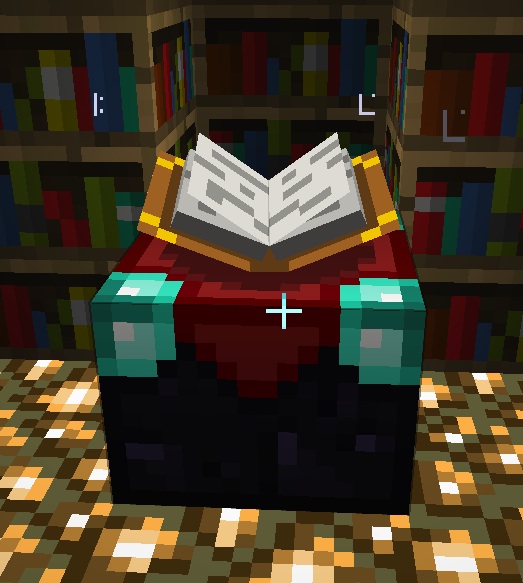
That thing in the middle, with a book floating on the top of it, is called an enchanting table. You can use it to enchant your weapons, armor, and tools to make them more powerful. It’s a single block, made on a crafting table from four blocks of obsidian, two diamonds, and a book. And the point is, it has significant behavior that does not in any way derive from the things of which it is made. Not only can you enchant things on it, the book on top moves around by itself, and letters magically fly towards it from the books on the shelves around it. It is its own thing, with its own behavior. You might almost say that it’s alive.
It has, in fact, a nature. For all that you have to make it from other things, it’s a natural object in the Minecraft world, rather than an artifact. Unlike the Dark Tower of Wizardry, it has its own Java code in the Minecraft application that gives it its nature.
And this is the thing that’s so cool. All of the neat stuff that happens in Minecraft ultimately depends on blocks and items with natures given to them by the application. The neat artifacts you can build work by combining these natural elements in ways that they work together.
Just like in the real world. Everything comes down to the natures of natural objects, which are not necessarily explicable purely in terms of the parts from which they are made.
They say art imitates life. Does it ever!
SOPA/PIPA
You have told your congress-critter that SOPA/PIPA are bad bills, and shouldn’t be passed, haven’t you?
Natural and Artificial Things
What’s the difference between stones, trees, dogs, and people on the one hand, and houses, pianos, and motorcycles on the other? According to Aristotle, the basic difference is that the things in the first group are natural things, while the things in the second are artificial things. That seems obvious, but to Aristotle, the difference goes deeper. Natural things are so called because they possess a nature that determines what they are, and how they behave. The oak tree outside my house has the nature of an oak tree. This determines how it grows, and how big it gets, and how hard the wood is. A dog has the nature of a dog, and so it barks, wags its tail, and so forth. Humans have human nature. All of these things are what they are because of something inside them.
Houses, pianos, and motorcycles, being artificial, a product of artifice, the creation of an artisan, do not have a nature. Rather, a piano is assembled from pieces; and many of these pieces are natural objects that each operate according to its own nature. Metal wire naturally vibrates and emits a tone when struck. The wood of the case naturally resonates to the tone of the wire and amplifies it. An artifact is a way of putting natural things together so that their natures all work together to achieve some desired effect.
But if artificial things don’t have a nature to call their own, they do have a property that natural things, especially living ones, generally don’t have: you can take them to pieces and reassemble them. If you take a motorcycle apart, it’s true that you no longer have a motorcycle; but if you put them back together again properly, your motorcycle is as good as new.
If you take person to pieces, on the other hand, you can’t usually reassemble them, Dr. Frankenstein not withstanding.
This distinction is often denied by the materialists among us. A human being is just atoms, they say; we can explain everything in terms of the movements of atoms. We don’t need any natures! Atoms are good enough. Given time, we’ll be able to build new people just by assembling atoms together in the right way. And yet, there’s more to being a person than just being the right set of atoms.
 The View from the Foothills