
HDR pictures are all the range in some circles; you take several bracketing exposures of a scene, under-exposed, normally exposed, and over-exposed, and combine them to produce a single image that covers a wider dynamic range (a wider scale from dark to light) than you can get in a single picture. That’s particularly an issue on bright sunny days, where one scene can range from deep shadows to bright pale whites, a range that most cameras have trouble with.
Now, one of the Fuji X10’s claims to fame is its handling of dynamic range: it’s got some kind of special sensor, and can produce a wider dynamic range in camera under the right circumstances. I was curious to give this a test. As a result I’ve got two pictures here, of the same scene, taken (unfortunately) on two different days from slightly different positions using two different focal lengths. (So sue me). But the time of day was the same (within half-an-hour). Today was nice and bright, and yesterday was even brighter. I’ve not done anything at all to these pictures, except to reduce them in size for posting on the web.
First, here’s the picture I took today, with the dynamic range set to 100%:

There’s lots of a shadow detail in the foreground, which is where I was focussing, but there isn’t much highlight detail in the buildings across the street. Note especially the white building in the second row, sticking up over the brick and yellow buildings, and the white superstructure on the brick building at the far right. Finally, the sunny areas of the construction site are just a little too bright.
This is exactly the kind of picture I’d expect to get with my previous cameras…unless I remembered to underexpose a bit, which case the buildings in back would look nice, but the shadows would be much darker.
Now, compare this with the picture I took yesterday, where I set the dynamic range to 400%—and remember that yesterday was even brighter and more contrasty:
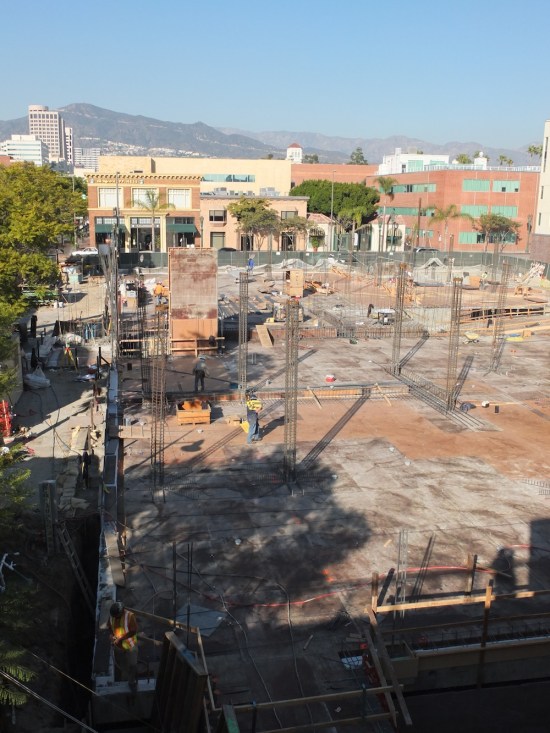
There’s much more detail in all of the buildings across the street, and especially that white building in the second row, which it turns out is actually a yellow building. The sunny parts of the construction site are also richer in color. And—we haven’t lost any shadow detail.
Serious photographers often like to go out in the early morning and late afternoon to catch the “golden hours”, because the light is warmer and easier to deal with. Me, when I get a chance to walk the streets with my camera, it’s often on days more like these. I’m glad I have a tool that will let me make the most of it.




 The View from the Foothills