Frank Frazetta has died. Lars has the scoop; below is my favorite of Frazetta’s book covers.

When I was in high school, there was a Chevy van I saw once in a while that had this picture painted on the side. I never knew who it belonged to, alas.

Frank Frazetta has died. Lars has the scoop; below is my favorite of Frazetta’s book covers.
When I was in high school, there was a Chevy van I saw once in a while that had this picture painted on the side. I never knew who it belonged to, alas.
Jack Campbell has at last finished his Lost Fleet series with The Lost Fleet: Victorious, and yes, he sticks the dismount.
It’s hard to review the last book in a series without giving important details away, but I shall try. First, since I’ve not reviewed most of the intermediate books, the premise. As the first book begins, the Alliance Fleet arrives in the capital system of the Syndicated Worlds, intending to take them by surprise, destroy their fleet, and end a war that’s been going on for the past century. But it’s a trap. The Syndics are expecting them, and most of the Alliance fleet is wiped out, along with its admiral. The captain with the greatest seniority is one John “Black Jack” Geary. But Geary’s situation is a little unusual.
In one of the opening battles of the war, Geary, then a lieutenant, takes acting command of his heavily damaged ship after the captain is killed. He sends off most of the crew into escape pods, and keeps fighting the ship until the last possible moment. He barely manages to reach an escape pod, which puts him into hibernation until such time as he can be recovered. But the Alliance was forced to flee the system, and in fact his pod is not recovered until a century later…by the Alliance Fleet on its way to the Syndics’ capital system. During his hundred year sleep, he discovers, he has been promoted to captain, and turned into a legendary hero. He’s the senior captain, all right: 100 years of seniority. But he has only commanded a ship for a matter of hours.
And yet, with all his inexperience he’s in many ways more experienced than anyone else in the fleet. Casualties have been so heavy for so many decades that most of what was once known about how to handle fleets in battle has been lost: those who knew it died in battle, and those who came after had no time to learn. Geary, though, was trained when the Alliance Navy was at its peak.
Following the debacle in the Syndic home system, Geary must try to get the remnants of the Alliance Fleet back home. The route used for the sneak attack is closed to them; it’s going to be a long, hard journey. “Black Jack” (a name he despises) has his work cut out for him.
The Fleet arrives home at the end of the fifth book—that’s not really a spoiler, narrative causality dictates that it was going to happen eventually—but there’s more to be done. Will Geary attempt to ride his success to control of the Alliance government? What about the war with the Syndics? And then, there have been signs of potentially deadly aliens on the far side of Syndic space, aliens who might have more to do with the Alliance than any of the Alliance leaders realize. And how about Geary’s love life? There are quite a few loose threads, and Campbell ties them all off for us.
Taken as a whole, the Lost Fleet books aren’t quite as entertaining as David Weber’s Honor Harrington tales are at their best (though some of the more recent of those have been dreadful). But Campbell keeps up the quality all the way through; if you like the first one, The Lost Fleet: Dauntless, you’ll enjoy the rest of the ride.
James made a dalek. (He’s been watching Dr. Who.)
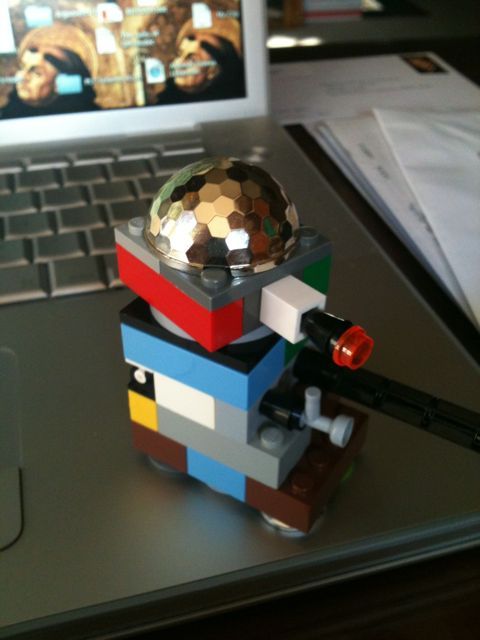
Just for smiles, I am posting this from my new iPhone.
Papa Married A Mormon, by John D. FitzGerald, is a fascinating book on a number of counts. Those who have read The Great Brain series as a kid (or to their kids) will recognize the author’s name; but rather than fictionalized version of his childhood, here FitzGerald is writing a book of family history: the story of where his grandparents and parents came from, and how they ended up in the town of Adenville in Utah. Many of the characters are familiar from the The Great Brain, but many are not—John and Tom had an older sister (who knew?), and their Uncle Will owned the biggest saloon in the vicinity.
But though John and his siblings appear, it’s really about John’s parents, Tom and Tena. Tom was a Catholic, a journalist from Pennsylvania, who followed his black sheep brother Will to Utah to fulfill his dying mother’s last request. Tena was a Mormon, the daughter of the owner of the general store in the neighboring town of Enoch. It was love at first sight on Tom’s part, evidently, and it led to no end of incident. It’s also the story of Silverlode, a mining town that grew up next door to the prosperous Mormon town of Adenville, a rambunctious dangerous place whose denizens were forbidden to enter Adenville without permission.
So the book is a treat on several levels. First, it’s a neat piece of history; second, I was fascinated to see how Tom and Tena and their families worked out their mixed marriage; third, the FitzGeralds are genuinely interesting people; and fourth, it’s often laugh-out-loud funny, one of those books that you can’t help reading passages out of to anyone who’s in the room. And fifth, there’s a goodness about the whole thing that’s truly compelling. There are also some surprises; the Great Brain books are more highly fictionalized than I had realized.
Highly recommended.
I’ve read a fair number of books that Julie has recommended, but she’s just put a new spin on it.
Paul: Tarsus to Redemption, Vol. 1 (story by Matthew Salisbury, Art by Sean Lam) is a fictional take on the life of St. Paul…presented as a manga-style comic. Julie mentioned on her blog that she’d gotten a review copy from the publisher, and that it looked interesting. A few days later, I got an e-mail from the publisher saying that Julie had mentioned to them that I might like it, and would I like a copy? I said, “Sure”, and it arrived yesterday. So now, not only has Julie recommended it to me, she’s arranged to have the publisher supply me with it. How cool is that?
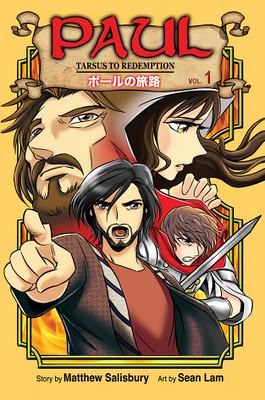
As I say, the book is a manga re-telling of the life of Saul of Tarsus. The very notion kind of filled me with dread. It gave me visions of something painfully earnest, with characters who smile too much and are filled with warmth and growfulness—sort of like a Japanese version of the old “Davy and Goliath” TV show. I feared it would be both tedious and didactic.
In fact, it’s nothing of the kind. As the book begins, Saul, with help from his buddy Septus and some others, kills a pair of Christians and burns their home to the ground. He has dedicated his life to rooting out this pernicious “sect”. Septus, his helper, is a Roman centurion, a convert to Judaism; he’s even more zealous than Saul. He’s exactly the sort of person Jesus talks about when he says,
Woe to you, scribes and Pharisees, hypocrites! for you traverse sea and land to make a single proselyte, and when he becomes a proselyte, you make him twice as much a child of hell as yourselves.
Then, of course, Saul has his encounter on the road to Damascus. He changes in ways that Septus cannot accept. And he learns the heroism to stand up for the Lord when it isn’t safe to do so: to stand up when it might mean your life, rather than seeking to take the lives of others. The authors have done something interesting here. They make Saul’s conversion realistic; they make his repentance real, and gripping; and they show how much he has given up.
So the story works for me. On the other hand, I thought the book was a little too long on purely visual story-telling; I’d have like a few more words. And there were a few places where I was honestly puzzled by the words that were there; places where the dialog didn’t seem to flow quite right. Of course, I’m not usually a manga reader; there are probably some conventions that I’m unaware of that would make it clearer.
Also, it’s rather short. I got through it in about half-an-hour, and my son David raced through it over breakfast this morning. But all that said, I liked it well enough, and David’s eager to read Volume 2, which is supposed to be out this summer. As Paul is intended for readers of age 12 and up, I’d say the authors have accomplished what they set out to accomplish. ‘Nuff said.
We think of happiness as an emotion: I feel happy today. But there’s a sense in which happiness is simply an objective state. For example, I have a job, and so am able to take care of my family. That’s a happy situation. I am much happier than if I had no job, and were not able to take care of my family. And that’s independent of whether I feel happy or not, or whether I actually feel like going to work or not.
 The View from the Foothills