
The winds have come up the last couple of nights, and there’s dust everywhere, a pleasant little legacy of last month’s fires. The last several mornings, there’s been a brown-tinged haze hanging over La Crescenta. Alas, my sinuses are not immune.
Monthly Archives: October 2009
Aquinas: A Beginner’s Guide
Philosophy is hard. The terminology is complicated, the words often don’t mean what you think they mean, and there’s over 2500 years of philosophical tradition to digest. Even when you think you understand what a philosopher is saying, you’re almost certainly you’re missing something.
And if you’re not a trained philosopher, it’s even harder.
For the last year or so, I’ve been trying to make headway with the philosophy of St. Thomas Aquinas. With the help of quite a many books, a lot of hard work, and encouragement from a surprising number of folks on-line, I begin to think that I’m at last beginning to understand a little of the very basics. (To quote Steven Brust, I might be putting that too strongly.) I know what some of the terms mean, and what they don’t mean; I know how some of the ideas go together. And one of the experiences I’ve had over and over again, as I read through something by St. Thomas and seen him pull yet another principle out of the air in the course of an argument, is a strong wishing for book I’ve mentally titled, Things St. Thomas Takes For Granted. St. Thomas has a number of basic assumptions, axioms, and self-evident (to him, at least) principles that he uses, and I’ve been longing to know what they are and how they fit together.
Edward Feser’s Aquinas: A Beginner’s Guide is the closest thing I’ve yet found, and I more or less devoured it.
Not only does he explain what St. Thomas is talking about, on such topics as metaphysics, natural theology, psychology (one of those words that doesn’t mean what you think it means) and ethics, he explains how modern philosophers typically mis-read St. Thomas, and why their objections and arguments against him fail.
I found it clearly written, explaining many hard and easily misunderstood concepts plainly and well, including a variety of my own misunderstandings, and when I got to the end I wanted more.
No doubt some of the bright light that went on in my head was illusory: things I thought I understood will slip away as I go back to wrestle with what St. Thomas actually said. And it’s entirely possible that I wouldn’t have found the book so helpful and enjoyable if I hadn’t put in all of the work I’d done previously. But as it is, I like, and I highly recommend it.
Robbie the Robot
I’ve been working on a computer game for the last month or so; it’s a programming game of sorts. The goal is to maneuver Robbie the Robot through a variety of dangerous environments by writing short little programs. It’s not ready for anyone but Tcl programmers to play with (i.e., I’ve not packaged it up as a downloadable application), but it’s already kind of cute. Here’s a level from the game, showing the robot in mid-execution of a program. He’s trying to get from the start point (the blue spot) to the finish (the green target). Click on the image to see it full size.
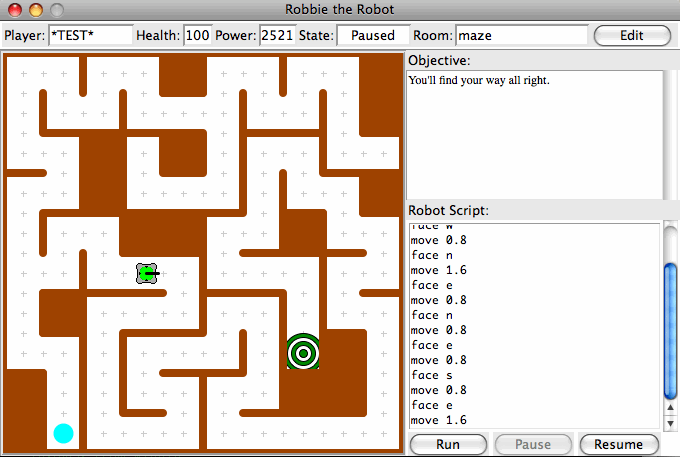
Screen shot of Robbie the Robot Game
I should add that the screen shot shows it running in test mode; that’s why there’s an “Edit” button in the upper right. You can create new rooms and edit existing ones using another simple language.
Did I say that this was aimed at my kids?
Endorsement Policy
Because the FTC is now requiring that bloggers who endorse products disclose whether they were paid for their endorsements, and because I review books, I now have an explicit endorsement policy.
The nutshell version: I don’t do paid endorsements, and if I’m reviewing a book sent to me for review I’ll say so.
The Nook
The Atlantic Wire has an article about Barnes & Noble’s new e-book reader, the Nook. It’s an interesting looking product; I’m quite curious to see one, though I’m quite happy with my Kindle.
Amazing Clarity
While I was in Portland for the Tcl/Tk Conference, I naturally went to Powell’s books; and given my current interest, I raided the theology shelves. One of the books I found, with glee, was Frank Sheed’s Theology for Beginners.
I discover authors in two ways: sometimes I’ll just pick something up while browsing, and sometimes I’ll go looking for something because I’ve seen positive mentions from a number of different sources. And sometimes in the latter case, the book or author in question is hard to get a hold of. In Sheed’s case, I’d seen him mentioned by a number of writers whom I’ve come to trust, but I simply never found any of his books at the bookstore, and (having lots of other books to read first) never got sufficiently motivated to look on-line. Besides, there’s the thrill of the chase: it’s fun to hunt for things.
So anyway, I found it at Powell’s, read a few pages, and snapped it up, along with Sheed’s Theology and Sanity (which I’ve not yet read). And I am singularly impressed.
First of all, Sheed writes with the clarity of C.S. Lewis. It’s a clarity he earned, speaking and fielding questions in Hyde Park, and learning how to get across to all kinds of people. Second, where Lewis was inclined to emphasize “Mere” Christianity in his writings, Sheed is trying to convey the richness of Catholic Christianity in all of its fullness—and he does so clearly, thoroughly, and not at all dryly. Many things that I’ve come to understand in dribs and drabs over the last two years are all laid out neatly and in order. The book is fifty years old (and thus pre-dates Vatican II) but except for a handful of references to details of the Latin Mass it doesn’t feel dated at all.
Lewis famously described Christianity as a house with many rooms, and “Mere” Christianity a description of the whole house, or perhaps of the hallway between the rooms. If you’re a fan of C.S. Lewis you’re curious what they believe in the Catholic room, you could hardly do better than start this one book (which, I’ve just discovered, is available from Amazon).
New Theme
And there it is, up there: the proverbial View from the Foothills. (My photo, by the way.)
Back in Action
The good folks at Dreamhost resolved my WordPress problems—the blog is now working again. And as a result of trying to diagnose them, I’ve upgraded all of the software, which means that many new features are available to me. Way cool.
Old News
I tried to post this yesterday, but my WordPress installation was having problems; probably everybody who cares has heard all about it by now anyway. But here it is.
This is big news—potentially huge news. The Vatican has announced a new provision for Anglicans to come into communion with Rome while retaining Anglican practice as much as possible.
There’s long been a pastoral provision for Anglican priests who become Catholic to be ordained as Catholic priests, even while married; and there have long been Anglican Use parishes that use an Anglican service modified to be in line with Catholic doctrine and canon law. Now there’s going to be something called “Personal Ordinariates.” I’m not quite clear on what that means, but what it seems to mean is that the Church will allow the creation of Anglican Use “dioceses,” headed by a bishop who is a former Anglican bishop or priest. I put “dioceses” in scare quotes because they aren’t diocese in the classic sense; they are clearly a special case.
The big question is the extent to which anyone takes advantage of this new provision. Many Episcopalians and Anglicans have chosen to swim the Tiber as individuals; there are many Anglican priests and even bishops who have done so. But there have been few congregations who have chosen to come over en masse, and hence few Anglican Use parishes.
Still, this is major news, and cause for rejoicing.
Troubles with WordPress
I swear, I don’t know what’s going on. Certain things with WordPress just aren’t working. I can post short test posts, but it’s choking on anything substantive. Â I’ve upgraded to the latest version, and it hasn’t helped. Â I don’t get it.
 The View from the Foothills