
It’s not as pretty as the sky I saw a couple of weeks ago, when I didn’t have my camera with me….but it’ll do.

It’s not as pretty as the sky I saw a couple of weeks ago, when I didn’t have my camera with me….but it’ll do.
So yesterday I got a second lens for my DSLR, a Nikon 50mm F/1.8. I got this lens for a number of reasons. First, it’s a prime rather than zoom, i.e., it has only one focal length. I wanted to try living with a single focal length for a while; lots of people have recommended this as a good way to get a feel for what different focal lengths can do for you. Second, it’s much “faster”, i.e., it has a wider maximum aperture, than my other lens. Third, I’ve heard extremely good things about it; optically, it’s considered to be very good. Fourth, for a lens it’s dirt cheap, which means that I could squeak it into my budget.
So today I took it out shooting. And I happened to take this picture of some power towers on the ridge line, and I happened to take it at F/22 (minimum aperture) just to see what would happen:
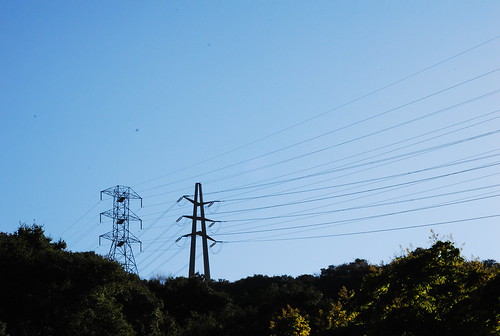
And what happened, I’m afraid, was Dust Bunnies. See those black spots in the sky? The two most noticeable are on the left side. Here’s a close-up, just for smiles:

Can you see them now? What those are, is dust particles on the camera’s sensor. See, the sensor gets electro-statically charged, and that attracts dust. And since you can swap lenses, dust can get in. So you get dust on the sensor. I don’t know if this dust was there when I bought the camera, or whether it moved in afterwards; but I’ve not removed the lens all that often, so I suspect it was there to begin with. It’s just hard to see except against a bright, plain background with a small aperture, and I’ve not taken many pictures like that to date…that came out, anyway (you remember, I had this problem with my lens diaphragm….).
Anyway, so what to do? It’s possible to remove these with the Clone Tool in Photoshop Elements…ugh. I can send the camera in to be cleaned; I gather that it’s not uncommon for new cameras to have dirty sensors, and that Nikon will clean it once for free; after that it’s $40. Plus shipping. Plus two weeks travel time. Ugh. My sources indicate that this will be a recurring problem; it’s something I’m simply going to have to deal with.
There are ways to clean the sensor yourself, and I’ve been looking into those. The best articles I’ve seen have been at The Luminous Landscape, a photography site run by landscape photographer Michael Reichmann. He discusses a couple of methods that I’m going to have to look into, given that my house is a dust magnet.
I’m used to looking at the pictures I take one at a time, rather than side-by-side. Whilst at soccer practice this evening, I took a bunch of photos of the sunset and of things lit by the sunset. Later I looked at them several times–one at a time–and as usual had trouble deciding which I liked best. Some were, as usual, clearly not so good; but also as usual, some were close enough that I just wasn’t sure. After a while, though, I managed to weed most of them out.
Then I went into LightZone to edit one of them. By default, LightZone shows you a set of large thumbnails of the photos in the directory. Suddenly I could see all of them side-by-side. And I was amazed at how a few of the twelve pictures I’d kept simply jumped out at me. They were clearly better than the others.
I’m going to have spend more time looking my virtual contact sheets on a virtual light table.
(Oh, here’s the picture I wanted to fix up.)

My, but this book is filled with folks who aren’t politically correct.
The premise is simple. Following WWII, a vet named John Rolfe, a Southerner, settles down in a house in Oakland, California. A freak accident with his shortwave radio set opens a gate between his basement and…somewhere else: an alternate California that’s approximately as it was when Columbus first came to the New World. A California that’s unspoiled, unpolluted, by modern standards almost unpeopled. Rolfe knows a good thing when he sees it, but he realizes that he can’t make use of his discovery all by himself. Who else to enlist but his old army buddies and their families? After all, there’s plenty of land–and there’s gold in them thar hills!
Flash forward six decades. A game warden named Tom Christiansen is on a bust of a ring that smuggles endangered species…including a California condor. Except that every California condor in existence has been tagged and tracked from birth; and this condor is unrelated to any of them. Something very odd is going on.
The story jumps back and forth between Tom Christiansen’s detective work and eventual discovery of the gate, and vignettes of the history of Rolfe’s new country, the Commonwealth of New Virginia. Ultimately, Tom gets caught up in a power struggle between the Rolfes and some of the other “Thirty Families” who lead the Commonwealth.
Surprisingly, Stirling doesn’t gore any of my personal team of oxen with this book. On the other hand, he certainly expected to gore somebody’s cattle, for the book’s dedication page includes the following quotation: “There is a technical, literary term for those who mistake the opinions and beliefs of characters in a novel for those of the author. That term is ‘idiot’.” I find it interesting that Stirling felt this disclaimer was necessary. In the power struggle that concludes the book we’re definitely on one side rather than the other; but it’s also clearly presented as a choice between lesser and greater evils. One would have to be an idiot to think that novel celebrates Rolfe’s imperalism; and yet I can’t think of anything else in it which would motivate such a disclaimer. Unless he’s all for imperialism despite Rom Christiansen’s concerns about it? Perhaps he’ll step in and let us know what he was thinking.
Anyway, I liked it, and wouldn’t mind reading further tales set in the same world.
A couple of weeks ago, Jane and I went down to the Getty Center in Los Angeles. If you’re not familiar with the Getty, it’s a sort of an art museum, sort of a public gardens, and sort of an interesting pile of architecture. Among (many) other things, the Getty has a massive collection of photographs; and though I didn’t really hope to see any of them (the art galleries proper are rather small) I figured the museum bookstore would have a neat photography section. Also, I hoped to take some nifty pictures of the grounds with my new camera. We didn’t have as much time as I’d have liked, but I did get some good shots…or so I thought until I got home.
One of the differences between the Nikon D80 and my old camera is that there’s no live LCD–you have to look through the viewfinder. (“Have to”! “Get to” would be more accurate.) The LCD is used for menus, which I don’t use all that much while I’m out shooting, and for reviewing the pictures you’ve taken. Reviewing them is neat, but extremely limited. You can tell if a shot is egregiously awful…but a shot that looks good on the LCD, that is exposed properly and well-composed, might still look awful when you see it full-size on your computer screen. Consequently, I don’t tend to look at the D80’s LCD all that often, or I’d have noticed the problem quicker.
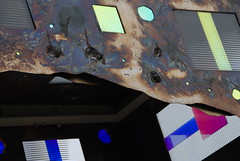
Not to put too fine a point to it, I had a horrible problem with over-exposure–not by a little, but by an awful lot. Most of the shots were simply unusable; some were exposed properly; and some few were over-exposed, but in an interesting way. Here’s an example:

What you’re seeing are a couple of giant “bouquet” shapes made of steel rebar with bougainvillea planted inside so that it spills out the top. I was trying to get the colorful tops along with part of one the Getty buildings and some sky; instead I got what you see. But why was I having so many exposure problems? I’d been experimenting with manual exposure and different ways of metering, so I assumed it was my fault, made a note that I’d have to be more careful in the future, and moved on.
The next Friday I went to my son’s soccer game, and took a bunch of pictures using semi-auto exposures (shutter priority or aperture priority), and again, many of them came out slightly or horribly over-exposed. I was nonplussed: in semi-auto mode, the camera sets the exposure; it surely ought to be able to do a better job. I got on-line at photo.net, and with my friend Ted the Test Lead, to ask about what I was seeing. Both Ted and the gang in the on-line forum eventually nailed it: it wasn’t just me, there was a problem with the camera or lens–and the evidence pointed to a sticky lens diaphragm.
When you take a picture, you need a certain amount of light to expose it properly. This gives you a choice: you can let a lot of light through a large hole for a short time, or a little light through a small hole for a longer time. The size of the hole is called the aperture; the length of time is the shutter speed. The mechanism that controls the aperture is the lens diaphragm; and the consensus was that sometimes the diaphragm wasn’t closing to a smaller size when it was supposed to, that it was getting stuck part way.
That seemed to explain what I’d been seeing; so I went out that afternoon, and started taking some test pictures. What I found surprised me. The pictures I took with a wide-open aperture were fine; the pictures I took with a smaller aperture were over-exposed. The smaller the aperture, the worse the over-exposure. It began to look like the lens wasn’t stopping down the aperture at all! Quickly conjectured, quickly tested. The D80 has a depth-of-field preview button, which stops down the aperture to the current setting (the aperture is usually wide-open except when you’re actually taking a picture). I stopped it down to F/22 (which is very small), and pressed the DOF preview. No change. Nothing. Suddenly, it all became clear–the only pictures I’d taken that worked over the previous week were those taken with the aperture at or near wide-open.
The folks at Samys Camera were very good about it, and swapped the lens for one that works properly; the salesguy said he’d never seen such a thing (with that lens, anyway), and he looked honestly shocked.
So, problem solved!
Well, maybe. I now have a lens that’s working the way it’s supposed to, and that’s a very good thing. It turns out, though, that the D80’s “matrix metering” system does tend to over-expose by about 2/3 of a stop in some circumstances. The conjecture is that it’s a marketing thing, with the intent of making high-contrast scenes look more “punchy”; the less expensive consumer-oriented D50 does the same, but the more expensive D200 (their low-end pro DSLR) does not. I’ll need to get used to that…or perhaps I’ll just experiment with spot and center-weighted metering.
Man, have I got a lot to learn!
I used to be a big fan of Orson Scott Card, ever since I read his first published work, the short story “Ender’s Game”, in Analog magazine. It was a dynamite story, and though I bought the novel Ender’s Game PDQ when it was published I always thought that the short story was better. In recent years, though, I’ve rather stopped reading him, for a variety of reasons, one of which is a tendency he’s developed of rewriting his early works, works I remember fondly, in ways that annoy me. When Ender’s Shadow was published some years ago, it seemed like more of that. I didn’t buy a copy, and when my brother loaned me his and suggested I read it, it sat on the shelf.
Just in the last few months, several readers have told me that it’s actually a pretty good book. So when I headed off to Chicago for the Tcl conference this year, I decided to give it a try. And it’s become clear that I had dismissed it too hastily–from what I remember of Ender’s Game (the novel), I do believe I like this one considerably better. Bean’s a more interesting character than I would have guessed–more interesting than Ender, in fact–and Card does a neat job of developing him. He also manages to put a new spin on the story without breaking what’s gone before.
That’s all there is to say, really. Those of my readers who are familiar with the Ender books have probably already read this one, and I can’t say much about the plot without spoiling the earlier books for those who haven’t read them. I liked it. I’m going to have to look up the sequel(s). ’nuff said.
I’m off to the Tcl conference this morning; the shuttle arrives to pick me up in ten minutes or so. So I’ll be spending the next few days near Chicago, where it’s expected to be cold and wet, with storms on Thursday. I fly home on Friday; pray for me (if you’re so inclined) that my flight won’t be delayed.
There won’t be any book reviews this week, and I won’t be responding to my e-mail, but I might make a blog entry now and again.
Which reminds me…we emptied a 24-pack of Diet Pepsi yesterday. My 9-year-old asked to have it; he wanted to make a Halloween costume out of it.
“Do you know what it’s going to be?” he asked.
“A mask for your head?”
“No, a costume for Panda!” Panda is his teddy bear.
I was surprised. “Panda’s going to Halloween dressed as a case of Diet Pepsi?”
“No, as a Vending Machine!”
And a little while later he showed me Panda all dressed up as a vending machine–with the ability to vend cans of soda, I might add.
I’ve not been posting much because I haven’t actually finished any books to review since I got my new camera. In lieu of that, I thought I’d reveal what the “view from the foothills” actually looks like:

Although, in point of fact, this isn’t the view from where I live; rather, it’s a view of where I live.
I’ve not posted much this past week, for the same reason that I’ve been humming an old Paul Simon tune on and off for days. You see, after much thought, and contemplation, and discussion, and research I’ve finally opted to make the move to a fancy “DSLR” camera. Here’s one of the first pictures I took with it.

An “SLR” is a “Single Lens Reflex” camera…which is to say, a camera with a “through-the-lens” viewfinder. That’s the “single lens” part. The “reflex” part relates to the mirror which normally hangs down in front of the film and directs the light from the lens up into the view finder. When you press the shutter release, the mirror swings up out of the way. Your traditional fancy 35mm camera with the big flash unit on top and the bevy of replaceable lenses is an SLR. A DSLR, of course, is a Digital SLR, in which a digital sensor has replaced the 35mm film.

What I ended up with, of course, was a Nikon; why else would I be humming “Kodachrome” to myself? (“I’ve got a Nikon camera, I love to take the pho-o-o-tographs, Oh Mama don’t ta-a-a-a-ke my Kodachrome away….”). In fact, I got a Nikon D80, a newish camera that’s rather a blend of their bottom-of-the-line D50 with their prosumer D200. Needless to say I’ve spent quite a bit of time over the last week playing with it.
I’m enjoying many things about the D80. It’s got a great big bright beautiful viewfinder, which has been a revelation. I’m used to composing my shots on the LCD on the back of the camera, so it’s been a long time since I last used a camera’s viewfinder; and as I’ve never had an SLR-class camera before I’d never known what a beautiful thing a proper through-the-lens viewfinder can be. At last, I feel like I can really see what I’m doing. Instead of looking at a little picture on the back of the camera, I’m looking at the subject. Add to this that I’m nearsighted, so I wear distance glasses. When I’m wearing them, it strains my eyes a bit to look at things close up–so using that LCD, either I have to take my glasses off (in which case I can’t really see the scene) or I have to hold the camera far enough from my face that I can focus on the LCD, which just makes the picture smaller. With the D80, I can wear my glasses, and look through the viewfinder at the subject. ‘Swonderful.
Then there’s that delightful little noise it makes when I press the shutter release–that little noise that means that the mirror flipped up and then down again. I dunno why, but there’s something much more satisfying about it than that little pre-recorded click my other cameras have made. And there there’s the low-light characteristics. I took the following picture at ISO 400; there’s no noise, and it’s crystal clear:

I drove into a parking garage this afternoon, and as I opened my window to push the button and grab my ticket I was bemused to see a grasshopper on my hood. It stayed there as I drove around and about and up several levels, and naturally I took some pictures of it. The day was dim and overcast, and even where I parked, at the west end of the structure, the light was none too good. I took the following picture, handheld, using a 300mm zoom lens (35mm equivalent) at ISO *1600*; the grasshopper was sitting on the windshield wiper.
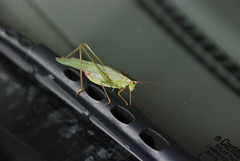
Couldn’t have done that with my old camera.
As is usual at this time of the month, the monthly issue of Ex Libris Reviews is now on-line.
 The View from the Foothills