Spilled Milk

So this morning, through no fault of her own, Jane spilled a full glass of milk across the kitchen table…and onto my laptop, on which I was reading the morning’s news. I turned it off, and dried it off, and let it air dry during the day, and it appears to be working now. Except for two things: the CapsLock key doesn’t work (why? The milk didn’t land on that end of the keyboard), and I can only get a capital “I” using the shift key on the righthand side of the keyboard. The shift key on the lefthand side of the keyboard works fine for every key…but “I”.

Wait a minute….the “I” is working again….but the CapsLock still doesn’t work.

Now if only I could understand why “LeftShift-i” wasn’t giving me “I” to begin with. I can’t think of any reasons that make sense. I can think of reasons why the “i” key might fail altogether, and I can think of reasons why the LeftShift key might fail altogether, but I can’t think of any reason why that combination, and only that combination, would fail.

And how come my web browser says “Display a Menu” on the status line when I press the CapsLock key?

I’m confused.

Update: Now my “Down Arrow” key doesn’t work, and the guy at the computer store said, “By all means bring it in–it needs to get cleaned out as soon as possible. In the meantime, leave it turned off.” So I’ve hooked up my external backup drive to my kids’ eMac (and ain’t it slow, though!) and I’m presently copying all of my user files from my external backup drive to my other external drive so that I can run off of my external backup drive without feeling like I’ve got no backup. It looks like it’s got about two more hours to go. Then I can begin to think about paying the bills.

Note to readers: if you don’t have a good backup of your computer, make one. This can happen to you.

Back to Virtue, by Peter Kreeft

Some while back I reviewed C.S. LewisThe Abolition of Man, an outstanding book on the decay of a common sense of morality in our culture and the effect it was likely to have on society. Peter Kreeft’s Back to Virtue reads like a companion to Lewis’ work–except that by the time Kreeft wrote it in the late 1980’s, the problems Lewis foresaw were already here. And they are still with us today. I was fascinated to read the following passage:

We have lost objective moral law for the first time in history. The philosophies of moral positivism (that morality is posited or made by man), moral relativism, and subjectivism have become for the first time not a heresy for rebels but the reigning orthodoxy of the intellectual establishment. University faculty and media personnel overwhelmingly reject belief in the notion of any universal and objective morality.

Yet our civilization, especially the two groups just mentioned, talks a good game of ethics. Ethical discussion has grown into the gap left by a dying ethical vision. It is the kind of discussion Saint Paul described as “ever learning and never coming to a knowledge of the truth.” (Perhaps he had a prophetic vision of our modern TV talk shows!) It is intellectual ping-pong, “sharing views” rather than seeking truth. For how can we seek something we do not believe in? The notions that there is objective truth in the realm of morality and that an open mind is therefore not an end in itself but a means to the end of finding truth are labeled “simplistic” by the intellectual establishment when, in fact, they are simple sanity and common sense.

As I read this, written twenty years ago, I had a vision of virtually all of the progressive Episcopalian rhetoric I’ve read over the last three or four years. Kreeft nailed it; he absolutely nailed it. I could quote more; I was constantly reading bits of it to Jane as I went through it.

As the father of four children, I want my kids to grow up knowing right from wrong; and I want them to be able to articulate their knowledge. This book is going to help me do that, because it’s going to help me do it for myself. I’ve read it once, and I think I’m going to re-reading it fairly often for a while; there’s a wealth of information and practical advice that I can definitely use. If you’re concerned about where society’s going–and what you personally can do about it–you should read this book. I recommend it highly.

Bystander: A History of Street Photography, by Colin Westerbeck and Joel Meyerowitz

Some while back I reviewed Beaumont Newhall’s History of Photography. While reading that book I was particularly taken with his description of various street photographers, notably Henri Cartier-Bresson and Eugene Atget. And given that I take most of my pictures while out-and-about, walking hither-and-yon, I was curious to learn what other photographers had done in similar circumstances.

I asked around, and was pointed at this book. I had to order it on-line, and at $50 it was rather expensive to be buying sight-unseen; but it came recommended, and I was still in the early days of my passion for photography–I find that when I take up a new hobby, I almost go out looking for reasons to spend money, not a good habit but a common one, I suppose–and I went ahead and ordered it. My chief concern was that it would be too lightweight, that I’d read through it in a couple of hours and wonder what I’d spent my money on.

That was a number of months ago; and as I just finished it this evening I suppose I can’t call it lightweight. In fact, it’s quite a detailed exposition of street photography, from its earliest origins in the 19th century up through the final decades of the 20th. If I have a complaint it’s that there aren’t enough pictures–but then, there are seldom enough pictures in a book like this–and that the pictures aren’t well integrated with the text. This was done on purpose, I guess, to let the pictures stand alone, but it would have made it simpler if the pictures were closer to where they were discussed. Also, the tone of the text is rather more hifalutin’ than in Newhall’s book–so that instead of devouring it in a couple of days, as I did Newhall’s book, I spread it out in small segments over several months.

On the whole, though, I have to pronounce myself satisfied. I’ve now been exposed to the work of a great many skilled street photographers, and learned a great deal about their motivations. I’ve also taken a great deal more photographs, many of them in the street, since I acquired the book. And I’ve learned a few things.

First, it’s difficult to do real street photography walking around a quite suburban neighborhood. Street photography delights in odd juxtapositions of people, and you simply don’t get enought people on the streets. And then, if I go downtown there are more people on the streets…but I find taking pictures of folks I don’t know rather daunting, especially since I don’t really want to call attention to myself. Consequently, my forays into real street photography have been extremely limited to date. But as I intend to continue walking, and I intend to continue taking pictures (I’ve made–and kept–over a thousand exposures since January) I rather expect I’ll take a few more that qualify.

Current Events

It’s possible, even likely, that many of you are blissfully unaware that The Episcopal Church’s triennial General Convention is winding to a close in Columbus, Ohio tomorrow. It’s even likely that many of you are blissfully unaware that The Episcopal Church holds a General Convention every three years! Would that we all could be so blessed. Unfortunately, knowledge of General Convention is like Pandora’s Box–once you open it, all sorts of unpleasant things fly out, and you’ll never be rid of them.

You might recall that earlier this year my parish chose to leave what was then called the Episcopal Church in the United States of America (ECUSA) and seek refuge in the Diocese of Luweero in the Anglican Church of Uganda, a church to which our parish somewhat remarkably has deep and longstanding ties. I have consequently been watching General Convention with some interest, as the forces which drove St. Luke’s to this odd step have been the prime topic of discussion in Columbus. I have been watching, and praying for clarity.

The Episcopal Church, as this convention has asked it to be called, consists largely of three groups: the progressives on the one hand, the traditionalists on the right, and the folks in the middle who have been attending The Episcopal Church for years and don’t know what all the fuss is about it. It’s fair to say that the folks at Convention fall into one of the first two groups, as the latter (a group I belonged to not so long ago) are hardly aware of their yearly Diocesan Convention, let alone the triennial General Convention.

For those of us in the second of the two groups, the traditionalists, it’s become clearer and clearer over the last few years that (A) the progressives have captured the national church organizations, most of the seats in the House of Bishops, and a substantial number of the individual parishes, and that (B) the progressives and the traditionalists have no common ground for discussion. We argue from the Bible, from tradition, and from orthodox theology; they argue from….well, in point of fact, what do they argue from? I’ll come back to that.

I imagine that point (A) has long been obvious to the progressives as well; point (B) seems to have eluded most of them. There are several reasons for that. First, they seem to take it as an article of faith that if opposing parties will simply sit down and hash things out, they can come to a reasonable consensus. That we traditionalists haven’t yet come to a reasonable consensus with the progressives simply means that we haven’t discussed it sufficiently…because if we had, then naturally we’d see it their way. That we continue to disagree with them is simply a sign that we’re unreasonable. (Bear in mind, these are the folks who seem to think that the Israelis could come to a reasonable accommodation with Hamas if they’d just sit down and talk things over. Israel tried that with Yasser Arafat, and it got them nothing but years of suicide bombers.) There are no problems so big that enough careful listening won’t make them go away.

The second reason is that Anglicanism has always incorporated many different theological parties of wildly different views, and as a result Anglicans have gotten really good at papering over the differences with grand-sounding but theologically vague rhetoric. Those who rise to the top of the leadership in TEC are generally especially good at this, and that makes it difficult to see the divisions clearly.

The progressives, so far as I understand their position, base their policies on the “liberation theology” that came out of Latin America in the 1980’s. Liberation theology, so far as I understand it, is a realized eschatology–a plan to bring about Heaven on Earth by breaking down every last barrier, every last oppressive structure, to liberate every last oppressed and marginalized group. In this system, the Church becomes primarily a means to this end; the Bible is important so far as it serves this end; the Resurrection is primarily a metaphor for this liberation; and notions of morality, sin, and redemption are secondary, where they are not in fact instruments of oppression and marginalization. Consequently, they have supported first the ordination of women as priests and bishops followed by the blessing of same-sex unions and the ordination of gay and lesbian priests.

It is always dangerous to characterize your opponents’ views; there’s always the risk of raising up what James Lileks once terms “a clone army of strawmen.” But I believe I’m presenting their views fairly, though no doubt overly simplistically.

The traditionalists, on the other hand, esteem traditional Christian orthodoxy, traditional Christian morality, and view the Bible as the inspired Word of God that holds authority today, rather than as a man-made document that might have been appropriate two-thousand years ago but is now sadly out-of-date. For the traditionalists, the traditional teachings of the church are not to be thrown out simply because they conflict with the demands of our modern culture and of liberation eschatology. If one can make a biblical and theological argument in the context of tradition for some new innovation, such as the ordination of women, then some traditionalists might accept it. This is, in fact, the state of affairs regarding women’s ordination: some traditionalists accept it on theological grounds, and some do it.

What first made the vast gap between the progressives and traditionalists apparent to most of us was the aftermath of the last General Convention, when a gay man who had left his wife and children to live with his gay partner was confirmed as the Bishop of New Hampshire. We begged and pleaded, all over the Anglican blogosphere, with the progressives to give us a theological justification, on solid biblical grounds, for what they had done–and none was forthcoming. I never even saw it attempted. I still haven’t. The progressives simply do not value that kind of argument.

As a result, much of the coverage of the Current Unpleasantness has focussed on the question of gays and lesbians in TEC, even though for us traditionalists the issues go much deeper and broader. Because the question of gays and lesbians in TEC is the presenting problem, though, even we tend to spend too much time on it.

Which is no doubt why yesterday’s events have thrown all of us for a loop. Yesterday, after just five ballots, a woman was elected to be the Presiding Bishop (what in other Anglican bodies would be called an Archbishop) of TEC. Bishop Schori is the first female Anglican primate. This puts her in a position of authority over all other bishops in TEC.

I don’t believe that ordination of women as priests and bishops was in the forefront of anyone’s mind as Convention opened this year–yet there are three dioceses in TEC (Quincy, San Joaquin, and Fort Worth) which do not accept the validity of women’s ordination. The Diocese of Fort Worth has already requested “alternate primatial oversight” from the Archbishop of Canterbury–in other words, the bishop of Fort Worth has refused to accept Bishop Schori’s authority. Word is, it’s likely that the other two will do the same once Convention is over and their delegations return home. On top of these, Bishop Schori is one of the more liberal bishops in TEC, fully at home with the realized eschatology of liberation that drives the progressives. The progressives at Convention, through this election and through the resolution process, have been standing their ground and have been refusing to resort to the kind of nebulous rhetoric the previous Presiding Bishop is famous for.

I and many others prayed for clarity; it looks like we’re getting it, in spades.

(A footnote: now is not the time for me to discuss the rightness or wrongness of women’s ordination. Suffice it to say, there are theological arguments rooted in scripture for both positions. It’s not an issue I have strong feelings about, nor have I studied the arguments on either side.)


The Chronicles of Amber, by Roger Zelazny

Roger Zelazny eventually wrote ten books in the Amber series; what I’m speaking of here are the original five books about Corwin, Prince of Amber: Nine Princes in Amber, The Guns of Avalon, The Sign of the Unicorn, The Hand of Oberon, and The Courts of Chaos. It’s probably been fifteen years, or possibly even twenty, since I’d last read these, and ya know, they haven’t changed a bit. It was nice to become reacquainted after so long, but somehow it didn’t seem as long as all that while I was reading. It’s as though every single word had been engraved in my brain–I wasn’t so much reading them as remembering them. Consequently, I won’t try to review them as such; when I first encountered them, they were too electric, too mind-blowing for me to be particularly objective now.

If you have any taste for high fantasy, and you’ve not read Zelazny, you owe it to yourself to check out at least these books, and then Lord of Light as well. Finding them might be tricky. There’s an omnibus edition, entitled The Great Book of Amber if I recall correctly, which I think is still available. It also includes the Second Chronicles of Amber, five more books involving Corwin’s son, and is printed on really shoddy paper–at least, the copy I first saw was. It’s too big to read comfortably, and the paper looked like it would start to fragment after a few years. I didn’t buy it.

The copy I read this time is the two volume hardcover edition published the Science Fiction Book Club back in the 1980’s, which I bought used last month. Most of the SFBC editions were cheaply bound, with thin boards and bad paper; this quality of the binding and paper in this one is surprisingly good, and the folks at the used book store told me that it’s much in demand as the only hard cover edition of the Corwin books that’s readily available. Publishers take note!

The Old Zoo

Today I returned to a place I last saw when I was no more than three years old, and probably younger than that: the old Griffith Park Zoo. The old zoo was replaced by the current Los Angeles Zoo in 1966; it has since been turned into a picnic area, and is much frequented by walkers, joggers, and photographers. I have one dim and indistinct memory of the old zoo: the zoo trams were pulled by engines in the shape of elephant heads. Picture a giant “Dumbo” head, less the circus cap and giant ears, pulling a tram and you’ve got it. At least, so I remember it. I had caught sight of these trams and wanted a closer look, and I distinctly remember running towards one that was coming down the path in our direction. I wasn’t going to get in its way, but my mom scooped me up anyway. And that’s what I remember about the old zoo.

This morning, we packed up the kids and headed over there for a “family walk”. Naturally I grabbed the camera. As I say, it’s been converted into a picnic area:

20060617-075417.jpg

All of the modern amenities are close at hand (and apparently have seen considerable use).

20060617-075508.jpg

The zookeepers must have had a fun time feeding the animals; here’s a picture (slightly blurry, alas) looking up the stairs from the zookeeper’s entrance in the back of one enclosure:

20060617-075711.jpg

Looking at this cage, I really wonder how you were expected to see whatever kind of creature lived inside. Whatever it was, it certainly wasn’t likely to get out.

20060617-081920.jpg

Some of the cages are still occupied, if untended. Here we see some domestic ivy escaping into the wild.

20060617-081846.jpg

And one set of monkey cages still had inhabitants.

20060617-080440.jpg

Not-So-Wild Life

Whilst walking through the park with my boys after dinner this evening, we spotted this little fellow:

20060615-170351.jpg

You can’t tell from this picture, but he was moving strangely, and his (or her, I suppose) other ear flopped around when he moved as though he could no longer make it stand up. Plus, he was nibbling grass in broad daylight over ten feet from any cover.

This, my friend, is no wild rabbit. As we realized later, this is a tame rabbit that has had, in all likelihood, the worst day of his life. How do I know? His behavior; his wide, staring eye; and then there’s his color. I’ve never seen a native rabbit that shade; all of our native rabbits are gray. In fact, they are just about the same color as this lizard, which we spotted at about the same time:

20060615-170449.jpg

About the only good thing we can say about this rabbit’s future is that by this time tomorrow he will no longer be hurt and terrified, because a coyote will have gotten him. The lizard, on the other hand, will be just fine.

Update: Jane saw this rabbit again several days later, still hopping about in the open in broad daylight (it was mid-morning), but still ambulatory. Apparently my predictions of its demise were over-pessimistic. Still, I think it’s unlikely to last the summer.

Jerome and the Seraph, by Robina Williams

This is an extremely puzzling book; I’m still trying to figure out what to make of it. (I’ll note in passing that the author sent me this copy for review.) It’s intended to be a light-hearted fantasy; I didn’t find it particularly amusing. One of the central characters is the absurdly named “Quant”, the Quantum Cat. You know, the cat that’s dead and alive at the same time, due to Heisenberg’s Uncertainty Principle? Which is invoked in the following way: “Looking at something alters it. Looking moves particles around.” Except that it doesn’t, of course–not at the macro level. But as this is a lighthearted fantasy I don’t want to make too much of that.

It takes place at a very odd English monastery–or, to be more precise, a friary; the residents are friars. Their precise order is never named, though apparently they are Roman Catholic friars. But there’s very little of the religious life in the book. There’s an occasional reference to Mass, but there’s nothing of the monastic Hours, although the services of the Hours are what give the rhythm to the religious life. Indeed, the friars seem to live lives that are largely unscheduled and have lots of free time, whereas I’ve never met a man of the cloth who couldn’t have used umpteen more hours in the day. More than that, few of them seem to have any sense of Roman Catholic doctrine or theology. Perhaps that’s the common state of religious communities in the early 21st century, but I’d certainly hope for better than this.

In most cases I wouldn’t worry so much about this sort of thing, of course. If a mystery novel pays a quick visit to a monastery, I’m not put off by little inaccuracies in theology. It all depends on the book’s world view, and this is in part what’s so puzzling about Jerome and the Seraph. Most books published today are written from the secular humanist world view. If God exists at all, he’s in his heaven; meanwhile we have to get along in the world as it is. Even fantasy fiction is mostly written from this world view: the supernatural trappings are window-dressing, there for atmosphere and to drive the plot; the only extent to which most fantasy novels are meant to be realistic is in the interactions between the characters. In “secular” novels I don’t usually sweat the religious or theological details, provided that the book isn’t out-and-out hostile to my faith.

There are exceptions to the rule of the secular world view in fantasy, of which J.R.R. Tolkien and C.S. Lewis are no doubt the most prominent. The puzzling thing about Jerome and the Seraph is that it doesn’t appear to be written from the secular world view…but I’m not entirely sure just what its world view is. It certainly isn’t the orthodox Christian world view of Tolkien and Lewis, but there’s a definite emphasis on “spirituality”.

On the one hand, we have our poorly catechized and sadly ignorant friars; on the other hand, some of them are clearly shown to have a real love and devotion to Jesus Christ. As the book opens Brother Jerome has just died (he stumbled in the friary’s graveyard and broke his head on a tombstone). He’s quite disgusted about the whole thing, and surprised about the after life, which seems to be quite amazingly empty; just him and nothing else. But despite not going to heaven in any Christian sense–which he describes to himself in terms of cherubs, harps, and fluffy clouds, as though that notion had any real validity–he’s not distressed, downcast, or even much exercised about it. I would have thought it would call for some radical readjustments. Later on, Quant (who appears to be not only a cat, but also the “seraph” of the title) assures Jerome that Jerome’s Lord is indeed Lord of All…but this appears to be meant in the Universalist sense, i.e., that all religions are more or less successful attempts to draw near to God, and that all of them have more or less the same content. To be fair, I’m reading between the lines here, but the vagueness with which the idea is expressed is of a piece with the fuzzy theology of the whole book. To add to the puzzling theological tone I’ll note that Brother Jerome is (per the author’s afterword) intended to be the re-incarnation of St. Jerome, the man who first translated the Greek Old Testament into Latin, as though meek, simple Brother Jerome the late friary cook is anything like that irascible, cantankerous desert father.

As I say, I wouldn’t ordinary stress myself over the theology and worldview of a book like this, except that it seems to be important to the author, and clear theology is important to me.

On top of this, the book doesn’t seem to have much of a plot–or if it does, it eluded me. The late Brother Jerome spends a fair amount of time learning the ropes of the after-life, being bailed out of trivial scrapes by Quant, and wandering about the friary and visiting with his old pals who aren’t dead yet; but not to any particular result that I can see. There are only two important conflicts in the book. The first is when Jerome discovers that there’s more to God than he realized (this is where the Universalist tendency comes in), and although he’s shocked his eventual resignation to the actual state of things has no real consequence in the book. (This is part of why I say I think the theology, such as it is, is important to the author. I think there’s a message here) Then there’s Father Fidelis, the friary’s “guardian”, which I take to be an office like “abbot” or “mother superior”. Father Fidelis spends the book going through some kind of spiritual crisis, apparently involving a sexy woman who’s just moved into the parish. He resolves it by the end of the book and takes a new lease on life…but although his fidelity or possible lack thereof is a major topic of conversation at the friary (and even Brother Jerome goes and takes a peek at the woman’s house) there’s no interaction between Fidelis and any of the others (including Jerome) on the subject. Nothing Jerome or Quant does seems to have any bearing on it at all.

So there you have it. It’s theologically muddled, relatively plotless, not particularly amusing (to me, at any rate), yet seems to be pushing the Oneness of All Religions. I can only conclude that the author is similarly muddled but deeply “spiritual”, rather like many of the current leaders of my late denomination, the Episcopal Church. Frankly, I probably wouldn’t have finished it or reviewed it except that the author paid for the book and the postage to get it here from England and I’d feel like a heel if I didn’t give it a fair shot; and I feel a bit like a heel anyway since I hate writing bad reviews when I know the author is going to read them.

Possibly I’m reading too much into this; possibly Williams meant no more than to write a lighthearted fantasy and thought it would be fun to set it in a religious community, rather as Dan Brown meant to write a pot-boiler and thought it would be fun to make the Catholic Church the villain. I dunno. But if so, then I am most definitely not among the intended audience.

There’s a sequel, entitled Angelos; and as Ms. Williams first inquired as to whether I’d like to read and review that book and then threw Jerome and the Seraph as well, so that I’d have the full story, I rather feel compelled to read it too….if only for additional clues as to where Ms. Williams is coming from. But that will be another review.

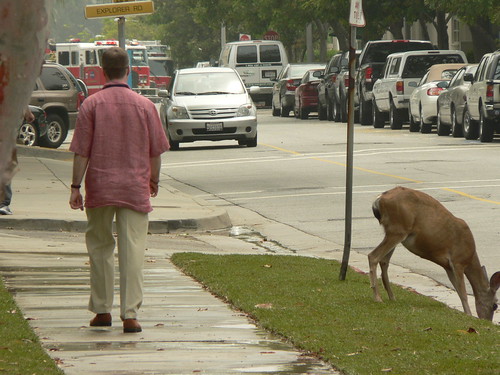
Oh, Deer!

20060606-093319.jpg

There’s always a lot going on where I work. Though I don’t believe the deer is on the payroll. (That’s Ted the Test Lead walking past the deer, by the way.)