Hiatus!

Well, OK, considering that it was about two weeks ago that I said that I wasn’t on hiatus, despite appearances to the contrary, and that I haven’t posted anything since, I suppose I’m more or less on hiatus.

I hadn’t intended to be; I’ve just had no interested in writing anything for last couple of weeks. I’ve spent the last month putting the finishing touches on the project that’s consumed most of my time for the last year, and though the last week or so have been fairly relaxed I simply haven’t had any creative juices left over at all.

I’m rather hoping that I won’t remain at such a low ebb for much longer; but it’s moot for at least the next week, because Monday morning I’m off on another business trip.

I expect to get this month’s Ex Libris Reviews on-line sometime this weekend (such as it is; I reviewed very few books this month), but that may be it until after I get back.
Hiatus?

No, not really; I was just on a business trip to Ft. Leavenworth, Kansas, for a week. A well-timed week, actually; I flew out there on Monday, the day after all of the tornados (over a hundred in one day in the Midwest) and flew home yesterday, the day before another major storm was due to roll in.

Anyway, I’m back.

Slavery

Lars Walker makes an interesting point about slavery that I’d not previously considered:

The first thing to understand is that slavery is not an anomaly in human history. Our own society’s abolition of slavery is the anomaly. There have been very few cultures in the world – and those few very primitive – that did not practice slavery. Up until modern times the sophistication and greatness of a culture were almost always proportionate to its slave-holding.

This is because, up until the Industrial Revolution, slaves were the only labor-saving devices that existed.

He stretches the point slightly; water wheels and wind mills predate the industrial revolution by a good bit, I believe, and I suspect you’d have to define serfdom as a moderate form of slavery for his argument to hold. Nevertheless, there’s a lot of truth to what he says.

Read the whole thing, except possibly for the opening paragraphs on snow and roof rakes.

Past Photo Op


Past Photo Op

Originally uploaded by will.duquette.

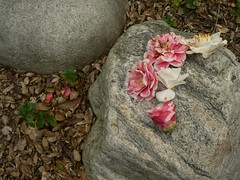
One of Descanso Garden’s two claims to fame is its Camellia Forest. Camellias aren’t native to California, but live oaks are; and camellias grow well in the shade, in acid soil. Many years ago, a man named Manchester Boddy realized that live oaks are really good at producing both, and that an oak forest is the perfect place for growing camellias.

The camellias are blooming right now, and in my in rounds I frequently see little mounds of camellia blooms in odd places. At first I was a loss to account for them; the ground under the camellia plants are frequently carpeted with fallen blooms, but not in little mounds; and anyway the mounds are never under the camellia plants.

Judging that garden gnomes are unlikely culprits, I have since concluded that these shabby little mounds are the work of other photographers. That remains conjecture, however, as I’ve never caught one at it.

The Other Shoe

I finally got my first piece of comment spam on this new blog yesterday. Or, rather, the first that got through the built-in spam filter. I hope that this isn’t a preview of coming attractions…..

Ship of Destiny, by Robin Hobb

This is the final book in Hobb’s Liveship Traders trilogy, and although it took me a long time to get through it I enjoyed it very much, and stayed up late on Saturday night to finish it. This is fairly typical for Hobb’s books: they are very long, and slow to get started; and the problems the characters face are painful enough and develop slowly enough that I usually prefer to read them in small doses. But constant acceleration can build quite a bit of momentum, and I usually end up reading the last couple of hundred pages in one or two big gulps. The effect is more pronounced when the book is the last in a trilogy, as this one is.

It would be difficult to say much about the plot without spoiling the earlier books, so I won’t; but I will say that the ending is quite satisfactory. It resolved the major conflicts (of which there were many), tied off the loose ends, and left me wanting more. Not too shabby, all things considered.

Mardi Gras

Yesterday was Mardi Gras, or Shrove Tuesday as we Anglicans call it, and consequently we feasted in proper Anglican fashion–but going out for pancakes. In years gone by that might have meant going to a church pancake supper, but that tradition has faded, at least at St. Luke’s; so we went to IHOP instead. And given that I’d not had either pancakes or hashbrowns in over a year, it was a feast indeed. Today, of course, I’m back on the wagon.

On the way to IHOP, I explained to our kids what Mardi Gras is all about, that it’s a time to feast before the penitential season of Lent. I explained that different people celebrated in different ways, and that in some places folks let their celebrations get out of hand and “behave very badly indeed.”

“What,” said my son James, “You mean like, they don’t say ‘please’?”