Orange Flowers


Orange Flowers

Originally uploaded by will.duquette.

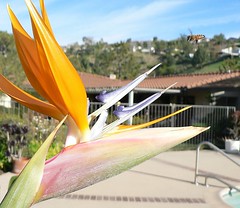
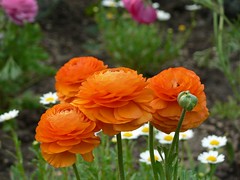
I’ve been spending a ridiculous amount of time taking pictures at Descanso Gardens recently–so much time that when one of my boys suggested that I go for my daily walk at Descanso today, because maybe the train would be running, I didn’t really plan on taking many pictures. I brought my camera anyway, just because I always take it with me on my walks; I figured I’d take a few pictures of my kids. Seventy-some pictures and almost an hour later we left the gardens…and on the way out, just after I’d put my camera away, these flowers caught my eye. “One shot,” I said. “I have time for one shot.” I snapped this as quickly as I could, and ran off to join the kids.

Creative Nature & Outdoor Photography, by Brenda Tharp

The difficulty in reviewing non-fiction books like this one is to know how to describe the content more pithily than the title does. With Tharp’s book I must concede defeat; it really is about creative nature and outdoor photography. Contrarily, books on photography are easier to judge than most, as they are generally filled with the author’s own photographs; her credentials are evident on every page. By that measure, Tharp writes whereof she knows.

The book is, I confess, a little too advanced for me. She writes for users of the traditional film SLR camera, and assumes they are familiar not only with basic photographic technique but also with the more esoteric features of their cameras–as a result, this should not be your first book about photography. On the other hand, she has a great deal to say about composition and the use of light that applies equally well to film and digital photography, and on that front I might have learned a thing or two. It’s a book I’ll want to come back to when I’ve a little more experience.

In the meantime, I still recommend Bryan Peterson’s Understanding Digital Photography, and also his Understanding Exposure which I’ve been reading simultaneously with this one. It covers some of the same ground, and goes into much more detail about how to use your camera.

(Side note: I’ve been lucky in my choice of books–there are a lot of duds out there, and somehow I’ve managed to spot some of the better ones. A little research pays off.)

Fish Fountain, Morning


Fish Fountain, Morning

Originally uploaded by will.duquette.

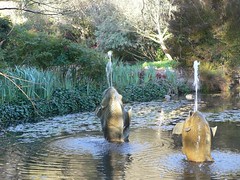
All of the photography books say to visit locations at different times of day, to see how the light differs. This morning, consequently, I toddled off to Descanso Gardens; and while there I shot another picture of the Fish Fountain. This is the same scene and composition I posted yesterday; but the difference between the two is striking. Yesterday’s is peaceful and lovely, as you’ll see if you scroll down a bit. This one, on the other hand, is just dull.

Fish Fountain


Fish Fountain

Originally uploaded by will.duquette.

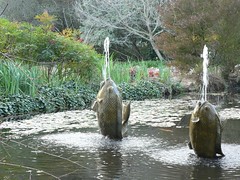
I’d seen these bronze fish every time I’d visited the Gardens over the last few weeks, and I’d kind of mentally been saying, “Not yet, not yet.” Today my son James suggested I take a picture of them as we were walking past. I glanced over, and said “Now.”

The photography books I’ve been reading have said over and over again that frontlight is dull. When the light is coming from behind you and fully illuminating the front of the subject, all of the shadows are erased and the picture has no depth. Here, the light is coming from behind and to the left, and gosh, the picture has all kinds of depth. I’d like to say that I set it up that way on purpose, but I didn’t; I just got lucky. Still, it’s neat to see these things working in my own photos.

Here and There

Someone’s built a working model of Babbage’s Difference Engine out of Lego.

For the Chinese New Year, Ian Hamet apparently scared the living daylights out of a Shanghai man who desperately deserved it–the man had just run him down in the street while running a red light. Fortunately, laowai are indestructible….

If you’re like me (and why wouldn’t you be?) you’ve probably never wondered about this.

The Tenser has posted a detailed discussion of “Doc” Smith’s use of language in the Lensman series.

Why Photography: The Art of the Matter

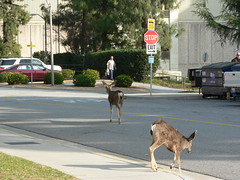
Historically, I’ve taken photos for three reasons. First, I’ve taken the usual snapshots of family vacations, family gatherings, and cute kid tricks. We’ve all done it, and that’s enough about that. Second, I’ve always liked taking pictures of the odd, the unusal, and the incongruous…as, for example, the following shot, which I took just a couple of days after I got my new camera:


JPL Deer

Originally uploaded by will.duquette.

Yes, JPL’s got deer. I see them several times a week, usually on the hill above my building. Occasionally they condescend to mingle with the rocket scientists. Once in a while I’ll see them sacked out on the lawn in front of the main administration building; I’m still hoping to catch them there when I’ve got my camera with me.

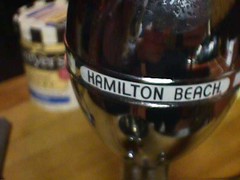
But also, each time I’ve gotten a new digital camera I’ve taken a flurry of arty shots, just because I thought they’d look neat. Here’s one of the first pictures I took with my first digital camera back in 1997:


Hamilton Beach

Originally uploaded by will.duquette.

It’s a close-up of a Hamilton Beach milkshake mixer showing a nifty reflection and a blurry carton of ice cream in the background. It’s not a very good image by current standards; the camera had less than one megapixel (640×480), and the images were compressed like mad to fit on 1.44MB floppies. I still like the composition, though, especially the carton of ice cream. I took a lot of interesting pictures with that first camera, and the image quality is uniformly lousy. They make barely adequate photo album prints at 4″x3″. Eventually, this became discouraging–it’s always worth taking pictures of the kids, or the family vacation, but why go to the effort to take arty photos when you can’t make decent prints? This continued to be a problem with my second digicam. And neither of them allowed much control over the exposure–not that I really wanted to learn about that then.

My third digicam, a Canon S-30, takes much better pictures; and it ostensibly allows you to do manual exposures. The menus for setting the advanced features are a nuisance to use when you’re in a hurry, though, and although I tried to use some of them I always found myself forgetting to reset them afterwards…and consequently would completely ruin the next set of shots. In addition, I didn’t have anyone handy to answer questions about how to use them.

This time, though, things are different. I’ve got a nice new camera; it’s not a DSLR, but one can plausibly do serious photography with it. The images it produces are nice and sharp; and its 5 megapixels are enough that I’ve made some gorgeous 8×10 prints. Plus, thanks to my friend the Test Lead I had some notion of how exposure works when I first started using it; and thanks to his explanations and advice, and to the books which I most likely would not have bought if I hadn’t known I had an expert on tap, I’ve been taking some pretty nice pictures.

So really, that’s why photography: everything needful came together all at once, and all of the impediments (including my own dreadful ignorance) were banished.

How deeply I’ll get into photography is hard to say. I intend to fully explore the capabilities of my new camera. I have no intentions of getting into film photography, nor have I any intentions of upgrading to a digital SLR for the foreseeable future; my Lumix is a good all-around camera, and it’s small and light enough that I don’t mind carrying it around with me…which means I’ll be able to capture that odd and unusual subject or take that arty picture when my whimsy takes me. A DSLR would be bigger and heavier, as well as a lot more expensive. But who knows what the future will bring?

Bird of Paradise


Bird of Paradise

Originally uploaded by will.duquette.

This one was pure luck. I was taking pictures of this Bird of Paradise bloom…and when I looked at them at home discovered that in the best shot I’d also captured a honey bee coming in for a landing on the bloom. The bee is to the upper right, just even with the horizon; you might need to click through to a larger copy of the picture in order to see it clearly.