
I’ve not said much about my diet in the last several months, which probably means that most of my readers have forgotten about it, and the rest probably think that I’ve given up on it. Not so! Today marks my first anniversary, more or less–and I’m down a total of 64 pounds (six of them in the last month). God is good. God is very good.
Monthly Archives: February 2006
Truly Funny Video
You’ll need a high-speed connection for this one…but don’t miss it.
(Via TitusOneNine,)
Sundial 2
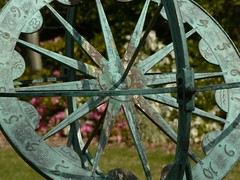
Sundial 2
Originally uploaded by will.duquette.
Here’s another shot of the same sundial. I like the previous composition better, but at least in this one the sundial’s…adornments…are less obvious.
Sundial 1

Sundial 1
Originally uploaded by will.duquette.
I’ve seen this sundial every time I’ve been over to Descanso Gardens this past month; today the light was right, and I took a bunch of pictures. I took care with the composition, and worked to get a nice, colorful background… but it turns out that the most careful composition can be ruined by an overlooked dollop of pigeon poop.
Shadow Chair
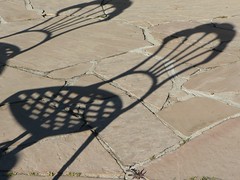
Shadow Chair
Originally uploaded by will.duquette.
The Test Lead points out that this really needs a bit cropped off of the left hand side and along the bottom. Still, it’s a nifty picture.
Year of the Unicorn, by Andre Norton
This is the third of Norton’s “Witch World” novels, at least according to one publication scheme, and it has an entirely different flavor than its predecessors.
Across the ocean from Estcarp lie the dales of High Halleck. The dalesmen have just concluded a war against the Hounds of Alizon, Estcarp’s neighbors and enemies; they have done so with the help of fell warriors called the Were-Riders, and now it is time for repayment. Thirteen virgins of the Dales must willingly go with the Were-Riders as brides, never to return to High Halleck.
The story is told from the viewpoint of one of the chosen thirteen, a young lady named Gillan. Gillan is an orphan of the war; and it soon becomes clear that her parents were of Estcarp, for she has strange powers (powers she wisely keeps hidden), and can see the Were-Riders as they are, rather than as they seem. This leads her into great danger.
The difference in tone between this book and its predecessors is vast. The narration is first-person rather than third, with the result that our immersion in Norton’s world is enhanced. The tale is told purely as a fantasy, rather than as an uncomfortable mixture of fantasy and science fiction. Most important, Gillan’s voice is much richer than the flat, transparent third-person prose of the Simon Tregarth books.
I don’t know where these three books lie in Norton’s overall output, but it appears that between the second and third something clicked.
Web of the Witch World, by Andre Norton
This is the second of the Norton’s “Witch World” books, and it has
precisely the same strengths and flaws as its predecessor, being
essentially the second half of one complete story: the battle of the
people of Estcarp against men of Kolder. Like Simon Tregarth, our hero,
the men of Kolder are from another world; and like Tregarth, their
home world is one of science, indeed, one where science is greatly
advanced over that of Earth. Tregarth’s knowledge of science gives him
an edge, and with the help of his wife, Jaelithe, and the mind powers
they share, the Kolder-men are eventually destroyed.
It’s not a bad tale–certainly it kept me turning pages–but it feels
rather dated. The “super-science” of the Kolder-men hasn’t worn well,
and their very name, “Kolder”, i.e., “colder”, is a little too obvious.
The result is a tale that seems plenty deep and satisfying as one reads
it, but appears much less substantial on later reflection. It’s a tale
well-told, but there’s something lacking. Or is there? I’m really not
sure. All I can say is, there’s something of substance there while I’m
reading it, but it fades away with the dawn.
Some Comments on Comments
I’d like to formally apologize for the length of the period of time during which posts on the previous incarnation of this blog appeared to offer the possibility of making comments while in fact preventing everyone from doing so.
Ahem.
These problems do not apply to the new, improved View From The Foothills. You don’t need to login; you don’t need to jump through hoops; if you want to leave a comment, just click on “comments” and (if you’re a human being) you can do so.
I realize that I’m being a bit inconsistent to encourage people to comment after months and months of training them not to. Ah, well.
Welcome to Uganda
Well, it’s finally happened. The other shoe has dropped. The balloon has gone up. Call it what you will, things are different today than they were yesterday.
When I woke up yesterday morning, I was a reluctant Episcopalian. As of approximately 9 PM yesterday evening I became, along with virtually everyone else in my congregation, a member of the Anglican Church of Uganda.
Uganda?
Understanding Exposure, by Bryan Peterson
This is the book that explains how to do the things that Brenda Tharp takes for granted in Creative Nature & Outdoor Photography. Peterson covers generally the same range of topics here as he does in Understanding Digital Photography, but he goes into considerably more detail; I now understand the process of metering the light far better than I did beforehand, for example. Peterson writes clearly and engagingly, and as always his enthusiasm is infectious. Best of all, the book is filled with delightful images–and for each he explains in detail just how he set up, metered, and exposed each shot. This is definitely a book I’m going to come back to again and again.
If you’ve got a digital camera, and you’ve any curiousity at all what you can do with it, by all means get a copy of Understanding Digital Photography. If you’re like me, reading it will inspire you to go out and take all sorts of truly wretched pictures, and probably some very good ones. Then, if you’re still having fun, get this book and keep shooting; it will take you to the next level.
 The View from the Foothills