Photografee

A reader sent me links to a couple of articles on digital photography from a webzine called TidBITS. The first compares oil painting techniques with photography, and talks about how to enhance photos in similar ways in Photoshop; the second talks about getting the best color and sharpness out of color printers.

I’ve read both; all I’ve got to say is, the author is an ardent perfectionist and knows far more about either topic (and the pitfalls of each) than I’m quite comfortable with knowing. For the brave, TidBITS has at least one other related article (and possibly more than one) by the same author.

Sunlit Fountain

Sunlit Fountain

Sunlit Fountain,
originally uploaded by will.duquette.

I went for a walk at Descanso Gardens on my way home from work today, and thereupon walked straight into this: the setting sun shining through trees into a fountain of water. Even a novice can see a good scene when it whacks him on the head with a two-by-four. I took a bunch of pictures, of which this is the best.

Do look at the larger sizes; it’s well worth it.

Let There Be Light!

Let There Be Light!

Let There Be Light!,
originally uploaded by will.duquette.

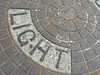
I found this while out walking the other day. It’s a manhole cover of some kind, but it’s a lot bigger than most; it says “C OF G” on the other half, which I presume stands for “City of Glendale”. The recess around the word “LIGHT” was already full of light-colored gravel when I came across it; I liked the contrast between the dark letters, the light gravel, and word “light” itself.

If I were to print this, I’d crop it down a bit, so as to lose the fragment of letter in the upper right corner; and in retrospect I really should have moved the stick in the lower left.

Understanding Digital Photography, by Bryan Peterson

The reviews at Amazon didn’t lie; this is a fabulous book. Whereas most books I’ve seen on digital photography are mostly about using Photoshop, Peterson’s book is mostly about how to take good pictures. There’s a slim section on using Photoshop at the back, 40 pages out of 160 total: the basic clean-up steps Peterson does with most photos, and a few advanced techniques for composing multiple photos into a single image.

Other than that, the book is all about taking pictures with digital cameras–that is, on the photographic aspects of taking pictures with digital cameras. Peterson assumes the reader is both reasonably serious about photography and capable of reading an owner’s manual. He doesn’t tell you how to set the aperture using your particular camera’s controls; instead he tells you why and to what, depending on what you’re looking to accomplish. On the way he covers issues of exposure, composition, depth-of-field and the like; how to stop motion and how to emphasize it; how to shoot vast landscapes and intimate portraits; when the light is best and how to make the best use of it; what to do when conditions are just wrong; shooting at night and during the day; and on and on. He has a boundless and infectious enthusiasm for his subject, and the book is filled with gorgeous pictures, tips, tricks, and suggestions.

Peterson generally assumes the reader will be using a Digital SLR with multiple interchangeable lenses and an external flash, and consequently some of the things he discusses don’t apply in my case. I won’t be switching between a wide-angle and telephoto lens, for example. Most of what he has to say applies in either case, though, and where there are important differences–e.g., the effect of specific apertures on depth-of-field–he’s careful to explain how it works in both cases.

In short, this is a fun book to read, and useful as well; and Peterson’s enthusiasm is infectious as to be a real inspiration. It’s not all pie-in-the-sky, either; I’m already taking better pictures than I was. Highly recommended.

Photographic Composition, by Tom Grill & Mark Scanlon

As has no doubt been abundantly clear over the last week, I’ve got a new camera, and I’ve aspirations to learn how to use it properly. One of my friends at work is seriously into photography–which is to say, he’s utterly nuts–and he’s going to be helping me along. In the meantime, of course, any new hobby is a good excuse to go shopping for books. Unfortunately, finding good books on photographic techniques proved difficult.

The Photography section at the first store I went to (a Borders) consisted mostly of large expensive “art” books and coffee table books containing beautiful pictures from various cities and countries. While a careful study of many of these would undoubtedly benefit a serious student of photography, I’m hardly at that level. This particular store also had a “Digital Photography” section, grouped with the computer books. It consisted almost entirely of books which show you how to use Photoshop to overcome your non-existent photography skills. I saw nothing with an emphasis on how to take a good picture.

I went from there to a large independent bookstore. It has a large section on the arts, including architecture and photography, and I had high hopes. The situation was indeed somewhat better: the books were at least organized by type. There was a large section of books collecting photos by one or another photographer; a second of monographs by photographers; and a third consisting mostly of fashion photography with two whole shelves of books on photographic techniques. I didn’t see anything I liked, though.

A couple of days later I went to a third bookstore, another Borders. They had a relatively small photography section, but–wonder of wonders–they had many books on photographic technique. There were a few that were specifically aimed at digital photography; most of those were, again, more about Photoshop than about taking good pictures. But I did find one book that appeared to be exactly what I was looking for: Photographic Composition, subtitled “Guidelines for Total Image Control through Effective Design”. Published by Amphoto, it covers all aspects of photographic composition, with lots and lots of example photographs.

I’ve since read the book cover-to-cover, and anticipate reading through it once or twice more, a little bit at a time–it’s a difficult book, but the subject is sufficiently complex that it will take time and repetition to fully digest it. I’m glad I bought it, and expect to learn quite a bit from it.

The book is not perfect, however. The authors take their subject (and, I suspect, their photographs) a little too seriously. Every Photograph Must Make A Statement, and every aspect of the photo’s composition must contribute to that Statement. They give some examples towards the end of the book; taken after one of the authors returned from serving with the Peace Corps in Brazil during the 1960’s, they are all about his alienation with America as he found it on his return.

Gag me.

On top of that, the authors appear to prefer pictures with a lot of soft focus and without a lot of clear, crisp detail; which I suppose is natural if photography is about making statements rather than taking compelling pictures of interesting subjects. In their defense, of course, they were trying to choose images that illustrated their points without a lot of distracting elements. Possibly, the simplicity of the images stems from their pedagogical style rather than their preferences. Nevertheless, the whole book is weighed down by their serious, portentous attitude. There might be some fun in photography, but you’d never know it from this book.

All that said, Grill and Scanlon manage to explain a variety of basic concepts in reasonable detail, well enough that there are a number of obvious mistakes I hope I won’t be making again.

If anyone has a better book to recommend, of course, I’d love to hear about it.

Got a book on digital photography…

…which had really good reviews on Amazon.

First thing I read, the author’s saying that you never want to use JPEG format because it’s a lossy format: you lose a bit of the detail every time you open and close the file!

Well, no. You lose detail every time you (1) open, (2) edit, and (3) save the file as JPEG. And when the image is initially compressed as JPEG, of course. But after that, anybody with any computer savvy knows better than to save an image they’re working on in JPEG format until they are completely, absolutely done; and even then, you keep a non-lossy copy. Other than that, you can open the file and view it as many times as you like without degrading the quality even a smidge.

I’m not going to dismiss everything he says out of hand; I’m reading the book to learn about photography, not image processing. But my confidence is shaken.

Rover Prototype

Rover Prototype

Rover Prototype,
originally uploaded by will.duquette.

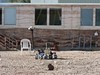
Here’s a prototype Mars rover relaxing in JPL’s Mars yard. They’ve got a number of these prototypes, all different; they use them to develop and test new rover software. Why they had this one out yesterday I’ve no idea, but it makes a nice picture.

Why, yes, JPL is a nifty place to work.

Delapidated House

20060122-134055.jpg

20060122-134055.jpg,
originally uploaded by will.duquette.

This is a sad old house I see every day on my way home from work. It’s an anachronism; it’s on the main street through town, and the only others houses on that street for blocks in both directions were converted into businesses a long time ago. Until recently, though, it appeared to be in decent shape…but recently, there are signs that it will soon be coming down.